| Piú votate - Mars through Mars Express (ESA - Original Raw Frames & Orbital Panoramas) |

Claritas_Fossae-2-029-290304-0068-6-co-02.jpgClaritas Fossae (2 - ESA/ DLR/ FU Berlin - G. Neukum)79 visitevedi il commento al frame che precede
(13 voti)
|
|

Claritas_Fossae-5-098-140904-0508-6-3d-01-ClaritasFossae_hires.jpgClaritas Fossae (5 - ESA/ DLR/ FU Berlin - G. Neukum)91 visitenessun commento
(12 voti)
|
|

Claritas_Fossae-1-029-290304-0068-6-co-02.jpgClaritas Fossae (1 - ESA/ DLR/ FU Berlin - G. Neukum)98 visiteCaption ESA originale:"These Mars Express images show Claritas Fossae, an ancient tectonic region on Mars, west of Solis Planum, a tectonic and volcanic area south-east of the Tharsis volcano group.
The images were taken by the High-Resolution Stereo Camera (HRSC) on Mars in orbit 68 from an altitude of 271 Km. The images are centred at 255,7° East and 30,9° North. North is on the left".
(14 voti)
|
|
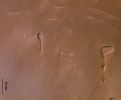
Volcanoes-Ascraeus_Mons-1-027-150304-0068-6-co-01.jpgAscraeus Mons from Mars Express (1 - ESA/ DLR/ FU Berlin - G. Neukum)113 visiteDue immagini in colori naturali del Vulcano Ascraeus Mons e dei suoi rilievi assolutamente affascinanti.
Ed eccoVi la Caption ESA originale:"This colour image shows a larger portion of the southern flank of Ascraeus Mons. The lighter, pink areas on the colour image, are clouds.
The visible lava tubes are caused by the crusting (or cooled lava) which occurs over a lava channel, a covering making the channel into a tunnel.
When lava production ceases, the tunnel empties and the roof of the tunnel falls in, making an elongated depression.
Occasionally, the depression forms a chain of small pits over an emptied lava tunnel. Pit chains and lava tunnels are common on the Martian surface and are also seen on other terrestrial planets and the Moon".
(9 voti)
|
|
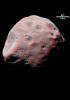
Phobos-406-Mars_Express-stereoME_full.jpgPhobos from Mars Express (HR and Stereo View)198 visitePhobos in versione "stereo", ripreso da una distanza di circa 200 Km dalla Sonda Europea Mars Express. Sulla Sn dell'immagine si può vedere molto bene il famoso "Stickney Crater", di oltre 10 Km di diametro.
Notevole il quantitativo di crateri e crepacci visibili che caratterizza l'intera superficie di questa Luna Marziana e che ci racconta, in play-back, di un passato turbolento.
(15 voti)
|
|
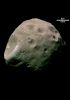
Phobos-405-N-High_Res-ME_full-00.jpgPhobos from Mars Express (Original ESA HR-RAW Frame)366 visitenessun commento
(25 voti)
|
|
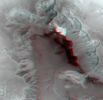
Juventae_Chasma_3D-1.JPGJuventae Chasma (High-Def-3D; credits: ESA)107 visiteSpettacolare: un 3D assolutamente straordinario.
Original caption:"These images, taken by the HR Stereo Camera (HRSC) on board ESA’s Mars Express spacecraft, show the depression of Juventae Chasma, cut into the plains of Lunae Planum on Mars.
The HRSC obtained these images during orbit 243 with a ground resolution of approximately 23,4 mt per pixel. The scenes show the region of Lunae Planum, at approximately 5° South and 297° East.
The depression of Juventae Chasma, located North of Valles Marineris, cuts more than 5000 mt into the plains of Lunae Planum. The floor of Juventae Chasma is partly covered by dunes.
In the valley, to the North-East, there is a mountain composed of bright, layered material. This mountain is approximately 2500 mt high, it has a length of 59 Km and a width of up to 23 Km. The OMEGA spectrometer on board Mars Express discovered sulphate on the surface of Mars and confirmed that this mountain is indeed composed of sulphate deposits".
(13 voti)
|
|
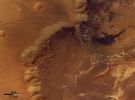
Melas_Chasma.jpgMars from orbit: Melas Chasma Region (Enhanced Natural Colors; credits: ESA - G. Neukum (FU Berlin) and oth.s - Mars Express - DLR)124 visiteA parte ogni considerazione estetica (si tratta di un'immagine davvero bellissima, per qualità e nitidezza), ci stiamo domandando se il colore di Marte non possa variare drammaticamente a seconda del tipo di ripresa che viene effettuata. Nelle immagini riprese da Sonde in orbita, infatti, il colore della superficie appare sempre (o quasi) di un acceso color arancio mentre, al suolo, tutto sembra sbiadirsi o, addirittura, trasformarsi (dal giallo al marrone e dal rosso fuoco al verde scuro). Fantasia?!?
(15 voti)
|
|
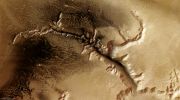
Echus_Chasma-398-260508-2204-6-co-01-H1.jpgEchus Chasma (False Colors)71 visiteThe High-Resolution Stereo Camera (HRSC) on board ESA's Mars Express has returned images of Echus Chasma, one of the largest Water Source Regions on the Red Planet.
The data were acquired on September, 25, 2005.
The pictures are centred at about 1° North and 278° East and have a ground resolution of approx. 17 mt/pixel.
Echus Chasma is an approx. 100 Km long and 10 Km wide incision in the Lunae Planum High Plateau North of Valles Marineris, the "Grand Canyon" of Mars. Echus Chasma is the Water Source Region of Kasei Valles, which extends thousands of Km to the North, and its southern-most part. The images of the Echus Chasma plateau show valleys that are about 10 km long and 1000 m deep. The main valley, Kasei Valles, is about 4 km in depth. The smaller valleys, also called sapping canyons, originate from the discharge of groundwater.
Echus Chasma is bounded to the West by the Echus Chasma Plateau, which lies about 4 Km above Echus' floor. MareKromium
(6 voti)
|
|
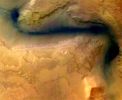
Reull_Vallis-ESA-1-PCF-LXTT.jpgPseudo-Lake in Reull Vallis (Absurde Colors; credits: ESA/DLR/FU Berlin, Dr G. Neukum)129 visite...senza parole...MareKromium
(19 voti)
|
|
|
|
| 106 immagini su 9 pagina(e) |
 |
|
|
|
|
|
9 |
|








