| Piú votate - Mars through Mars Express (ESA - Original Raw Frames & Orbital Panoramas) |

Ismenius_Lacus-H1201_0000_ND2_H-PCF-LXTT.jpgFrame H1201_0000_ND2: Ismenius Lacus Region222 visiteCaption ESA:"The scene shows the Region of Ismenius Lacus, about 77 Km wide in the North and 63 Km wide in the South, about 845 Km in length, and centered at - approx. - 25° East Long and 40° North Lat.
The image represents a Transitional Region on the Surface separating the heavily Cratered Highlands in the South from the smooth Northern Plains.
The Dissected Terrain contains a series of Mesas (i.e.: isolated "High Plateaux") and Buttes (i.e.: small and flat-topped Hills).MareKromium
(2 voti)
|
|
Lava_Flows-Daedalia_Planum-PCF-LXTT.jpgDaedalia Planum (Absolute Natural Colors; credits for the additional process. and color.: Dr Paolo C. Fienga - Lunexit Team)91 visitenessun commentoMareKromium
(2 voti)
|
|

MA_ADIM_VALLIS-440-20090629-6393-6-co-01_H1-1.jpgProximities of Ma'adim Vallis (Natural Colors; credits: ESA)84 visiteCaption ESA:"Mars Express image of a Region close to Ma’adim Vallis, one of the largest - after Vallis Marineris - canyons on Mars.
The imaged Region lies South-East of Ma’adim Vallis; the pictures are centred at about 29° South Lat. and 182° East Long. and have a ground resolution of 15 mt/pixel.
Ma’adim Vallis is located between the Volcanic Province of Tharsis, which harbours 4 volcanoes, including the largest in the Solar System, and the Hellas Planitia Impact Basin.
The canyon, approx. 20 Km wide and 2 Km deep, originates in the Southern Highlands close to the so-called ‘Dichotomy Boundary’ and ends in Gusev Crater.
The Dichotomy Boundary is a narrow Region separating the cratered Highlands, located mostly in the Southern Hemisphere of Mars, from the Northern Hemisphere's Lowland Plains".MareKromium
(2 voti)
|
|
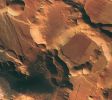
NoctisLabyrinthus.jpgNoctis Labyrinthus (Natural Colors + MULTISPECTRUM; credits: ESA & Lunexit)141 visiteThis image was taken by the High-Resolution Stereo Camera (HRSC), onboard ESA’s Mars Express imaged the Noctis Labyrinthus Region, the ‘Labyrinth of the Night’ on Mars.
The HRSC took these pictures on 25 June 2006 in orbit 3155, with a ground resolution of approx. 16 mt/pixel.MareKromium
(2 voti)
|
|

L-h0513_0009_nd2-00.jpgFrame Mars Express RAW n. h0513_0009_nd293 visiteMareKromium
(2 voti)
|
|
NP-h1169_0000_nd2-00.jpgFrame Mars Express RAW n. h1169_0000_nd292 visiteMareKromium
(2 voti)
|
|
Juventae_Chasma_3D-3.gifJuventae Chasma (High-Def-3D - EDM n.2; credits: ESA)85 visitenessun commento
(2 voti)
|
|
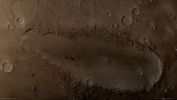
Orcus_Patera-472-20103007-2216-2238-6-co-01-PCF-LXTT2.jpgOrcus Patera (Absolute Natural Colors; credits: Dr Paolo C. Fienga - Lunexit Team)177 visiteCaption ESA:"The High-Resolution Stereo Camera (HRSC), on ESA Mars Express Spacecraft obtained image data in the Orcus Patera Region on 5 and 11 October 2005. The data were acquired during orbits 2216 and 2238 and this image was derived from the HRSC nadir channel, which provides the highest detail of all the channels".MareKromium
(1 voti)
|
|
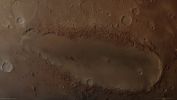
Orcus_Patera-472-20103007-2216-2238-6-co-01-PCF-LXTT1.jpgOrcus Patera (Natural Colors; credits: Dr Paolo C. Fienga - Lunexit Team)147 visiteCaption ESA:"Orcus Patera is an enigmatic elliptical depression located between Elysium and Olympus Mons.
This well-defined depression extends approximately 380 by 140 Km in a N/NE–S/SW direction. It has a Rim that rises up to 1800 mt above the surrounding Plains, while its Floor lies 400–600 mt below the surroundings. The term ‘Patera’ is used for deep, complex or irregularly shaped Volcanic Craters such as the Hadriaca Patera and Tyrrhena Patera at the N/E margin of the Hellas Impact Basin.
However, despite its name and the fact that it is positioned near Volcanoes, the actual origin of Orcus Patera still remains unclear".MareKromium
(1 voti)
|
|
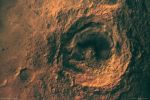
MaunderCrater.jpgMaunder Crater (Natural Colors + MULTISPECTRUM; credits: ESA & Lunexit)89 visiteThe above image shows the striking Maunder crater lying at approx. 50° South Lat. and 2° East Long., in the Noachis Terra Region on Mars.
The High Resolution Stereo Camera (HRSC) on ESA’s Mars Express orbiter took pictures of the Noachis Terra Region during orbits 2412 and 2467 on 29 November and 14 December 2005, respectively, with a ground resolution of approx. 15 mt/pixel.
The Sun illuminates the scene from the North-East (top left in the image).
Maunder crater, named after the British Astronomer Edward W. Maunder, is located halfway between Argyre Planitia and Hellas Planitia on the Southern Highlands of Mars.
With a diameter of 90 Km and a depth of barely 900 mt, the Crater is not one of the largest impact craters on Mars at present, but it used to be much deeper. It has since been filled partially with large amounts of material.MareKromium
(1 voti)
|
|

Claritas_Fossae-4-096-140904-0508-6-co-01-ClaritasFossae_hires.jpgClaritas Fossae (4 - ESA/ DLR/ FU Berlin - G. Neukum)76 visiteCaption ESA originale:"The lava blankets of the Solis Planum area cover the eastern parts of the older Claritas Fossae ridge and surround some of the higher ground. The geological history of this region can be reconstructed by analysing the layers of tectonic grabens, impact craters, volcanic features and even small valley networks. The complexity of Claritas Fossae Region suggests that some of the events took place at the same time. Furthermore, the detailed view of the large southern impact crater shows patches of dark material which are located near the central and marginal parts of the impact crater floor. This material may be of volcanic origin".
(10 voti)
|
|

Claritas_Fossae-3-096-140904-0508-6-co-01-ClaritasFossae_hires.jpgClaritas Fossae (3 - ESA/ DLR/ FU Berlin - G. Neukum)86 visiteCaption ESA originale:"The displayed region is the eastern part of Claritas Fossae and the western part of Solis Planum at longitude 260° East and latitude of about 28° South.
The diffuse blue-white streaks in the northern parts of the scene (Sx di chi guarda) are clouds or aerosols. The Claritas Fossae (‘fossa’ is Latin for trough----->canale) region is characterised by systems of ‘grabens’ running mainly north-west to south-east. These can be traced several hundred kilometres up to the northern Tharsis shield volcanoes.
A "graben" forms when a block of the planet’s crust drops down between 2 faults, due to extension, or pulling, of the crust. A ‘horst and graben’ system can occur where there are several parallel faults.
Geographically, the grabens separate the eastern volcanic plains of the Solis Planum region from the western Daedalia Planum lava plains.
(10 voti)
|
|
| 106 immagini su 9 pagina(e) |
 |
|
|
|
|
|
8 |
|








