| Piú votate - Mars through Mars Express (ESA - Original Raw Frames & Orbital Panoramas) |
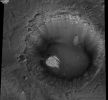
Craters-Pollack_Crater-H1201_0001_ND3_crop_wide-0.jpgPollack Crater and "White Rock" (RAW Frame; credits: ESA - Mars Express)72 visitenessun commentoMareKromium
(4 voti)
|
|

B-h0032_0000_bl3-00.jpgFrame Mars Express RAW n. h0032_0000_bl367 visite
(4 voti)
|
|
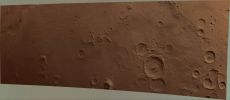
Hellas_Planitia-H0572_0000_ND2_H-PCF-LXTT.jpgFrame H0572_0000_ND2: Hellas Planitia Region220 visiteCaption ESA:"The HRSC on board ESA's Mars Express Spacecraft obtained this image on July, 1st, 2004 during orbit 572 with a ground resolution of approx. 45,1 mt per pixel.
The scene shows a portion of Hellas Planitia, a Region which is about 234 Km wide in the North, 345 Km in the South, about 898 Km in length, and centred at approx. 89° East Long. and 29° South Lat.
This image represents an area on the Northern Eastern Rim of Hellas Planitia, also known as the Hellas Impact Basin in Mars's Southern Hemispere. The Basin is thought to have formed around 3900 Million Years ago in a single massive impact".MareKromium
(3 voti)
|
|

Hesperia_Planum-224co01_H-PCF-LXTT.jpgHuge Massif in Hesperia Planum248 visiteCaption ESA:"The HRSC on ESA's Mars Express obtained this image on June, 13th, 2004, during orbit 506 with a ground resolution of approx. 37,6 mt per pixel.
This view shows a portion of the Hesperia Planum Region, containing the Massif, and located at approx. 30,3° South Lat. and 97,8° East Long.".MareKromium
(3 voti)
|
|
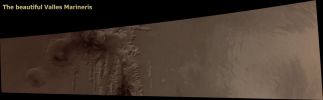
Valles_Marineris-h0442_0008_nd3.jpgPortion of the Valles Marineris Canyon System (Natural Colors; credits for the additional process. and color.: Dr Paolo C. Fienga)89 visitenessun commentoMareKromium
(3 voti)
|
|

Aeolian_Features-Windstreaks-h0165_0068_nd3-PCF-LXTT.jpgWindstreaks (Natural Colors; credits for the additional process. and color.: Dr Paolo C. Fienga - Lunar Explorer Italia)88 visitenessun commentoMareKromium
(3 voti)
|
|

Phobos-400-455-20091201.jpgBig Brother and Little Brother70 visitePhobos and Deimos RAW (left panel) and processed images (right panel).
In a first, ESA’s Mars Express Orbiter imaged the Martian Moons Phobos and Deimos together on November, 5th, 2009.
Apart from their ‘wow’ factor, these unique images will help the HRSC team validate and refine existing orbit models of the two moons.
The images were acquired with the Super Resolution Channel (SRC) of the High Resolution Stereo Camera (HRSC). The camera took 130 images of the moons on November 5th at 09:14 CET in a span of 1,5 minutes at intervals of 1", speeding up to 0,5" intervals toward the end. The image resolution is 110 m/pixel for Phobos and 240 m/pixel for Deimos — Deimos was more than twice as far from the camera.
The Super Resolution Channel of the HRSC uses an additional lens, which has a very narrow field of view of just 0,5°, providing four times the magnification than otherwise providing four times the resolution of the HRSC colour stereo channel.
Phobos, the larger of the two moons, orbits closer to the Red Planet, circling it every 7 hours and 39 minutes. It travels faster relative to Mars than the Moon relative to Earth.
Phobos was about 11.800 Km from Mars Express when the images were taken. Deimos, instead, was about 26.200 Km away.MareKromium
(3 voti)
|
|

Echus_Chasma-398-260508-2204-6-co-01-H2.jpgHigh Cliffs Surrounding Echus Chasma on Mars76 visiteWhat created this great cliff on Mars? Did giant waterfalls once plummet through its grooves? With a four-kilometer drop, this high cliff surrounding Echus Chasma, near an impressive impact crater, was carved by either water or lava. A leading hypothesis is that Echus Chasma, at 100-Km long and 10-Km wide, was once one of the largest water sources on Mars. If true, water once held in Echus Chasma likely ran over the Martian Surface to carve the impressive Kasei Valles, which extends over 3000 Km to the North. Even if initially carved by water, lava appears to have later flowed in the valley, leaving an extraordinarily smooth floor. Echus Chasma lies north of tremendous Valles Marineris, the largest canyon in the Solar System. The above image was taken by the robotic Mars Express spacecraft currently orbiting Mars.
Nota Lunexit: checchè ne dica la NASA, questo frame NON E' una fotografia.MareKromium
(3 voti)
|
|
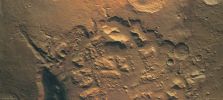
NepenthesMensae-385-090408-5212-6-co1-01.jpgNepenthes Mensae (MULTISPECTRUM; credits: Lunexit)111 visiteThe High Resolution Stereo Camera on board ESA’s Mars Express Orbiter imaged Nepenthes Mensae, a river delta on Mars, on 22 January 2008.
The data was acquired in the Region lying at approx. 3° North and 121° East, with a ground resolution of 15 mt/pixel.
The southern part of the image shows a structure reminiscent of a river delta on Earth, whose material was eroded from a valley, about 30 Km long and upto 1000 mt deep. This formed a fan-shaped deposit at the mouth of the valley. The rim of the deposit stands roughly 300 mt above the floor of the depression.
The resemblance of the structure to river deltas on Earth suggests that it was formed by a similar mechanism. Scientists believe that sediment transported by water was deposited as the flow of the water slowed down where the channel widened and met the mouth of the river.
The pictures show that the Region was affected by two episodes of flooding.
The first left a cone-shaped deposit, reaching far out into the lowland.
The second episode formed the fan with the distinct margin. This margin could indicate the location where sediments flowed into a standing body of water or ice.
Numerous hills and flat-topped mountains visible in the central part of the depression are remnants of the material that was present in the area.
The material was then eroded forming the depression, leaving behind the elevations visible today.MareKromium
(3 voti)
|
|
NP-h1169_0000_p12-00.jpgFrame Mars Express RAW n. h1169_0000_p1283 visiteMareKromium
(3 voti)
|
|
NP-S-h0241_0009_nd3-00.jpgFrame Mars Express RAW n. h0241_0009_nd368 visiteMareKromium
(3 voti)
|
|
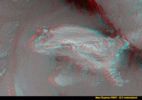
Juventae_Chasma_3D-2.gifJuventae Chasma (High-Def-3D - EDM n.1; credits: ESA)70 visitenessun commento
(3 voti)
|
|
| 106 immagini su 9 pagina(e) |
 |
|
|
|
|
7 | |
|








