| Piú votate - Mars through Mars Express (ESA - Original Raw Frames & Orbital Panoramas) |

A-h0751_0000_re2.jpgFrame Mars Express RAW n. h0751_0000_re273 visite
(6 voti)
|
|

A-h0751_0000_gr2.jpgFrame Mars Express RAW n. h0751_0000gr272 visite
(6 voti)
|
|
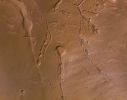
Volcanoes-Ascraeus_Mons-2-027-150304-0068-6-co-01.jpgAscraeus Mons from Mars Express (2 - ESA/ DLR/ FU Berlin - G. Neukum)92 visitevedi il commento al frame precedente
(6 voti)
|
|
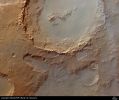
Craters-Hale_Crater-134-021104-0533-6-co-02.jpgHale Crater (Natural Colors; credits: G. Neukum (FU Berlin) et al. - Mars Express - DLR - ESA)102 visitenessun commento
(6 voti)
|
|

Aeolian_Features-Yardangs-Eumenides_Dorsum-ESA-ME-424-20081105-5114-6-co-01-H1-PCF-LXTT-IPF.jpgFeatures of Eumenides Dorsum (Absolute Natural Colors; credits for the additional process. and color.: Dr Paolo C. Fienga - Lunexit Team)117 visiteThis frame, which is a mosaic of several orbital images obtained by the High Resolution Stereo Camera onboard the ESA - Mars Express Orbiter, shows us a number of Surface Features; in particular, and in addition to the presence of Plains, Buttes and just a few ancient and semi-buried Impact Craters, we suggest you to pay some special attention to the unbelievable complex of Sinuous Erosional Surface Striations, known as "Yardangs" (which are the most common Aeolian - meaning "sculpted by Wind" - Features that can be found on the Red Planet), that covers a huge portion of the central part of the picture.
All the abovementioned Surface Features are located in the Eumenides Dorsum Region of Mars, which lies to the West of the Tharsis Volcanic Province and forms part of the Region known as Medusae Fossae, at approx. 2° South Latitude and 206° East Longitude. The images here were taken on the date of December, 26, of the AD 2007; they have a ground resolution of about 13 meters per pixel and cover an area (in total) of about 12.000 square Km.
This frame (which is the Original ESA - Mars Express HRST b/w mosaic n. 424-20081105-5114-6-co-01-H1) has been additionally processed and then colorized in Absolute Natural Colors (such as the colors that a human eye would actually perceive if someone were onboard the ESA - Mars Express Orbiter and then looked down, towards the Surface of Mars), by using an original technique created - and, in time, dramatically improved - by the Lunar Explorer Italia Team. Different colors, as well as different shades of the same color, mean, among others, the existence of different Elements present on the Surface of Mars, each having a different Albedo (---> Reflectivity) and Chemical Composition.MareKromium
(5 voti)
|
|

Craters-Pollack_Crater-H1201_0001_ND3_crop_wide-PCF-LXTT-3.jpgPollack Crater and "White Rock" (Absolute Natural Colors; credits for the additional process. and color.: Dr Paolo C. Fienga - Lunexit Team)258 visitePollack Crater is located in the "Sinus Sabaeus Quadrangle! of Mars, at approx. 7,9° South Lat. and 334,8° West Long. Pollack Crater is about 96 Km in diameter and it was named after Dr James B. Pollack, an American physicist (1938 –1994).
Pollack Crater contains a large Light-toned Deposit (known as "White Rock" or "Pollack's White Fingers") that was once thought to be a Salt Deposit. Truth is that nobody knows, so far, the real nature of White Rock and the reason of its bright color - even though some people - Scientists and Professional Researchers - say that White Rock "only APPEARS white, but it is not", and the reason why of this appearence is in the fact that its surroundings are exceptionally dark.
On the other hand, we believe, as Lunar Explorer Italia Team, that such a "theory" is incredibly lame and does not deserve to ba called and known as a "theory" at all.
MareKromium
(5 voti)
|
|

Aeolian_features-Yardangs-2-s_015_050504_0143_4_3d_01_Yardangs_FAZ-PCF-LXTT.jpgWind-Lanes (Absolute Natural Colors; credits for the additional process. and color.: Dr Paolo C. Fienga - Lunexit Team)231 visiteCaption ESA originale:"Loose sand fragments were transported by wind, and impacted on the Bedrock, slowly removing parts of the Surface, like a sand-blaster. If the winds blow in the same direction for a long enough period, ‘Wind-Lanes’, as shown in the picture, can occur. On Earth, the remnants of these features which have not been eroded away are called ‘Yardangs’. Where the Surface consists of more resistant material, the force of the wind may not be strong enough to cause this sand-blasting. This might be the reason for the three flat regions (the first in the foreground on the left, and the other two on the top right), which measure about 17 by 9 Km".MareKromium
(5 voti)
|
|

A-h0061_0000_re2-00.jpgFrame h0061_0000_re2 - South Polar Vision (Absolute Natural Colors; credits for the additional process. and color.: Dr Paolo C. Fienga - Lunexit Team)255 visitenessun commentoMareKromium
(5 voti)
|
|
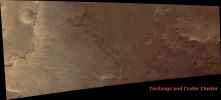
CR-h0500_0000_nd3-00-PCF-LXTT.jpgFrame h0500_0000_nd3-00 - Yardangs and Crater Cluster (Natural Colors; credits for the additional process. and color.: Dr Paolo C. Fienga - Lunexit Team)214 visitenessun commentoMareKromium
(5 voti)
|
|

CR-h0550_0000_nd3-01-PCF-LXTT.jpgFrame h0550_0000_nd3-01 - Rayed Crater and Collapse Features (Natural Colors; credits for the additional process. and color.: Dr Paolo C. Fienga - Lunexit Team)235 visitenessun commentoMareKromium
(5 voti)
|
|
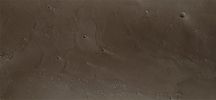
Tiu_Valles-ESA-PCF-LXTT.jpgTiu Valles (Natural Colors; credits: Dr Paolo C. Fienga - Lunexit Team)89 visiteThis image taken by the High Resolution Stereo Camera (HRSC) on board Mars Express shows the mouth of the Tiu Valles Channel System on the Red Planet. The picture was taken in orbit 3103 on 10 June 2006 with a ground resolution of approx. 16 mt/pixel. Visible in the lower part of the image are remnants of a once 'Streamlined' Island. The upper part of the scene covers the mouth of the Tiu Valles nearly in its entire width, approx. 55 Km.
Its winding, meandering Ridges, bound by depressions are eye-catching. The processes that formed these odd structures are still unknown. Possibly, during flooding events, water or water-rich surface layers came in contact with lava from the surrounding areas, which then might have led to the formation of these mysterious ridges.
The Region is located at approx. 27° North Lat. and 330° East Long. The Sun illuminates the scene from the North West, the lower left-hand side in the image. MareKromium
(5 voti)
|
|
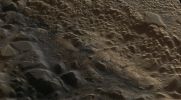
IaniChaos-ESA-PF.jpgIani Chaos (possible Natural Colors; credits ESA - additional color. and process. Dr Paolo C. Fienga)109 visiteIani Chaos on Mars, an area where Light Toned Deposits, or LTD, are known to be present. An analysis of data and images from Mars Express suggests that several LTD, some of the least understood structures on Mars, were formed when large amounts of groundwater burst on to the Surface. Scientists propose that groundwater had a greater role in shaping the Martian Surface than previously believed, and may have sheltered primitive life forms as the Planet started drying up.
This image was obtained with the High Resolution Stereo Camera on board ESA’s Mars Express Spacecraft.
Nota Lunexit: a nostro avviso questa "immagine" NON E' VERA! E' un disegno. Al limite, è la trasposizione digitale di un frame RAW originale unprocessed (ma ne dubitiamo). MareKromium
(5 voti)
|
|
| 106 immagini su 9 pagina(e) |
 |
|
|
5 | |
|
|
|








