| Piú votate - Mars through Mars Express (ESA - Original Raw Frames & Orbital Panoramas) |
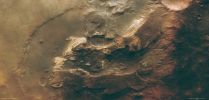
Craters-Terby_Crater.jpgTerby Crater (Natural Colors + MULTISPECTRUM; credits: ESA & Lunexit)86 visiteThe High Resolution Stereo Camera (HRSC) on board ESA’s Mars Express Orbiter imaged the Terby Crater on Mars on 13 April 2007 during orbit 4199.
The Region is of great scientific interest as sediments there hold information on the role of water in the history of the Planet. Eye-catching finger-shaped plateaux extend in the North-South direction. They rise up to 2000 mt above the surrounding terrain. The relatively old crater was filled with sediments in the past, which formed plateaux on erosion.
The flanks of the plateaux clearly exhibit layering of different-coloured material. Differences in colour usually indicate changes in the composition of the material and such layering is called ‘bedding’. Bedding structures are typical of sedimentary rock, which has been deposited either by wind or water. Different rock layers erode differently, forming terraces.
The valleys exhibit gullies, or channels cut in the ground by running liquid, mainly in the Northern part of the image.
These gullies and the rock-bedding structure indicate that the region has been affected by water.
MareKromium
(9 voti)
|
|

B-h0032_0000_ir3-00.jpgFrame Mars Express RAW n. h0032_0000_ir374 visite
(9 voti)
|
|
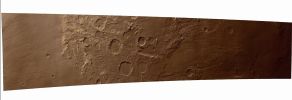
Claritas_Fossae-H0530_0000_ND2-PCF-LXTT.jpgFrame H0530_0000_ND2: Claritas Fossae Region225 visiteCaption ESA:"The HRSC on board ESA's Mars Express Spacecraft obtained this image on June, 20th, 2004, during orbit 530, with a ground resolution of approx. 31,4 mt per pixel.
This scene shows portion of the Claritas Fossae Region, covering an area roughly 200 by 1150 Km and centered at approx. 258° East Long. and 32° South Lat".
MareKromium
(8 voti)
|
|
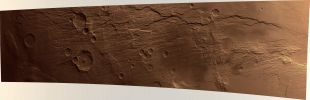
Claritas_Fossae-H0563_0000_ND2_H-PCF-LXTT.jpgFrame H0563_0000_ND2: Claritas Fossae Region223 visiteCaption ESA:"This scene shows the Region of Claritas Fossae, about 150 Km wide in the North and approx. 550 Km wide in the South, about 1200 Km in length, and centered at - approx. - 253° East Long. and 32° South Lat. The Linear Fractures of Claritas Fossae have widths ranging from a few Km up to about 100".MareKromium
(8 voti)
|
|
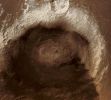
Craters-Crommelin_Crater-PCF-LXTT.jpgCrommelin Crater (Natural Colors; credits for the additional process. and color.: Dr Paolo C. Fienga - Lunar Explorer Italia)78 visiteCoord.: 5,1° North Lat. and 349,8° East Long.MareKromium
(8 voti)
|
|
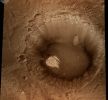
Craters-Pollack_Crater-H1201_0001_ND3_crop_wide-3.jpgPollack Crater and "White Rock" (Natural Colors - Tri-Chromatic Version; credits for the additional process. and color.: Dr Paolo C. Fienga - Lunexit Team)70 visitenessun commentoMareKromium
(8 voti)
|
|
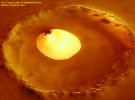
Craters-Lauth_Crater_in_Vastitas_Borealis_Region-Frozen_Lake-W-212-010705-1343-6-3d-01-03.jpgThe misterious "Frozen Lake" of Vastitas Borealis (4 - Extremely Enhanced Natural Colors; credits for the additional process. and color.: Lunar Explorer Italia)74 visitePiena Estate Polare Marziana: polveri rosse ricoprono il cratere senza nome di Vastitas Borealis e colorano, in parte, il suo "laghetto" centrale.
Da notare che, in accordo alle nostre assunzioni di partenza (ed in accordo a regole elementari di logica e di buon senso), un cielo ricco di polveri color arancio, gialle e rossastre (e dunque, di conseguenza, un cielo color rosso/arancio e giallo - di base) si dovrebbe adeguatamente riflettere con questi medesimi colori nelle acque - a questo punto ghiacciate o meno diventa indifferente - del lago di Vastitas.
Ebbene, la regola elementare per cui le acque e/o i ghiacci superficiali, "usualmente", riflettono il colore del cielo, nel frame ESA Originale (fateci caso!) diremmo che NON trova applicazione.
Come mai? Forse abbiamo sbagliato noi...O forse l'immagine ESA è un'mmagine bella ma fasulla? O forse i suoi colori sono stati taroccati (male)?
O magari essa è frutto di incompetenza?
Oppure - chissà... - l'immagine ESA di partenza è un mix di tutte e tre le possibili (e summenzionate) variabili... Decidetelo Voi.MareKromium
(8 voti)
|
|
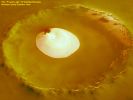
Craters-Lauth_Crater_in_Vastitas_Borealis_Region-Frozen_Lake-W-212-010705-1343-6-3d-01-02.jpgThe misterious "Frozen Lake" of Vastitas Borealis (3 - False Colors; credits for the additional process. and color.: Lunar Explorer Italia)73 visiteQuesta "visione" (sempre di fantasia e sempre solo sino ad un certo punto...) del Lago Ghiacciato di Vastitas si riferisce, invece, all'inizio dell'Estate Polare Marziana.MareKromium
(8 voti)
|
|

Craters-Lauth_Crater_in_Vastitas_Borealis_Region-Frozen_Lake-W-212-010705-1343-6-3d-01-01.jpgThe misterious "Frozen Lake" of Vastitas Borealis (2 - False Colors; credits for the additional process. and color.: Lunar Explorer Italia)69 visiteNoi non sappiamo se i riflessi color verde ed azzurro che cogliamo nelle immagini telescopiche di Marte (sia ottenute da Terra, sia dallo Spazio - via HST ad esempio) sìano il prodotto di mere aberrazioni cromatiche o se essi possano effettivamente costituire l'evidenza tangibile, rispettivamente, di forme di vegetazione indigena e/o di acque correnti superficiali.
Quello che sappiamo è che non possiamo - semplicemente - ignorare questi dati in sede di interpretazione "cromatica" delle immagini possedute, qualunque ne sia la fonte.
Questa "visione" (di fantasia, ma sino ad un certo punto...) del Lago Ghiacciato di Vastitas si riferisce alla tarda Primavera Polare Marziana.MareKromium
(8 voti)
|
|

Craters-Unnamed_Crater_in_Promethei_Terra-PCF-LXTT.jpgUnnamed Crater in Promethei Terra (Absolute Natural Colors; credits for the additional process. and color.: Dr Paolo C. Fienga - Lunar Explorer Italia)97 visitenessun commento
(8 voti)
|
|

A-h0751_0000_bl2-01.jpgFrame h0751_0000_bl2 - The South Pole of Mars (Absolute Natural Colors; credits for the additional process. and color.: Dr Paolo C. Fienga - Lunexit Team)279 visitenessun commentoMareKromium
(7 voti)
|
|

Coprates_Catena-h0438_0000_nd3-00.jpgSulphates in Coprates Catena? (CTX Frame - Natural Colors; credits for the Additional Process. and Color.: Dr Paolo C. Fienga - Lunexit Team)91 visitenessun commentoMareKromium
(7 voti)
|
|
| 106 immagini su 9 pagina(e) |
2 |  |
|
|
|
|
|
|








