| Piú votate - Mars through Mars Express (ESA - Original Raw Frames & Orbital Panoramas) |
Volcanoes-Olympus_Mons-PCF-LXTT.jpgOlympus Mons and Surroundings (Absolute Natural Colors; credits for the additional process. and color: Dr Paolo C. Fienga - Lunexit Team)81 visiteUna nostra elaborazione Multispettrale del maestoso Vulcano Olympus, ottenuta da un frame HR proveniente dalla Sonda ESA "Mars Express".
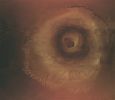
Caption ESA:"This is a mosaic of Olympus Mons, the highest volcano on Mars, which towers 26 Km above the surrounding plains. The image covers an area of approx. 600.000 sq/km.
The High Resolution Stereo Camera (HRSC) on board ESA’s Mars Express Orbiter imaged the Region over 18 orbits.
This image is an ortho-image mosaic, where the projecting rays are perpendicular to the plane of projection.
This corrects any deformations introduced by an imaging camera and therefore such an image can be fitted directly on to a map.
From the observations, 16 HRSC orbit strips, with around 35 Gigabytes of data were used to generate a Digital Terrain Model (DTM) mosaic and an ortho-image mosaic. The DTM mosaic has a resolution of 150 mt/pixel. The resolution of individual nadir images (taken by pointing the camera vertically down to the surface) is in the range of 12 to 40 mt/pixel. Individual terrain models with a resolution of up to 50 mt were derived for every HRSC image strip.
The HR DTMs and ortho-images are derived through a complex process. Matching surface features were used to 'stitch' the images strips together, and complex geometrical calculations were used to produce the 3D coordinates of all measured points in the area".MareKromium
(16 voti)
|
|

Volcanoes-Arsia_Mons-Eruption-04.jpgArsia Mons is erupting? (Processed Natural Colors; credits for the additional process. and color.: Dr Marco Faccin - Lunexit Team)125 visitenessun commentoMareKromium
(14 voti)
|
|
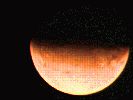
Volcanoes-Arsia_Mons-Eruption-06.gifArsia Mons is erupting? (a GIF-Movie in processed Natural Colors by Dr Marco Faccin - Lunexit Team)95 visiteSolo un'annotazione "tecnica": notate come l'Atmosfera di Marte (tutt'altro che impercettibile ed ultra-sottile...) si evidenzia sul bordo del Pianeta colorandosi, di fotogramma in fotogramma, dello stesso colore della Dominante propria del Filtro impiegato.
Un altro straordinario Lavoro del nostro Marco Faccin, che ringraziamo di Cuore!MareKromium
(13 voti)
|
|

Chasmas-Tithonium_Chasma-2-121-221004-0442-6-co-01.jpgTithonium Chasma - Valles Marineris156 visiteCaption ESA originale:"This image shows the western end of the canyons Tithonium Chasma and Ius Chasma, part of the Valles Marineris canyon system, which are up to 5,5 Km deep.
The image was taken on 26 May 2004 during orbit 442 with a ground resolution of approximately 52 metres per pixel. The displayed region is located at the beginning of the canyon system at about latitude 7° South and longitude 269° East. North is to the left".
(13 voti)
|
|
Volcanoes-Arsia_Mons-Eruption-05.jpgArsia Mons is erupting? (RAW Natural Colors; credits for the additional process. and color.: Dr Marco Faccin - Lunexit Team)79 visitenessun commentoMareKromium
(12 voti)
|
|

Craters-Unnamed_Double_Crater_in_Terra_Tyrrhena.jpgDouble Impact Crater in Terra Tyrrhena (Natural Colors + MULTISPECTRUM; credits: ESA & Lunexit)89 visiteThe High Resolution Stereo Camera (HRSC), ESA's Mars Express obtained images of the Tyrrhena Terra Impact Region on Mars.
On 10 May 2007, the spacecraft was in orbit number 4294 when it snapped pictures of the Region located at 18° South Lat. and 99° East Long. with a ground resolution of approximately 15 meters per pixel.
The Western part of the scene is dominated by a 35 Km-wide and approx. 1000 mt-deep impact crater with an extremely cliffy and chiseled edge. Another, 18 Km-long and approx. 750 mt-deep impact crater, in all likelihood a double impact crater, is located South of the large crater.
These 'double impact craters' develop when two objects, part of a binary, hit the surface almost simultaneously.MareKromium
(12 voti)
|
|
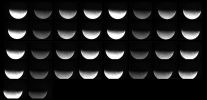
Volcanoes-Arsia_Mons-Eruption-02.jpgArsia Mons is erupting? (ALL available frames - a Photo-Mosaic by Dr Marco Faccin - Lunexit Team)79 visitePer il momento, l'unica ipotesi che noi, come Gruppo Lunar Explorer Italia (LunExIt), possiamo avanzare è orientata verso la verificazione di un fenomeno esplosivo (quello che ha generato la nuvola e poi il pennacchio) di considerevole portata. Se ad esso abbia fatto (e/o stia facendo) seguito una vera e propria eruzione, non lo possiamo sapere.
L'unica certezza è che "qualcosa" è successo.
Marte, se volete, ci ha dato un FORTE segnale di risveglio (ricordate che il vulcanismo è un segno tipico e caratterizzante degli ambienti geologicamente attivi).
Ora noi aspettiamo.
E continuiamo ad osservare...MareKromium
(11 voti)
|
|
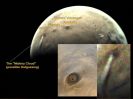
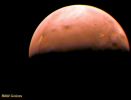
Volcanoes-Arsia_Mons-Eruption-00.jpgArsia Mons is erupting?139 visiteIn data 2 Luglio 2009, sono state ottenute (dalla Sonda ESA "Mars Express") una serie di immagini che SEMBRANO essere la prova visibile della verificazione di un fenomeno vulcanico tutt'altro che residuale nella Provincia Marziana di Tharsis: una nube piuttosto chiara, ma molto densa e compatta (oltre che di dimensioni davvero imponenti - ne stimiamo la lunghezza intorno ai 400/450 Km), pare infatti provenire dal Vulcano Arsia Mons.
La qualità delle immagini ESA (scattate lungo l'arco di circa 30 minuti) è - come sempre... - scarsa e quindi, se non altro per il momento, ci limitiamo a pubblicare l'immagine più significativa (ed in Natural Colors), nel contesto di un piccolo collage il quale Vi sarà di aiuto per capire non solo la possibile origine dello sfogo, ma anche le sue attuali dimensioni (calcolabili agevolmente, una volta tenutosi conto che la caldera di Arsia Mons ha un diametro di circa 110 Km).
Attendiamo le Vostre opinioni ed i Vostri commenti (speculazioni incluse)!MareKromium
(11 voti)
|
|
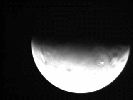
Volcanoes-Arsia_Mons-Eruption-03.gifArsia Mons is erupting? (a GIF-Movie by: Dr Marco Faccin - Lunexit Team)81 visitenessun commentoMareKromium
(10 voti)
|
|
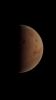
Volcanoes-Arsia_Mons_and_the_Tharsis_Montes-December_2012-PCF-LXTT-IPF-1.jpgNew "Smoke Emission" from Arsia Mons (Absolute Natural Colors; credits for the additional process. and color.: Dr Paolo C. Fienga/Lunar Explorer Italia/Italian Planetary Foundation)142 visiteIn questo interessantissimo (ed ovviamente sconosciuto ai più) frame ESA - Mars Express, ottenuto nel Dicembre 2012, una nuova (e possente, direi) Emissione di Fumi appare essersi formata nella (e caratterizzare la) Regione dove sorge il più "irrequieto" dei tre Tharsis' Montes: Arsia Mons.
Si tratta, ancora una volta, di complessi nuvolosi stratiformi che, "casualmente", si sono formati (o transitavano) nei pressi della Caldera di Arsia - come sostengono ESA e NASA -, oppure siamo realmente davanti ad una (forse l'ennesima) prova che Marte è ancora geologicamemte attivo?
Io la risposta non posso darvela, ma le immagini ci sono ed a me sembrano eloquenti. Poi, come sempre, la "Parola" passa a Voi Lettori...
Dr Paolo C. Fienga (PhD)MareKromium
(9 voti)
|
|
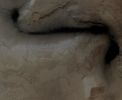
Reull_Vallis-ESA-2-PCF-LXTT.jpgPseudo-Lake in Reull Vallis (Absolute Natural Colors; credits for the additional process. and color.: Dr Paolo C. Fienga - Lunexit Team)100 visiteLa "risposta" Lunexit, in Absolute Natural Colors, ad uno degli orrori più grandi "Made by ESA": un (brutto e pure - leggermente - sfuocato) Mars Express Frame, colorato in arancio-giallo, verde e azzurro (!) il quale fece gridare (i soliti tre pseudo-Ricercatori prezzolati) al "Lago di Reull" (guardate il frame che precede).
Nessun "Lago", Signori: solo un Canyon colmo di sabbie ferrose ed ossidate! Meditateci sopra...MareKromium
(9 voti)
|
|
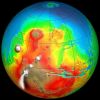
Volcanoes-Arsia_Mons-Eruption-01.jpgArsia Mons is erupting?87 visiteIn questa inequivocabile e spettacolarmente "visiva" ricostruzione del "pennacchio" scaturito dal Vulcano Arsia Mons (un grande complimento al nostro Marco Faccin per l'idea e per l'esecuzione!), ecco che la magnitudine del fenomeno segnalatoVi nella giornata di ieri (16 Luglio 2009) si evidenzia in tutta la sua straordinaria maestosità.
Ma che cosa è successo, esattamente?
Al momento, le Fonti Ufficiali (ESA e soprattutto NASA) non dicono nulla. L'ESA, onore al merito (quando c'é!), ha divulgato l'informazione e le prime immagini; la NASA...nulla. Silenzio assoluto.
Peccato.
Peccato perché, ora come non mai, puntare le ottiche delle Sonde Odyssey e Reconnaissance verso la caldera di Arsia Mons sarebbe una garanzia di immagini straordinarie e, certamente, di assoluto valore storico e scientifico.
Staremo a vedere...MareKromium
(9 voti)
|
|
| 106 immagini su 9 pagina(e) |
1 |
 |
|
|
|
|
|
|








