| |

| Piú votate - After One-Thousand Soles... |
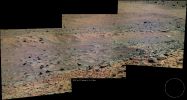
SOL1377-1-EB-LXTT.jpgVisual Survey - Sol 1377 (an Image-Mosaic in False Colors by Elisabetta Bonora - Lunexit Team)86 visitenessun commentoMareKromium 
(5 voti)
|
|
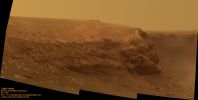
OPP-SOL1329-1193591285_32257-4_Sol1329B_P2379_L257atc-1.jpgCape Verde, according to NASA - Sol 132963 visiteCaption NASA:"A promontory nicknamed "Cape Verde" can be seen jutting out from the walls of Victoria Crater in this approximate true-color picture taken by the PanCam on NASA's MER Opportunity. The Rover took this picture on Martian Day, or Sol, 1329 (Oct. 20, 2007), more than a month after it began descending down the crater walls - and just 9 Soles shy of its second Martian birthday on Sol 1338 (Oct. 29, 2007).
Opportunity landed on the Red Planet on Jan. 25, 2004. That's nearly 4 years ago on Earth, but only 2 on Mars, because Mars takes longer to travel around the Sun than Earth. One Martian year equals 687 Earth days.
The overall soft quality of the image, and the "haze" seen in the lower right portion, are the result of scattered light from dust on the front sapphire window of the Rover's camera.
This view was taken using 3 PanCam filters, admitting light with wavelengths centered at 750 (near infrared), 530 (green) and 430 nanometers (violet)".MareKromium
(5 voti)
|
|
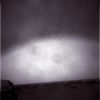
OPP-SOL1395-1.jpgLook at those grains of dust... - Sol 1395 (false colors; credits: Dr M. Faccin)65 visiteUna brillante intuizione (molto probabilmente corretta) del Dr Faccin sulla struttura fisica delle Camere di cui i MER sono dotati. Ma lasciamo che sia lui stesso a spiegare quello che ha scoperto:"...la NASA fa vedere che si ci sono nubi di polvere (intorno ai Rover) ma, osservando bene, si può notare che ci sono anche dei grani di questa polvere sugli obbiettivi.
Ora notate: alcune di queste macchie scure sono esagonali, una forma data dal diaframma. Scoperto questo, noi sappiamo che i CCD dei MER sono muniti di diaframma meccanico, al pari di una semplice camera digitale da 50 Euro.
Quanto detto si riferisce alla NavCam - che presumo sia analoga alla PanCam - la quale si distingue dalle Rear e FrontHazCam poichè esse, credo, sono ad obbiettivo fisso - simili alle webcam, tanto per intenderci...".
Allora: la NASA usa sempre "supertecnologie" da milioni di Dollari, oppure - magari qualche volta... - "tira a risparmiare"? E soprattutto: ma siamo così sicuri che ci vogliano "suprtecnologie" per "sopravvivere alle "estreme" (ma dove?!?) condizioni di Marte?
Siamo sempre più dell'idea che qualcosa non torni: complimenti e congratulazioni al Dr Faccin ed ora, se volete, la parola a Voi!...MareKromium
(8 voti)
|
|
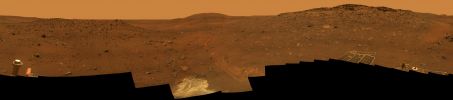
SOL1906-1943-Calypso_L257atc_br2.jpgCalypso Panorama - from Sol 1906 to Sol 1943 (Natural Colors; credits: NASA/JPL-Caltech/Cornell University)68 visiteCaption NASA:"This full-circle view from the Panoramic Camera (Pancam) on NASA's Mars Exploration Rover Spirit shows the terrain surrounding the location called "Troy", where Spirit became embedded in soft soil during the Spring of 2009. The hundreds of images combined into this view were taken beginning on the 1906th Martian Day (or Sol) of Spirit's Mission on Mars (such as May, 14, 2009) and ending on Sol 1943 (such as June, 20, 2009).
North is at the center; South at both ends. The Western Edge of the low plateau called Home Plate dominates the right half of the panorama. At the far right is a bright-topped mound called "Von Braun", a possible future destination for Spirit's exploration. Near the center of the panorama, in the distance, lies Husband Hill, where Spirit recorded views from the Summit in 2005. The ridge on the left, near the Rover Tracks leading to Troy from the North, is called "Tsiolkovsky".
For scale, the parallel tracks are about 1 meter (39 inches) apart. The track on the right is more evident because Spirit was driving backwards, dragging its right-front wheel, which no longer rotates.
The bright soil in the center foreground is soft material in which Spirit became embedded after the wheels on that side cut through a darker top layer. The composition of different layers in the soil at the site became the subject of intense investigation by tools on Spirit's Robotic Arm.
The PanCam Team named this scene the camera's Calypso Panorama.
This version is an Approximate True-Color, red-green-blue composite panorama generated from images taken through the Pancam's 750-nanometer, 530-nanometer and 480-nanometer filters.
This "Natural Color" view is the Rover Team's best estimate of what the scene would look like if we were there and able to see it with our own eyes.
Spirit has been investigating a region within Mars' Gusev Crater for more than 67 months in what was originally planned as a three-month mission".
Note Lunexit: la NASA, a quanto pare, confonde/mischia in maniera scandalosa il concetto di "True Colors" (ancorchè "approximate") con il concetto di "Natural Colors" - rileggete attentamente se non ci avete fatto caso.
Se la colorizzazione di questa immagine è, come scrivono gli Amici di Pasadena, la Best Estimate del Rover Team sul come la Piana di Gusev dovrebbe apparire ad occhi umani...beh, scusateci la presunzione, ma il loro livello tecnico a noi appare piuttosto imbarazzante...MareKromium
(8 voti)
|
|

SOL1559-2P264763301EFFAY00P2272R1M1.jpgHorizon... - Sol 1559 (MULTISPECTRUM; credits: Lunexit)68 visitenessun commentoMareKromium
(15 voti)
|
|
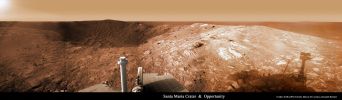
OPP-SOL2476-Kremer.jpgSanta Maria Crater - Sol 2476 (an Image-Mosaic by NASA/JPL- Cornell; credits for the additional process. and color.: Marco Di Lorenzo & Kenneth Kremer)135 visiteCaption NASA:"Celebrating 7 years on the Surface of the Red Planet, MER Opportunity now stands near the Rim of an about 90 meters wide Crater known as "Santa Maria".
Remarkably, Opportunity and its fellow Rover Spirit were initially intended for a 3 month long primary mission. Still exploring, the golf cart-sized robot and shadow (far right) appear in the foreground of this Panoramic View of its current location.
The mosaic was constructed using images from the Rover's NavCam.
On its 7 year anniversary, Opportunity can boast traversing a total of 26,7 Km along the Martian Surface.
After investigating Santa Maria Crater, the MER controllers plan to have Opportunity resume a long-term trek toward Endeavour, an approx. 22 Km wide Impact Crater which is now about 6 Km away from Santa Maria.
During the coming Soles, communication with the Rover will be more difficult as Mars moves close to alignment with the Sun as seen from Earth's perspective".
Nota Lunexit: questa elaborazione, secondo noi, è davvero scadente ed inoltre se alla NASA rileggessero le loro Captions prima di pubblicarle, probabilmente farebbero qualche meschina figura in meno (nella caption che descrive questa immagine, infatti - guardate la "NASA - Astronomy Picture of the Day" del giorno 29 Gennaio 2011 -, nonchè in svariate Captions inserite sul "NASA - Planetary Photojournal", il grande Cratere Endeavour viene spesso menzionato come Cratere Endurance).
Si, direte Voi, è una svista, una sciocchezza.
E invece NO, diciamo noi, non lo è affatto. E' un indice di poca accuratezza e di minima cura ed attenzione su quanto "diffuso" (diciamo "comunicato", valà, che è più realistico...) al Grande Pubblico.
E se i Ricercatori Privati, quando prendono una (anche minima) svista possono - anzi "devono", secondo alcuni! - essere "messi in croce", allora che anche i grandi Enti Spaziali, quando scrivono sciocchezze (e non parliamo degli innumerevoli strafalcioni grammaticali e sintattici che caratterizzano tantissime captions NASA e pure ESA...), vengano additati al pubblico ludibrio.
E anche questa è Democrazia.MareKromium
(7 voti)
|
|
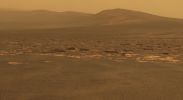
OPP-SOL2678-PIA14508NASA-JPL.jpgThe West Rim of Endeavour Crater - Sol 2678 (Natural Colors; credits: NASA/JPL-Caltech/Cornell/ASU)125 visiteCaption NASA:"A portion of the Western Rim of Endeavour Crater sweeps Southward in this color view from NASA's Mars Exploration Rover Opportunity. This Crater -- with a diameter of about 14 miles (approx 22 Km) -- is more than 25 times wider than any that Opportunity has previously approached during the Rover's 90 months on Mars.
This view combines exposures taken by Opportunity's PanCam on the 2678th Martian day, or Sol, of the Rover's work on Mars (Aug. 6, 2011) before driving on that sol. The subsequent Sol 2678 drive covered 246 feet (75,26 meters), more than half of the remaining distance to the Rim of the Crater. Opportunity arrived at the Rim during its next drive, such as on Sol 2681 (meaning Aug. 9, 2011).
Endeavour Crater has been the Rover Team's destination for Opportunity since the Rover finished exploring Victoria Crater in August 2008. Endeavour offers access to older geological deposits than any Opportunity has seen before.
The closest of the distant Ridges visible along the Endeavour Rim is informally named "Solander Point". Opportunity may investigate that area in the future. The Rover's first destination on the Rim, called "Spirit Point" in tribute to Opportunity's now-inactive twin, Spirit, is to the left (North) of this scene.
The lighter-toned Rocks closer to the Rover in this view are similar to the rocks Opportunity has driven over for most of the mission. However, the darker-toned and rougher Rocks just beyond that might be a different type for Opportunity to investigate. The ground in the foreground is covered with iron-rich Spherules, nicknamed "Blueberries," which Opportunity has observed frequently since the first days after landing. They are about 0,2" (5 millimeters) or more in diameter.
This view combines images taken through three different PanCam filters admitting light with wavelengths centered at 753 nanometers (near infrared), 535 nanometers (green) and 432 nanometers (violet). This "Natural Color" is the Rover Team's best estimate of what the scene would look like if humans were there and able to see it with their own eyes. Seams have been eliminated from the Sky portion of the mosaic to better simulate the vista a person standing on Mars would see".MareKromium
(18 voti)
|
|
OPP-SOL2010.jpgNereus Crater - Sol 2010 (Natural Colors; credits: Kenneth Kramer)116 visitenessun commentoMareKromium
(27 voti)
|
|
SOL1369-B-1198865273.jpgSpirit's West Valley Panorama (false colors; credits: NASA)83 visitenessun commentoMareKromium
(11 voti)
|
|
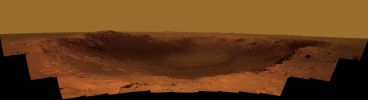
OPP-SOL2453-2454-PIA13794-1.jpgSanta Maria Crater in Natural Colors, according to NASA - Sol 2453 and 2454 (an Image-Mosaic by NASA/JPL-Caltech - Cornell-ASU)137 visiteNASA's Mars Exploration Rover Opportunity is spending the Seventh Anniversary of its landing on Mars investigating a Crater called "Santa Maria", which has a diameter about the length of a football field. This scene looks Eastward across the Crater. Portions of the Rim of a much larger Crater, such as Endeavour Crater, appear on the horizon.
The panorama spans 125 compass degrees, from North/North-West on the left to South/South-West on the right. It has been assembled from multiple frames taken by the PanCam on Opportunity during the 2453rd and 2454th Martian Days, or Soles, of the Rover's work on Mars (such as Dec. 18 and 19, 2010).
Opportunity landed in the Meridiani Planum Region of Mars on Jan. 24, 2004, Universal Time (Jan. 25, Pacific Time) for a mission originally planned to last for three months. Since that Prime Mission, the Rover has continued to work in bonus-time extended missions.
Both Opportunity and its twin, Spirit, have made important discoveries about wet environments on ancient Mars that may have been favorable for supporting microbial life.
By mid-January 2011, Opportunity reached a location at the South-Eastern edge of Santa Maria Crater. The Rover Team developed plans for Opportunity to spend a few weeks investigating rocks at that site during Solar Conjunction, a period when communications between Earth and Mars are curtailed because the Sun is almost directly between the two Planets. After completion of its work at Santa Maria, the Rover will resume a long-term trek toward Endeavour.
This view combines images taken through three different PanCam filters admitting light with wavelengths centered at 753 nanometers (Near InfraRed), 535 nanometers (green) and 432 nanometers (violet). This "Natural Color" is the Rover Team's best estimate of what the scene would look like if we were there and able to see it with our own eyes. Seams have been eliminated from the Sky portion of the mosaic to better simulate the vista a person standing on Mars would see.MareKromium
(23 voti)
|
|

SOL1369-A-1198865273.jpgSpirit's West Valley Panorama (approx. true colors; credits: NASA)80 visiteForse, tra i panorami colorizzati by NASA e, a nostro avviso, venuti fuori "infelici" (insomma: riusciti male), questa colorizzazione è, in assoluto, fra le tre peggiori.
La NASA è, di fatto, tornata alla "tinteggiatura gialla" che abbiamo visto ai tempi di Pathfinder: una Dominante Cromatica Giallo Ocra densa, piatta ed uniforme, tanto - esteticamente - brutta, quanto - scientificamente - improbabile.
Ma tant'è...
Caption NASA:"NASA'S MER Spirit captured this Westward view from atop a low plateau where Sprit spent the closing months of 2007.
After several months near the base of the plateau called "Home Plate" in the inner basin of the Columbia Hills range inside Gusev Crater, Spirit climbed onto the Eastern edge of the plateau during the Rover's 1306th Martian day, or Sol, (Sept. 5, 2007).
It examined rocks and soils at several locations on the Southern half of Home Plate during September and October.
It was perched near the western edge of Home Plate when it used its panoramic camera (Pancam) to take the images used in this view on sols 1,366 through 1,369 (Nov. 6 through Nov. 6, 2007). With its daily solar-energy supply shrinking as Martian summer turned to fall, Spirit then drove to the northern edge of Home Plate for a favorable winter haven. The rover reached that northward-tilting site in December, in time for the fourth Earth-year anniversary of its landing on Mars. Spirit reached Mars on Jan. 4, 2004, Universal Time (Jan. 3, 2004, Pacific Standard Time). It landed at a site at about the center of the horizon in this image.
This panorama covers a scene spanning left to right from southwest to northeast. The western edge of Home Plate is in the foreground, generally lighter in tone than the more distant parts of the scene. A rock-dotted hill in the middle distance across the left third of the image is "Tsiolkovski Ridge," about 30 meters or 100 feet from the edge of Home Plate and about that same distance across. A bump on the horizon above the left edge of Tsiolkovski Ridge is "Grissom Hill," about 8 kilometers or 5 miles away. At right, the highest point of the horizon is "Husband Hill," to the north and about 800 meters or half a mile away.
This view combines separate images taken through Pancam filters centered on wavelengths of 753 nanometers, 535 nanometers and 432 nanometers to produce an approximately true-color panorama".MareKromium
(23 voti)
|
|
|
| 2387 immagini su 199 pagina(e) |
|
|
|
|
|
|
|
|
|
199 |
|
|
|





