| Piú viste - SOLAR SYSTEM |

Enceladus-PIA14588-PCF-LXTT.jpgCrescent Enceladus (Absolute Natural Colors; credits for the additional process. and color.: Dr Paolo C. Fienga - Lunexit Team)233 visiteCaption NASA:"The Cassini Spacecraft looks at a brightly illuminated Enceladus and examines the Surface of its Leading Hemisphere. North on Enceladus is up and rotated 21° to the right.
The image was taken in Visible Light with the Cassini Spacecraft narrow-angle camera on Nov. 6, 2011. The view was obtained at a distance of approx. 67.700 miles (such as about 109.000 Km) from Enceladus and at a Phase Angle of 21°. Image scale is 2130 feet (649 meters) per pixel".MareKromium
|
|

Image034-51-Plates4B.jpgBlue Flares and the Invisible Crater: Panorama and Image from Above (1)232 visitePassi per il Weird Crater, che è piccolo e facile da dissimulare, ma il Cone Crater è un "gigante" del diametro di almeno 330 metri e profondo quasi 100: significa 2 volte e 1/2 il famoso cratere marziano Endurance, ripreso da Opportunity per oltre 6 mesi!
E allora? Sarà sicuramente un’illusione ottica, le foto ravvicinate del cratere ci tranquillizzeranno e ci faremo una bella risata sulla nostra ingenuità. E invece no. Secondo la NASA, Shepard e Mitchell avrebbero rischiato la pelle per arrivare sulla Luna, avrebbero scarpinato in atmosfera 0 per oltre 1 Km e poi, una volta, raggiunto questo maestoso cratere, si sarebbero religiosamente fotografati le punte dei piedi. Potremmo avanzare varie ipotesi: forse gli Astronauti hanno attraversato un momento di (enorme) appannamento mentale; o forse la “testolina” che spunta dall’ombra non è una formazione geologica e ha fatto qualcosa che ha innervosito i nostri Eroi. Il fatto certo è che tutto quello che gli Astronauti avrebbero fotografato è presente in questa tavola, riferita alla stazione di rilevamento C.
|
|

Helene-N00172780-N00172904-GB-LXTT.gifFlying around Helene (a GIF-Movie by Dr Gianluigi Barca - Lunexit Team)232 visitenessun commentoMareKromium
|
|

ZZ-Mercury-Craters-Raditladi_Impact_Basin-PIA14856-PCF-LXTT.jpgFeatures of Raditladi Impact Basin (Enhanced Absolute Natural Colors; credits for the additional process. and color.: Dr Paolo C. Fienga - Lunexit Team)232 visiteCaption NASA:"View of a section of the Floor and Peak-Ring Mountains of the Raditladi Impact Basin. The individual frames in the mosaic are about 20 km wide. The rounded, depressions, called "Hollows" are a fascinating discovery of MESSENGER's orbital mission and may have been formed by Sublimation of a component of the material when exposed by the Raditladi Impact Event.
Date Presented: September 29, 2011, at a NASA press briefing
Instrument: Mercury Dual Imaging System (MDIS)MareKromium
|
|

082-Craters-Unnamed_Crater-PIA15222-PCF-LXTT.jpgIn the Shadows... (Absolute Natural Colors; credits for the additional process. and color.: Dr Paolo C. Fienga - Lunexit Team)230 visiteThis image, one of the first obtained by NASA's Dawn Spacecraft in its low altitude mapping orbit, shows part of the Rim of a (relatively) fresh Unnamed Crater. The Terrain shown here is located in an area known as the Heavily Cratered Terrain in the Northern Hemisphere of 4-Vesta.
The image, taken by Dawn's framing camera, is centered at around 17° North Latitude and 77° East Longitude. It was obtained on Dec. 13, 2011, from an altitude of approx. 119 miles (about 191 Km). It covers an area of about 11 by 11 miles (such as approx. 18 by 18 Km).MareKromium
|
|

Image049-Ukert-4.jpgUkert: the "pseudo-triangular" Lunar Crater229 visitevedi il commento al frame precedente
|
|

Helene-N00172899_900.jpgHelene (High-Def-3D; credits for the additional process.: Dr Marco Faccin - Lunexit Team)228 visitenessun commentoMareKromium
|
|
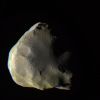
Helene-N00172877_78_79.jpgHelene (RAW Natural Colors; credits for the additional process. and color.: Dr Marco Faccin - Lunexit Team)227 visitenessun commentoMareKromium
|
|

9-Venus.jpgVenus from 2.700.000 Km (Galileo Probe)226 visiteLa competizione USA/URSS, finchè l'URSS è esistita, ha dato grandi risultati in termini di inventiva, volontà, capacità di fronteggiare le difficoltà e superare gli ostacoli (il Programma Apollo ne è la prova lampante!) ma poi...Dissoltasi l'Unione Sovietica e svanita la 'corsa' verso le Stelle, si è incominciato a guardare il 'portafogli' e, dato che le missioni spaziali "costano care", la NASA (o dovremmo dire "Il Congresso"?!?) ha ritenuto più saggio, sicuro ed economico limitarsi ad inviare sonde programmate per entrare in orbita attorno a Venere e poi scattare foto a raggi X della superficie, così da superare l'ostacolo costituito dalla coltre perenne di nubi che sovrasta il Pianeta, SENZA dover ricorrere al landing ed alla successiva, rapida ed inevitabile perdita della navicella.
|
|

Image028-Heat-Shields.jpgOnce again, the whole "scene"...226 visiteVirtual? Maybe what we saw was just a defective (or used for testing) Heat-Shield that was stored in one of Cape Canaveral's warehouses... Anyway, while putting the word "END" to this ridiculous farce, we wish to quote the snide comment of Dr A. Feltri, Author of this outstanding reconstruction of events:"...It makes me laugh when I think that (the Technicians of NASA's Mission Control) took nice pictures - for a month or so - of the old Heat-Shield they kept in their junkyard...".
LUN-EX-IT agrees with what Dr Feltri said and we also wish to make a small addition (on behalf of the President and Members): yes, we do laugh for a while, but then we become nauseated by watching how both NASA and the American Science Adm.n are trying to fool us. ALL OF US!
Unless... Unless this habit of telling (and SHOWING!) a bunch of BBS about Mars is just a very clever part of the "New Deal" created by Mr George W. Bush?!?...
No jokes: we are worried.
What did they find on Mars? "ALIEN 5", maybe?!?...
|
|

Image038-55-912527_3d2.jpgBlue Flares and the Invisible Crater: samples in 3D225 visiteQuello che invece gli Astronauti hanno fotografato (oltre ai propri piedi) sono alcuni campioni di "roccia" (i "samples", appunto) i quali vengono descritti come breccia+cristalli e di cui ho preparato una tavola tridimensionale per la gioia dei possessori di occhialini colorati.
Se quella specie di teschio di Darth Vader che si vede in basso a Dx è effettivamente una roccia, allora deduciamo che deve essere una roccia di natura davvero MOLTO particolare...
|
|

Hyperion-PIA14580-PCF-LXTT.jpgFeatures of Hyperion (Absolute Natural Colors; credits for the additional process. and color.: Dr Paolo C. Fienga - Lunexit Team) 225 visiteCaption NASA:"The sponge-like Surface of Saturn's moon Hyperion is highlighted in this Cassini portrait, captured during the Spacecraft's Sept. 16, 2011, Fly-By. Hyperion (which is about 168 miles, or approx. 270 Km across) has an irregular shape, and it tumbles through its orbit: that is, it does not spin at a constant rate or in a constant orientation. (A standard reference latitude-longitude system has not yet been devised for this moon.)
Images such as this one extend previous coverage and allow a better inventory of the surface features, the satellite's shape and changes in its spin.
The image was taken in Visible Blue Light with the Cassini Spacecraft narrow-angle camera. The view was obtained at a distance of approx. 55.000 miles (such as about 88.000 Km) from Hyperion and at a Sun-Hyperion-Spacecraft, or Phase, Angle of 37°.
Image scale is roughly 1720 feet (524 meters) per pixel".MareKromium
|
|
| 4548 immagini su 379 pagina(e) |
 |
|
|
|
|
9 | |
|
|
|
|





