| |

| Piú viste - SOLAR SYSTEM |

PLUTO.jpgPluto in "true color"239 visiteOvviamente non sappiamo molto di Plutone, ma le più recenti scoperte parlano di vasti depositi di acqua ghiacciata sulla sua superficie. Sappiamo pure che Plutone possiede un'atmosfera (composta da azoto, metano ed altri gas in misura minore) oltremodo sottile la quale, inevitabilmente, "ghiaccia" all'afelio del Pianeta (afelio--->il punto più lontano dal Sole).
Il lancio della Sonda New Horizons è stato concepito secondo tempistiche le quali dovrebbero portarla a ridosso di Plutone prima che la sua atmosfera ghiacci totalmente e quindi permetterci di studiarla (un minimo) ed analizzarne le componenti.
Facts-bites about Pluto&Charon:
Pluto orbits the Sun once every 248 years.
A person on Pluto would weigh 1/15 what they weigh on Earth - for comparison, the astronauts on the Moon had 1/6 of their Earth weight.
Pluto is named after the Greek god of the underworld.
The symbol for Pluto ("PL") is tribute to Percival Lowell, who started the search for the ninth planet in the early 1900s.
Charon is 20 times closer to Pluto than our moon is to Earth.
Pluto was discovered in 1930 by American astronomer Clyde Tombaugh.
American astronomers James Christy and Robert Harrington discovered Charon in 1978.
Charon is named after the mythological boatman who ferried souls across the river Styx to Pluto for judgment.
At 1,470 miles (about 2,370 kilometers) across, Pluto could fit between Washington, D.C. and Denver, Colorado.
Charon is half of Pluto's diameter - making it the largest satellite relative to the planet it orbits.
Pluto is an ice dwarf - a "new" type of planet common to the deep outer solar system.
Pluto-Charon is the solar system's only known binary planet.
Pluto's surface is among the most contrasty in the solar system.
Pluto has weather, winds, hazes, chemistry and an ionosphere.
Pluto's estimated surface temperature falls between --378 to --396 degrees F (-228 to -238 C).
Pluto is one of only two planets that rotates on its side - Uranus is the other.
Pluto's surface has nitrogen, methane and carbon monoxide ices on it.
A radio signal moving at the speed of light takes about 4 hours to reach Pluto from Earth.
The Kuiper Belt is a collection of icy, rocky objects residing beyond Neptune's orbit.
The first Kuiper Belt Object was discovered in 1992.
Some Kuiper Belt Objects (like Pluto) have an average reddish color, while others are gray.
|
|

Janus-PIA09872-PCF-LXTT.jpgCrescent Janus (Natural Colors; credits for the additional process. and color.: Dr Paolo C. Fienga - Lunar Explorer Italia)239 visiteCaption NASA:"The Cassini Spacecraft snapped this exquisite, close-up view of Saturn's moon Janus, looking toward the South Polar Region, on Feb. 20, 2008.
Janus is about 181 Km (approx. 113 miles) across.
The image was taken in visible light with the Cassini spacecraft narrow-angle camera. The view was acquired at a distance of approx. 169.000 Km (such as about 105.000 miles) from Janus and at a Sun-Janus-Spacecraft, or phase, angle of 71°. Image scale is roughly 1 Km (about 0,6 mile) per pixel".
MareKromium
|
|

A-A SUNFLARE.jpgA beautiful Solar Flare237 visitenessun commento
|
|

Image039-58-RimCrater.jpgBlue Flares and the Invisible Crater: the "samples" on Cone Crater's rim237 visiteA onor del vero, nelle fotografie dei "samples" che giacevano sul bordo del Cone Crater si sarebbe anche dovuta intravvedere, in lontananza, la parete del Cratere opposta a quella da cui è stata effettuata la ripresa ma...nulla. Guardate quest'ultima immagine 3D e quindi cercate di accettare un semplice fatto: i nostri Amici della NASA non vogliono farci vedere - né scoprire - nulla.
E quindi, per terminare, alle domande dell'amico Paolo C. Fienga sulla Blue Flare, risponderò con un'altra domanda: "Perché stupirsi per la scomparsa di qualche fuoco fatuo quando ci hanno fatto sparire sotto il naso un intero cratere di 35 ettari?"...
|
|

Image048-Ukert-4.jpgUkert: the "pseudo-triangular" Lunar Crater237 visite"...In questa tavola (che abbiamo dovuto frammentare in quattro sub-tavole - nota Lunar Explorer) ho indicato con dei riquadri rossi l'area più censurata/taroccata nelle varie foto 'ufficiali', mentre la linea verde serve a relazionare la foto planimetrica con quella obliqua...".
|
|
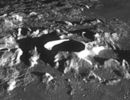
Image052-Ukert-5.jpgUkert: the "pseudo-triangular" Lunar Crater237 visite"...La censura che appare nel punto identificato come 'A' e le strane lastre che appaiono in 'B' (si tratta del frame precedente) sono elementi i quali vengono confermati da questa immagine Apollo 17, in cui la solita ombra - che vogliamo definire "provvidenziale" e che, come si vede benissimo, è stata estesa ad hoc ma in modo alquanto approssimativo... - corrisponde ai "puntini censori" di cui si è parlato e che si sono visti benissimo in uno dei frames precedenti.
Vogliamo fare dell'ironia? Sarà malizioso, ma il Lunar Orbiter risale agli anni '60 e, proprio in quel periodo, i "puntini censori" erano molto usati negli USA - e non solo - per coprire le "zone critiche" e perciò più "interessanti"... delle spogliarelliste!
E poi, in fondo, le stranezze (anche) nei dintorni di Ukert non mancano davvero...il LO 3, infatti, aveva già individuato nell'area di Ukert un evidente intreccio a maglia quadrangolare (o intreccio 'sinaptico') ben visibile al centro dell'ingrandimento di cui al frame che segue...".
|
|

ZZ-Mercury-Pond-PIA15203-PCF-LXTT.jpgMercurian "Pond" (Absolute Natural Colors; credits for the additional process. and color.: Dr Paolo C. Fienga - Lunexit Team)236 visiteThis image shows a small Pond of impact melt that was ejected from a Crater just out of view. The melt ponded in this low, forming a smooth surface similar to the Melt Ponds south of Kuiper Crater. North is toward the upper right corner.
This image was acquired as a High-Resolution targeted observation. Targeted observations are images of a small area on Mercury's Surface at resolutions much higher than the 250-meter/pixel (820 feet/pixel) morphology base map or the 1-Km/pixel (0,6 miles/pixel) color base map. It is not possible to cover all of Mercury's Surface at this high resolution during MESSENGER's one-year mission, but several areas of high scientific interest are generally imaged in this mode each week.
Date acquired: November 06, 2011
Image Mission Elapsed Time (MET): 229105038
Image ID: 980525
Instrument: Narrow Angle Camera (NAC) of the Mercury Dual Imaging System (MDIS)
Center Latitude: 63,9° North
Center Longitude: 256,5° East
Resolution: 16 meters/pixel
Scale: the smooth region is approximately 3 Km (about 1,9 miles) across
Solar Incidence Angle: 69,5° (meaning that the Sun is about 20,5° above the Local Horizon)
Emission Angle: 15,6°
Sun-Mercury-MESSENGER (such as "Phase") Angle: 85,2°MareKromium
|
|

ZZ-Mercury-Natural_Satellite-Caduceus-PIA15542.jpgNOT ALONE!236 visiteCaption NASA:"This discovery image provides the first evidence that Mercury has a small natural satellite or moon. Visible as a small bright spot in an image taken yesterday by the Mercury Dual Imaging System (MDIS) Wide Angle Camera (WAC), the moon is approximately 70 meters (230 feet) in diameter and orbits Mercury at a mean distance of 14.300 Km (such as 8890 miles). A proposal to name the moon "Caduceus", after the staff carried by the Roman god Mercury, has been submitted by the MESSENGER team to the International Astronomical Union, the body responsible for assigning names to celestial objects.
This discovery presents an unprecedented opportunity for a return of samples from the Mercury System, as Project Scientist Nat MacRulf explains. "We have yet to identify a sample from Mercury in any of the meteorite collections we have here on Earth. Such a sample would give us critical insight into the chemical composition of Mercury and the timing of crustal formation on that body, leading to a better understanding of how the planet formed and evolved. If we could obtain a sample of Caduceus, it would enhance the scientific return of the MESSENGER mission beyond our wildest dreams!"
Work on designing a scenario for sample return is already underway. MESSENGER Project Manager Burt Panini held an emergency meeting with the MESSENGER mission operations and navigation teams yesterday evening to determine if the spacecraft could be targeted toward the diminutive moon. After an intensive discussion, a unanimous decision was taken to abandon the orbit-correction maneuvers that had been planned for later this month to place the spacecraft in an eight-hour orbit. Instead, the new plan is to use the remaining propellant to crash MESSENGER into Caduceus. "Our detailed analysis tells us that if we act now, and with the right trajectory, MESSENGER will impart just enough momentum to the moon to break it free of Mercury's Gravity well and set it on an Earth-crossing trajectory suitable for recovery as a Mercury meteorite", said Panini.
This action will form the basis of a new request to NASA by the MESSENGER team for an extended extended mission, tentatively called "MESSENGER Infinitesimally Nudging Caduceus", or MIN-C for short. Once MIN-C is approved by NASA, the Spacecraft will be targeted for a collision trajectory. If Caduceus is successfully released from the pull of Mercury and placed on a course to reach Earth, we can expect the moon to arrive at Earth by 2014. "The risk to the public is reassuringly small", offers MESSENGER mission design lead Adam McJames. "We have designed a trajectory that will bring the moon to Earth at a remote location on the Wilkes Land ice sheet in Antarctica. This trajectory will avoid all population centers and will put the moon's impact site within reach for retrieval by the scientific staff at the U.S.-operated McMurdo Station".
If successful, MESSENGER's extended extended MIN-C mission will mark the first instance of the documented arrival to Earth of material from the Mercury system. Moreover, it will serve as the basis for a new Discovery-class mission proposal currently in development by the Applied Psychics Laboratory for a Mercury lander mission for in situ X-ray analysis of surface composition. That mission is to be named the Hermean On-surface Analysis with X-rays.
Date acquired: March 31, 2012
Image Mission Elapsed Time (MET): 131766564
Image ID: 6418
Instrument: Wide Angle Camera (WAC) of the Mercury Dual Imaging System (MDIS)
Center Latitude: 38,15° North
Center Longitude: 66,18° East
Resolution: 410 meters/pixel (0,25 miles/pixel) in the lower left corner of the image
Scale: the large crater in the center of the image (Copland) is about 210 Km (such as approx. 130 miles) in diameter.
Spacecraft Altitude: 16.200 Km (10.070 miles)
Incidence Angle: 69,1°
Emission Angle: 80,8°
Phase Angle: 138,2°MareKromium
|
|
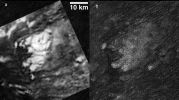
Titan-Regions-Tortula_Facula_Region-PIA13895.jpgTortula Facula (alias "Nondescript Obstacle")235 visiteCaption NASA:"These side-by-side images obtained by NASA's Cassini Spacecraft show the feature named Tortola Facula on Titan. The left image was obtained by the Visual and InfraRed Mapping Spectrometer data on Oct. 26, 2004, at a resolution of about 2 Km (1,242 mile) per pixel. This mosaic focuses on an area around 9° North Latitude and 145° West Longitude.
In 2005, scientists interpreted Tortola Facula as an ice volcano.
The right image shows the same feature, as seen by Cassini's Radar Instrument on May 12, 2008, at a much higher resolution of approx. 300 meters per pixel. Scientists now think that this feature is a "Nondescript Obstacle" surrounded by obvious wind-blown Sand Dunes, similar to those commonly found in this Region of Titan.
In radar images, objects appear bright when they are tilted toward the Spacecraft or have rough surfaces". MareKromium
|
|

Miranda-PIA00042-PCF-LXTT.jpgMiranda (Absolute Natural Colors; credits for the additional process. and color.: Dr Paolo C. Fienga - Lunexit Team)234 visitenessun commentoMareKromium
|
|

ZZ-Mercury-Craters-Unnamed_Crater_with_Hollows-PIA15069-PCF-LXTT.jpgUnnamed Crater with "Hollows" in Caloris Basin (Absolute Natural Colors; credits for the additional process. and color.: Dr Paolo C. Fienga - Lunexit Team)234 visiteThis stunning, and as of yet Unnamed, Crater lies within the Caloris Basin. Its fFoor provides another example of the beautiful "Hollows" found on Mercury and has an etched appearance similar to that found in the Crater Tyagaraja. This image was acquired as a high-resolution targeted observation. Targeted observations are images of a small area on Mercury's Surface at resolutions much higher than the 250-meter/pixel (820 feet/pixel) morphology base map or the 1-kilometer/pixel (0,6 miles/pixel) color base map. It is not possible to cover all of Mercury's Surface at this high resolution during MESSENGER's one-year mission, but several areas of high scientific interest are generally imaged in this mode each week.
Date acquired: October, 28th, 2011
Image Mission Elapsed Time (MET): 228326267
Image ID: 943690
Instrument: Narrow Angle Camera (NAC) of the Mercury Dual Imaging System (MDIS)
Center Latitude: 38,44° North
Center Longitude: 175,6° East
Resolution: 42 meters/pixel
Scale: this Unnamed Crater is approximately 38 Km (about 24 miles) across
Solar Incidence Angle: 76,1° (meaning that the Sun, at the time the picture was taken, was about 13,9° above the Local Horizon)
Emission Angle: 40,0°
Sun-Mercury-MESSENGER (or "Phase") Angle: 116,1°MareKromium
|
|

Image036-52-10075567_A.jpgBlue Flares and the Invisible Crater: Cone Crater233 visiteIn soccorso ci viene il fotogramma S70-49764 scattato il 12 Gennaio 1970 con obbiettivo 120mm - b/w - dallo stesso Apollo 14.
Mi limito a far notare come l'ombra del bordo occidentale si estenda per oltre 200 mt e, dato che sappiamo che l'ombra di quello orientale corrisponde ad un dislivello di circa 100 mt rispetto al fondo del Cone Crater, non ci vuole molto a stimare in diverse decine di metri l'altezza dell'orlo incriminato. In questo dettaglio è possibile stimare meglio le proporzioni ed i particolari del cratere: tutti elementi di cui, nelle foto panoramiche riprese "from the surface", non si trova alcuna traccia.
|
|
| 4548 immagini su 379 pagina(e) |
|
|
|
|
|
8 | |
|
|
|
|
|
|





