| Piú viste - SOLAR SYSTEM |

Dione&Tethys-PIA07630.jpgThe Eternal Companions58 visiteOriginal caption:"The moons Dione and Tethys face each other across the gulf of Saturn's Rings. Here, the Cassini spacecraft looks on the Saturn-facing Hemisphere of Tethys below and the anti-Saturn side of Dione above. The dark groove in the Rings is the Cassini Division.
This image was taken in visible light with the Cassini spacecraft narrow-angle camera on Sept. 22, 2005, at a distance of approximately 860.000 Km (about 530.000 miles) from Dione. Tethys was on the far side of the rings, 1,5 MKM (roughly 900.000 miles) from Cassini. The image scale is 5 Km (about 3 miles) per pixel on Dione and 9 Km (about 6 miles) per pixel on Tethys".
|
|
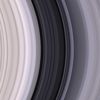
The Rings-PIA07631.jpgThe sweet colors of the Rings (approx. true colors)58 visiteOrigThe dark Cassini Division, within Saturn's Rings, contains a great deal of structure, as seen in this color image. The sharp inner boundary of the division (left of center) is the outer edge of the massive B-Ring and is maintained by the gravitational influence of the moon Mimas.
Spectroscopic observations by Cassini indicate that the Cassini Division, similar to the C-Ring, contains more contaminated ice than do the B and A-Rings on either side.
This view is centered on a region approx. 118.500 Km (about 73.600 mi) from Saturn's center. (Saturn is about 120.500 Km wide - roughly 74.900 mi - at the equator.) From left to right, the image spans approx. 11.000 Km (about 6.800 mi) across the Ring-Plane. Images taken using red, green and blue spectral filters were combined to create this view, which approximates what the human eye might see. The image was taken with the Cassini spacecraft narrow-angle camera on May 18, 2005, at a distance of approx. 1,6 MKM (about 1 MMs) from Saturn. Res. is 9 Km per px.
|
|

Japetus-N00043109.jpgGeodesic Japetus?58 visiteOriginal caption:"N00043109.jpg was taken on November 15, 2005 and received on Earth November 16, 2005. The camera was pointing toward Japetus at approximately 674.885 kilometers away, and the image was taken using the CL1 and CL2 filters. This image has not been validated or calibrated".
Nota: l'immagine, che mostra le cosiddette "star-trails" ed è quindi indice, assieme al bianco brillante della superficie illuminata di Giapeto, di una sostanziale sovraesposizione del frame, appare molto interessante soprattutto perchè ci consente di apprezzare bene la davvero particolare struttura del "disco" di Giapeto. Un disco-non disco, come aveva a suo tempo notato il Prof. Hoagland: una superficie non "smooth" (liscia) ed arrotondata, bensì squadrata, come fosse "scolpita", in qualche modo. E' evidente che la conclusione di Hoagland ("...Giapeto è una gigantesca nave spaziale...") rimane una boutade, ma l'assoluta peculiarità della forma - in termini globali - di questa luna lontana, resta un fatto.
|
|

Janus-N00047285.jpgThe "Runners": Janus and Epimetheus (3)58 visiteOriginal caption:"N00047285.jpg was taken on December 25, 2005 and received on Earth December 26, 2005. The camera was pointing toward Epimetheus (and Janus) that, at the time, was approximately 459.714 Km away. The image was taken using the CL1 and CL2 filters".
|
|

Japetus-N00049173.jpgTwo-faced Japetus58 visiteOriginal caption:"N00049173.jpg was taken on January 24, 2006 and received on Earth January 25, 2006. The camera was pointing toward Japetus that, at the time, was approximately 954.836 Km away.
The image was taken using the CL1 and CL2 filters".
|
|
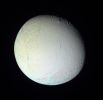
Enceladus-PIA07708.jpgEnceladus: a VERY active moon... (1)58 visiteA false color look reveals subtle details on Enceladus that are not visible in natural color views. The now-familiar bluish appearance (in false color views) of the Southern "Tiger Stripes" features and other relatively youthful fractures is almost certainly attributable to larger grain sizes of relatively pure ice, compared to most surface materials.
On the Tiger Stripes, this coarse-grained ice is seen in the colored deposits flanking the fractures as well as inside the fractures. On older fractures in other areas of Enceladus, the blue ice mostly occurs on the exposed wall scarps.
The color difference across the moon's surface (a subtle gradation from upper left to lower right) could indicate broad-scale compositional differences across the moon's surface. It is also possible that the gradation in color is due to differences in the way the brightness of Enceladus changes toward the limb, a characteristic which is highly dependent on wavelength and viewing geometry.
|
|
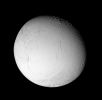
Enceladus-PIA07709.jpgEnceladus: a VERY active moon... (2)58 visiteWrinkles and cracks have reworked the surface of Enceladus, perhaps due to the influence of tidal stresses. The monochrome view also makes it clear that certain geological provinces on the moon have been altered by the activity, erasing ancient craters, while other places have retained much of the cratering record.
The terrain seen here is on the Trailing Hemisphere of Enceladus; North is up.
This image was taken using a near infrared spectral filter sensitive to wavelengths of light centered at 752 nnmts. The view was obtained using the Cassini spacecraft narrow-angle camera on Jan. 17, 2006 at a distance of approx. 153.000 Km (about 95.000 miles) from Enceladus and at a phase angle of 29°. Image scale is about 912 mt (such as approx. 2.994 feet) per pixel.
Nota: i 4 Giganti Gassosi (Giove, Saturno, Urano e Nettuno) sono mondi circondati da tante lune, alcune delle quali ancora geologicamente attive, a dispetto delle loro dimensioni e della enorme - e via-via crescente - distanza di questi Sistemi dal Sole. Pensate, p.e., ad Io ed Europa (per Giove); a Titano ed Encelado (per Saturno) ed infine ad Ariel (per Urano) e Tritone (per Nettuno). I piccoli mondi rocciosi, invece, hanno poche lune (o nessuna, come Venere e Mercurio) e queste lune NON sembrano - il dubitativo è d'obbligo - essere geologicamente attive. Il caso del Sistema Multiplo di Plutone va trattato a parte. Tutto ciò premesso, che cosa si può dedurre? Forse che la "Gioventù Geologica" di una piccolo pianeta roccioso (una "luna") dipende anche dalle caratteristiche del suo "Mondo Madre"? I 4 Giganti Gassosi emettono enormi quantitativi di radiazioni e posseggono caratteristiche tali da farli rassomigliare, ora più ed ora meno, a piccole "stelle mancate": questa circostanza potrebbe avere un peso?
|
|
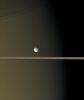
Enceladus-PIA08128.jpgIn-transit over Saturn's Terminator...58 visiteEnceladus hangs like a single bright pearl against the golden-brown canvas of Saturn and its icy Rings. Visible on Saturn is the Region where daylight gives way to dusk (--> crepuscolo). Above, the Rings throw thin shadows onto the Planet.
Images taken using red, green and blue spectral filters were combined to create this natural color view.
The images were taken using the Cassini spacecraft wide-angle camera on Jan. 17, 2006 at a distance of approx. 200.000 Km (about 100.000 miles) from Enceladus.
The image scale is approx. 10 Km (about 6 miles) per pixel.
|
|

000-vg1_p22830.jpgApproaching Saturn, from Voyager 158 visiteDifficile commentare degnamente le immagini Voyager 1 e 2 di Saturno e del suo Sistema. Quando le due Sonde Americane giunsero nello spazio di Saturno - solo per un breve passaggio, prima di dirgersi verso Urano, Nettuno ed i confini del Sistema Solare - le immagini che esse riuscirono ad ottenere affascinarono (a dir poco) il Mondo intero. I colori, ora tenui ed ora accesi, degli strati superiori dell'atmosfera Saturniana; la delicata struttura e tessitura degli Anelli, sino ad allora mai risolta da telescopi terrestri e/o da altre sonde; alcune delle lune di Saturno per la prima volta rivelarono una parte (piccola, ma significativa) dei loro segreti ai nostri Scienziati. Oggi, grazie alla Sonda Cassini-Huygens, Saturno e le sue Meraviglie sono diventati (un pò come è accaduto per la Luna e per Marte) degli elementi "quotidiani" e, quindi, meno magici e più scontati. Quasi un déjà-vu.
Noi, per restituire la giusta dignità a qualcosa che di "quotidiano" e "déjà-vu", a nostro parere, non ha proprio nulla, Vi proponiamo una piccola selezione di frames (scelti fra migliaia) che mostrano Saturno ed il Suo Sistema ora in "colori veri", ora in "colori falsi" ed ora in b/n.
Questi frames, lo ripetiamo, furono capaci - qualche annetto fa - di incantare il Mondo; noi, riproponendoli in versione originale, speriamo di ricreare la stessa magia.
Almeno per un istante.
|
|

004-vg1_3400941.jpgSaturn58 visitenessun commento
|
|

005-vg2_4362030.jpgThe atmosphere of Saturn58 visitenessun commento
|
|

010-vg2_p23919.jpgDense clouds and "tiny" cyclons...58 visitenessun commento
|
|
| 4548 immagini su 379 pagina(e) |
 |
|
|
|
|
|
|
|
|
379 |
|





