| Piú viste - SOLAR SYSTEM |

The Rings-PIA07631.jpgThe sweet colors of the Rings (approx. true colors)59 visiteOrigThe dark Cassini Division, within Saturn's Rings, contains a great deal of structure, as seen in this color image. The sharp inner boundary of the division (left of center) is the outer edge of the massive B-Ring and is maintained by the gravitational influence of the moon Mimas.
Spectroscopic observations by Cassini indicate that the Cassini Division, similar to the C-Ring, contains more contaminated ice than do the B and A-Rings on either side.
This view is centered on a region approx. 118.500 Km (about 73.600 mi) from Saturn's center. (Saturn is about 120.500 Km wide - roughly 74.900 mi - at the equator.) From left to right, the image spans approx. 11.000 Km (about 6.800 mi) across the Ring-Plane. Images taken using red, green and blue spectral filters were combined to create this view, which approximates what the human eye might see. The image was taken with the Cassini spacecraft narrow-angle camera on May 18, 2005, at a distance of approx. 1,6 MKM (about 1 MMs) from Saturn. Res. is 9 Km per px.
|
|

Japetus-N00043109.jpgGeodesic Japetus?59 visiteOriginal caption:"N00043109.jpg was taken on November 15, 2005 and received on Earth November 16, 2005. The camera was pointing toward Japetus at approximately 674.885 kilometers away, and the image was taken using the CL1 and CL2 filters. This image has not been validated or calibrated".
Nota: l'immagine, che mostra le cosiddette "star-trails" ed è quindi indice, assieme al bianco brillante della superficie illuminata di Giapeto, di una sostanziale sovraesposizione del frame, appare molto interessante soprattutto perchè ci consente di apprezzare bene la davvero particolare struttura del "disco" di Giapeto. Un disco-non disco, come aveva a suo tempo notato il Prof. Hoagland: una superficie non "smooth" (liscia) ed arrotondata, bensì squadrata, come fosse "scolpita", in qualche modo. E' evidente che la conclusione di Hoagland ("...Giapeto è una gigantesca nave spaziale...") rimane una boutade, ma l'assoluta peculiarità della forma - in termini globali - di questa luna lontana, resta un fatto.
|
|

Rhea-N00043374.jpgFeatures on the Terminator59 visiteN00043374.jpg was taken on November 26, 2005 and received on Earth November 27, 2005. The camera was pointing toward Rhea that, at the time, was approximately 70.878 Km away.
The image was taken using the CL1 and IR3 filters.
|
|

Rhea and Dione-PIA07649.jpgSpheres...59 visiteOriginal caption:"Saturn's sibling moons, Rhea and Dione, pose for the Cassini spacecraft in this view.
Even at this distance, it is easy to see that Dione (below) appears to have been geologically active in the more recent past, compared to Rhea.
Dione's smoother surface and linear depressions mark a contrast with Rhea's cratered terrain.
Sunlit terrain seen on Rhea (1.528 Km, or 949 miles across) is on the moon's Saturn-Facing Hemisphere. Lit terrain on Dione (1.126 Km, or 700 miles across) is on that moon's Leading Hemisphere. North is up.
The image was taken in visible light with the Cassini spacecraft narrow-angle camera on Nov. 1, 2005, at a distance of approx. 1,8 MKM (about 1,1 MMs) from Rhea and 1,2 MKM (approx. 800.000 miles) from Dione. The image scale is 11 Km (about 7 miles) per pixel on Rhea and 7 Km (about 4 miles) per pixel on Dione".
|
|

The Rings-Bulge-PIA07651.jpgA "bulge" in the F-Ring?!?59 visiteViewing Saturn's Rings very close to edge-on produces some puzzling effects, as these 2 images of the F-Ring demonstrate: the upper image was acquired from less than 1/10th of 1° beneath the RingPlane and shows a mysterious bulge. Such a feature has not been seen previously by the Cassini spacecraft from this angle. It is possible that, because of the very shallow viewing angle, the Cassini spacecraft's view takes a long path through the Ring, making very faint material visible. It also may be that an embedded object of about 1 Km stirs up the neighboring ring particles to create a bulge. Alternatively, an impact into an embedded moonlet that was covered with debris could produce a cloud like this. Images taken by the Voyager spacecrafts showed clumps that might have been produced in these ways. Cassini's investigations will help to determine the vertical extent of such clumps and understand their origins.
The lower image was obtained from less than a hundredth of a degree beneath the ringplane. Across the center of the rings is a dark lane, giving them an appearance not unlike that of a spiral galaxy, seen edge-on.
|
|

Saturn-PIA07656.jpgA "Dry Hurricane" on Saturn!59 visiteAn oval-shaped feature, wider than Earth and with streamers extending out to the East and West, swirls in Saturn's Southern Hemisphere.
Like the rainbands of a Southern Hemisphere hurricane on Earth, the streamers spiral into the feature in a clockwise direction.
Unlike Earth's hurricanes, this storm probably contains no liquid water.
The Planet's equatorial Rings cut across the top of the image.
The image was taken in wavelengths of polarized infrared light with the Cassini spacecraft wide-angle camera on Oct. 30, 2005, at a distance of approximately 324.000 Km (appx. 202.000 miles) from Saturn. The image scale is about 32 Km (appx. 20 miles) per pixel.
|
|

Janus-N00047285.jpgThe "Runners": Janus and Epimetheus (3)59 visiteOriginal caption:"N00047285.jpg was taken on December 25, 2005 and received on Earth December 26, 2005. The camera was pointing toward Epimetheus (and Janus) that, at the time, was approximately 459.714 Km away. The image was taken using the CL1 and CL2 filters".
|
|
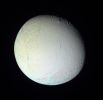
Enceladus-PIA07708.jpgEnceladus: a VERY active moon... (1)59 visiteA false color look reveals subtle details on Enceladus that are not visible in natural color views. The now-familiar bluish appearance (in false color views) of the Southern "Tiger Stripes" features and other relatively youthful fractures is almost certainly attributable to larger grain sizes of relatively pure ice, compared to most surface materials.
On the Tiger Stripes, this coarse-grained ice is seen in the colored deposits flanking the fractures as well as inside the fractures. On older fractures in other areas of Enceladus, the blue ice mostly occurs on the exposed wall scarps.
The color difference across the moon's surface (a subtle gradation from upper left to lower right) could indicate broad-scale compositional differences across the moon's surface. It is also possible that the gradation in color is due to differences in the way the brightness of Enceladus changes toward the limb, a characteristic which is highly dependent on wavelength and viewing geometry.
|
|

Enceladus-PIA08128.jpgIn-transit over Saturn's Terminator...59 visiteEnceladus hangs like a single bright pearl against the golden-brown canvas of Saturn and its icy Rings. Visible on Saturn is the Region where daylight gives way to dusk (--> crepuscolo). Above, the Rings throw thin shadows onto the Planet.
Images taken using red, green and blue spectral filters were combined to create this natural color view.
The images were taken using the Cassini spacecraft wide-angle camera on Jan. 17, 2006 at a distance of approx. 200.000 Km (about 100.000 miles) from Enceladus.
The image scale is approx. 10 Km (about 6 miles) per pixel.
|
|

Titan-PIA08157.jpgTitan & Epimetheus59 visiteCaption originale:"This poetic scene shows the giant, smog-enshrouded moon Titan behind Saturn's nearly edge-on Rings.
Much smaller Epimetheus (116 Km - or 72 miles - across) is just visible to the left of Titan (5.150 Km - or 3.200 - miles across).
The image was taken in visible light with the Cassini spacecraft narrow-angle camera on March 9, 2006, at a distance of approx. 4,1 MKM (such as about 2,5 MMs) from Titan. The image scale is 25 Km (about 16 miles) per pixel on Titan. The brightness of Epimetheus was enhanced for visibility purposes".
|
|

Titan-Dunes-IMG002116-br500.jpgThe Dunes of Titan and the Namibian Dunes59 visiteCassini radar sees sand dunes on Saturn's giant moon Titan (upper photo) that are sculpted like Namibian sand dunes on Earth (lower photo). The bright features in the upper radar photo are not clouds but topographic features among the dunes.
|
|
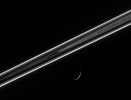
The Rings&Dione-PIA08201.jpgLike Neon-Lights...59 visiteCaption originale:"The dark side of the Ring-Plane glows with scattered light, including the luminous F-Ring, which shines like a rope of brilliant neon.
Below, Dione (1.126 Km, or 700 miles across) presents an exquisitely thin crescent.
The image was taken using a spectral filter sensitive to wavelengths of infrared light centered at 930 nanometers and it was acquired with the Cassini spacecraft narrow-angle camera on May 3, 2006 at a distance of approx. 1,8 MKM (about 1,1 MMs) from Dione and at a phase angle of 160°. Image scale is roughly 11 Km (about 7 miles) per pixel".
|
|
| 4548 immagini su 379 pagina(e) |
 |
|
|
|
|
|
|
|
377 | |
|





