| Piú viste - SOLAR SYSTEM |

Prometheus-N00021431.jpgRings and Prometheus59 visitenessun commento
|
|

Enceladus-N00030073.jpgEnceladus, from approx. 21.000 Km59 visiteUn grande cratere da impatto (in alto) il quale presenta, sul suo fondo, i segni di un evidente accumulo di materiale - polveri e macigni? - il quale, probabilmente, è franato all'interno del cratere dai suoi stessi bordi (forse a causa di movimenti sismici o, magari, a seguito di processi di gravity-wasting). Potrebbe anche trattarsi, tuttavia, di quello che residua di un "central peak" il quale, nelle ere, si è quasi completamente disintegrato, lasciando al suo posto una collina di detriti.
|
|

Epimetheus-PIA07567.jpgEpimetheus, from approx. 87.000 Km59 visiteCaption originale:"From 34° above Saturn's equatorial plane, Cassini gazed down at Saturn's moon Epimetheus. The region seen here includes territory farther North and East than that imaged in March 2005 (PIA06226).
The two largest craters visible here are the only officially named features on Epimetheus. The crater at the left (at about the 9 o'clock position) is named Pollux; the crater at lower left (containing a string of several smaller craters) is called Hilairea. Epimetheus is 116 Km (about 72 miles) across. The image was taken in visible light with the Cassini spacecraft narrow-angle camera on July 14, 2005, at a distance of approx. 87.000 Km (about 54.000 miles) from Epimetheus and at a phase angle of 95°. The image scale is 520 mt (approx. 1710 feet) per pixel".
|
|

Tethys-N00040073.jpgTethys Fly-By (6)59 visiteA poco meno di 30.000 Km di distanza da Tethys, le immagini diventano di gran lunga più dettagliate ma anche - inevitabilmente - più difficili da interpretare. La qualità di questo frame è cattiva (anche con un minimo di ingrandimento, l'immagine si sgrana), ma non ci sfugge la elevatissima albedo del fondo di alcuni crateri (fondo che sembra quasi bianco).
Questo tipo di effetto può dipendere dalla presenza di ghiaccio sul loro fondo, così come dalla particolare angolazione assunta dai raggi di un Sole comunque lontano rispetto alla superficie di Tethys ed all'angolo visuale di Cassini.
Last but not least: processi di vetrificazione.
|
|

Tethys-W00010668.jpgCrescent Tethys and the Rings59 visiteUn bellissimo frame: poco da dire al riguardo se non che l'immagine è stata ottenuta alla fine del Fly-By dell'ultimo week-end di Settembre 2005, quando Cassini si era allontanata da Tethys ormai di oltre 45.000 Km...
|
|

Hyperion-N00040280.jpgHyperion (8)59 visiteLa distanza si accorcia, anche se non di molto: siamo a circa 31.000 Km da Hyperion. Non molto da dire per quanto attiene questo frame il quale è molto simile al precedente.
|
|

Epimetheus-PIA07596.jpgEpimetheus in the darkness...59 visiteOriginal caption:"Small, multi-faceted Epimetheus wanders into Cassini's field of view, while Saturn's dark shadow cuts across the ringplane. Only a sliver of the outer A-Ring is seen here, including the narrow Keeler Gap. Epimetheus is a moon that is 116 kilometers (72 miles) across.
This view is from 10° out of the ringplane, gazing toward the lit face of the Rings.
The image was taken in visible light with the Cassini spacecraft narrow-angle camera on Aug. 31, 2005, at a distance of approximately 2,1 MKM (such as about 1,3 MMs) from Epimetheus and at a Sun-Epimetheus-spacecraft, or phase, angle of 60°. Resolution in the original image was 13 Km (about 8 miles) per pixel".
|
|

Dione-N00041243.jpgDione's Fly-By (16): from about 1.835 Km59 visitenessun commento
|
|

Tethys-N00041433.jpgCrescent Tethys59 visiteN00041433.jpg was taken on October 13, 2005 and received on Earth October 14, 2005. The camera was pointing toward TETHYS - distant approximately 644.161 Km away - and the image was taken using the P0 and GRN filters. This image has not been validated or calibrated.
|
|
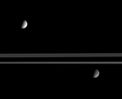
Tethys-PIA07623.jpgTethys and Dione59 visiteOriginal caption:"Saturn's expansive Rings separate the moon's Tethys (at the top) from Dione (at the bottom). Even in this distant view, it is easy to see that the moons' surfaces, and likely their evolutionary paths, are very different.
Both moons are on the far side of the Rings in this scene, which shows their Saturn-facing Hemispheres (terrain centered on 0° Long.). The dark shadow across the rings is cast by Saturn's Southern Hemisphere.
Note that the diameter of Tethys is about 1.071 Km while the diameter of Dione is approx. 1.126 Km.
This image was taken in visible light with the Cassini spacecraft narrow-angle camera on Sept. 12, 2005, at a distance of approx. 2,4 MKM (such as about 1,5 MMs) from Saturn. The image scale is about 17 Km (about 11 miles) per pixel on the two moons".
|
|

Mimas-N00042871.jpgMimas and Titan59 visiteOriginal caption:"N00042871.jpg was taken on November 11, 2005 and received on Earth November 11, 2005. The camera was pointing toward Mimas (and Titan) at approximately 3.224.642 Km away, and the image was taken using the CL1 and CL2 filters".
|
|

Dione&Tethys-PIA07630.jpgThe Eternal Companions59 visiteOriginal caption:"The moons Dione and Tethys face each other across the gulf of Saturn's Rings. Here, the Cassini spacecraft looks on the Saturn-facing Hemisphere of Tethys below and the anti-Saturn side of Dione above. The dark groove in the Rings is the Cassini Division.
This image was taken in visible light with the Cassini spacecraft narrow-angle camera on Sept. 22, 2005, at a distance of approximately 860.000 Km (about 530.000 miles) from Dione. Tethys was on the far side of the rings, 1,5 MKM (roughly 900.000 miles) from Cassini. The image scale is 5 Km (about 3 miles) per pixel on Dione and 9 Km (about 6 miles) per pixel on Tethys".
|
|
| 4548 immagini su 379 pagina(e) |
 |
|
|
|
|
|
|
376 | |
|
|





