| Piú viste - SOLAR SYSTEM |

Tethys-N00090942.jpgTethys (natural colors; elab. Lunexit)60 visiteCaption NASA:"N00090942.jpg was taken on August 29, 2007 and received on Earth August 30, 2007.
The camera was pointing toward TETHYS that, at the time, was approx. 50.411 Km away, and the image was taken using the CL1 and CL2 filters. This image has not been validated or calibrated".MareKromium
|
|

The_Rings-PIA08389_fig1.jpgThe Rings60 visiteA scan across Saturn's incredible halo of ice rings yields a study in precision and order. This natural color mosaic was acquired by the Cassini spacecraft as it soared 39 degrees above the unilluminated side of the Rings.
Major named gaps are labeled at the top. The main rings themselves, along with the F-Ring, are labeled at the bottom, along with their inner and outer boundaries.
The view combines 45 images -- 15 separate sets of red, green and blue images -- taken over the course of about 2,5 hours, as Cassini scanned across the Rings.
The images in this view were obtained on May 9, 2007, at a distance of approx. 1,1 MKM (about 700,000 miles) from Saturn. Image scale in the radial (horizontal) direction is about 6 Km (approx. 4 miles) per pixel.MareKromium
|
|
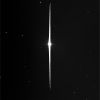
Enceladus-W00048456.jpgJust like a "Star"!60 visiteUno strabiliante "effetto goccia" (da over-saturation) per l'oggetto celeste la cui albedo è la più alta nell'intero Sistema Solare: Encelado, la "Luna di Neve".
Caption NASA:"W00048456.jpg was taken on August 11, 2008 and received on Earth August 11, 2008. The camera was pointing toward ENCELADUS that, at the time, was approx. 444.673 Km away.
The image was taken using the CL1 and CL2 filters and it has not been validated or calibrated".MareKromium
|
|

ZZ-Mercury-Limb-PIA10359.jpgCaloris Basin (natural colors; credits: Lunexit)60 visiteThis natural-color image of Mercury shows the great Caloris Impact Basin (see also PIA10383), visible in this image as a large, circular feature in the center of the picture. The contrast between the colors of the Caloris Basin Floor and those of the surrounding plains indicate that the composition of Mercury's surface is variable. Many additional geological features with intriguing color signatures can be identified in this image. For example, the bright spots just inside the rim of Caloris Basin are thought to mark the location of Volcanic Features, such as the volcano shown in this previously released Narrow Angle Camera (NAC) image PIA10942.
MESSENGER Science Team members are studying these regional color variations in detail, to determine the different mineral compositions of Mercury's surface and to understand the geologic processes that have acted on it. (...)
Date Acquired: January 14, 2008
Image Mission Elapsed Times (MET): 108827278-108827328
Instrument: Wide Angle Camera (WAC) of the Mercury Dual Imaging System (MDIS)
Resolution: about 2,3 Km (approx. 1,4 miles/pixel)
Scale: Caloris Basin is about 1550 Km in diameter (approx. 960 miles)
Spacecraft Altitude: approx. 13.000 Km (about 8000 miles)MareKromium
|
|

ZZ-Mercury-Craters-Kertész_Crater-PIA10933.jpgKertész Crater (Saturated Natural Colors; credits for the additional process. and color.: Dr Paolo C. Fienga/Lunar Explorer Italia/Italian Planetary Foundation)60 visiteLocated in the Western Edge of Mercury's giant Caloris Basin, Kertész Crater (recently named for André Kertész, a Hungarian-born American photographer) has some unusual, bright material located on its floor. Sander crater, located in the North-Western Edge of Caloris Basin, also shows bright material on its floor.
The MESSENGER Science Team is investigating the nature and composition of these bright materials and making comparisons between these two craters both located at the edges of Caloris Basin.
Just North-East of Kertész, a small crater has very bright rays and ejecta in this image, indicating that the crater is young.
Date Acquired: January 14, 2008
Image Mission Elapsed Time (MET): 108826812
Instrument: Narrow Angle Camera (NAC) of the Mercury Dual Imaging System (MDIS)
Resolution: 260 meters/pixel (0,16 miles/pixel
Scale: Kertész Crater is about 34 Km (approx. 21 miles) in diameter
Spacecraft Altitude: about 10.200 Km (approx. 6.340 miles)MareKromium
|
|

Anthe-PIA11101.jpgThe "Anthe Arc"60 visiteCaption NASA:"Cassini images reveal the existence of a faint "Arc of material" orbiting with Saturn's small moon Anthe.
The moon is moving downward and to the right in this perspective. In this image, most of the visible material in the Arc lies ahead of Anthe (2 Km, or a little more than 1 mile across) in its orbit. However, over time the moon drifts slowly back and forth with respect to the Arc.
The Arc extends over about 20° in Longitude (about 5,5% of Anthe's orbit) and appears to be associated with a gravitational resonance caused by the moon Mimas). Micrometeoroid impacts on Anthe are the likely source of the Arc material.
The orbit of Anthe lies between the larger moons Mimas and Enceladus. Anthe shares this region with two other small moons, Pallene (4 Km, or about 3 miles across) and Methone (3 Km, or approx. 2 miles across).
Methone also possesses an Arc (see PIA11102), while Pallene is known to orbit within a faint, complete ring of its own (see PIA08328).
Cassini imaging scientists believe the process that maintains the Anthe and Methone Arcs is similar to that which maintains the Arc in the G-Ring (see PIA08327). The general brightness of the image (along with the faint horizontal banding pattern) results from the long exposure time of 32" required to capture the extremely faint ring arc and the processing needed to enhance its visibility (which also enhances the digital background noise in the image). The image was digitally processed to remove most of the background noise. The long exposure also produced star trails in the background.
This view looks toward the un-illuminated side of the Rings from about 3° above the Ring-Plane.
The image was taken in visible light with the Cassini spacecraft narrow-angle camera on July 3, 2008. The view was obtained at a distance of approx. 1,2 MKM (such as about 739.000 miles) from Anthe and at a Sun-Anthe-Spacecraft, or Phase, Angle of 12°. Image scale is roughly 7 Km (about 4 miles) per pixel".MareKromium
|
|

Titan-Clouds-Noctilucent_Clouds-GIFMovie-N00023443-N00023924.gifNoctilucent Clouds over Titan (GIF-Movie; credits: Dr G. Barca)60 visiteSu Titano è notte, ma come queste immagini (ottimamente montate a formare un GIF-Movie dal nostro Dr Gianluigi Barca) dimostrano piuttosto chiaramente, delle grandi e vaporose formazioni nuvolose passano attraverso gli occhi elettronici di Cassini e si rendono palesi.
Magia delle riprese IR?
No, perchè queste immagini sono state ottenute nello Spettro della Luce Visibile.
E allora, come spiegare la (ripetiamo: EVIDENTE) luminosità delle nuvole di Titano?
Beh, esistono almeno tre modi per provare a spiegare (sensatamente) questo intrigante ed affascinante fenomeno, ma la soluzione (puramente ed assolutamente teorica e speculativa, lo sappiamo) che ci piace privilegiare la potete trovare descritta nell'articolo "Oltre la Nebbia", pubblicato sul nostro Blog "True Planets"...MareKromium
|
|

ZZ-Mercury-Limb-PIA12046.jpgMercurian Limb and Navoi Crater (Natural Colors; credits: Lunar Explorer Italia)60 visiteAt the center of this NAC image is the crater Navoi, named in November 2008 for the Uzbek poet Alisher Navoi (1441/1501 - see also PIA11762).
Located in the far north of Mercury’s Northern Hemisphere, Navoi can be seen clearly as a bright orange feature near the top of a previously released enhanced-color Wide Angle Camera (WAC) image of the Caloris Basin (part of which is shown in this release) (see PIA10359). As seen in that color WAC image, Navoi contains uncommon reddish material that indicates a different rock composition from its surroundings. In the high-resolution NAC image shown here, Navoi also appears to have an irregularly shaped depression in its center. Such depressions have been seen elsewhere on Mercury, including within Praxiteles Crater (see PIA12040), and may indicate past volcanic activity.
Date Acquired: January 14, 2008
Image Mission Elapsed Time (MET): 108828804
Instrument: Narrow Angle Camera (NAC) of the Mercury Dual Imaging System (MDIS)
Resolution: 550 meters/pixel (0,34 miles)
Scale: Navoi is about 66 Km (approx. 41 miles) in diameter
Spacecraft Altitude: approx. 21.700 Km (about 13.500 miles)MareKromium
|
|

Prometheus-4220346220_c47de906a1_o.jpgPrometheus adrift... (possible True Colors; credits: Dr M. Faccin - Lunexit Team)60 visitenessun commentoMareKromium
|
|

The Rings from approx. 121.000 Km.jpgThe Rings from app.x 121.000 Km59 visitenessun commento
|
|

The Rings from 6.278.000 Km.jpgThe Rings from app.x 6.278.000 Km59 visitenessun commento
|
|

Neptune-PIA02245.jpgNeptune from 16.000.000 Km59 visiteCaption NASA originale:"This color image, produced from a distance of about 16 MKM, shows several complex and puzzling atmospheric features. The Great Dark Spot (GDS) seen at the center is about 13.000 Km by 6.600 km in size - as large along its longer dimension as the Earth. The bright, wispy "cirrus-type" clouds seen hovering in the vicinity of the GDS are higher in altitude than the dark material of unknown origin which defines its boundaries".
|
|
| 4548 immagini su 379 pagina(e) |
 |
|
|
|
|
|
375 | |
|
|
|





