| Piú viste - SOLAR SYSTEM |

Titan-PIA08126.jpgShining through the Rings...60 visiteCaption originale:"Titan's smoggy atmosphere glows brilliantly in scattered Sunlight, creating a thin, gleaming crescent beyond Saturn's Rings. At this slight angle above the Ring-Plane, the thin F-Ring shines brightly. Light from Titan's eastern and western limbs (edges) penetrates the Cassini Division, which looks like a thin gap from this angle.
The image was taken in visible light with the Cassini spacecraft narrow-angle camera on Jan. 18, 2006, at a distance of approx. 1 MKM (such as about 600.000 miles) from Saturn. Planet-sized Titan (5.150 Km, or 3,200 miles across) was 2,2 MKM (about 1,4 MMs) from Cassini at that time. The image scale is 13 Km (8 miles) per pixel on Titan".
Nota: crediamo che sia la prima volta in cui la NASA, nel fornire i dati contingenti sul frame (ivi, in particolare, la distanza Sonda-Oggetto Ripreso), aggiunge la precisazione "...at that time...".
Ci teniamo a sottolineare che questo tipo di precisazione (a nostro parere fondamentale per far capire a tutti i Lettori - e soprattutto ai più giovani - che la "staticità" non appartiene al Cosmo) l'abbiamo introdotta noi, come Lun-Ex-It, in sede di integrazione dei dettati (captions) originali dei frames relativi a Saturno ed al suo Sistema.
|
|

Mimas-PIA08135.jpgOverlapping Planets60 visiteCaption originale:"Mimas briefly slipped in front of Tethys while the Cassini spacecraft looked on and captured the event in this series of images.
The images were taken in visible light with the Cassini spacecraft narrow-angle camera on Feb. 11, 2006, at a distance of approx. 3,7 MKM (such as about 2,3 MMs) from Mimas and 4,1 MKM (such as about 2,5 MMs) from Tethys. Resolution in the original images was approx. 22 Km (about 14 miles) per pixel on Mimas and approx. 25 Km (about 16 miles) per pixel on Tethys.
The images have been magnified by a factor of two".
|
|

C-Mercury-HR-PIA02416.jpgA slice" of Mercury... (HR)60 visiteCaption NASA originale:"A limping Mariner 10 spacecraft was coaxed into a third and final encounter with Mercury in March of 1975. Due to several problems with the aging spacecraft, only ~450 useful images of the planet were acquired, though many are at significantly higher resolution than previous encounters. This is one of the highest resolution images of Mercury acquired by Mariner 10: Frame 528922, ~90 m/pixel.
The vertical (tall narrow) format of the third encounter images resulted from problems with the tape recorder and transmitter on the spacecraft. Only the middle quarter of each frame could be sent back".
|
|

Rhea-N00055725.jpgMoments of Rhea (3)60 visitenessun commento
|
|

Japetus-N00056228.jpgA little slice of light...60 visiteCaption originale:"N00056228.jpg was taken on April 01, 2006 and received on Earth April 02, 2006. The camera was pointing toward Iapetus that, at the time, was approximately 1.867.469 Km away, and the image was taken using the CL1 and IR1 filters".
|
|

Enceladus&Dione-PIA08150.jpgCrowded Saturnian Skies...60 visiteAs our robotic emissary to Saturn, the Cassini spacecraft is privileged to behold such fantastic sights as this pairing of two moons beyond the Rings. The bright, narrow F-Ring is the outermost ring structure seen here.
In this scene, bright Enceladus begins to slip in front of more distant Dione. Enceladus is closer to Saturn than Dione, and orbits the planet at greater velocity. Thus, the smaller moon eventually passed the larger one, as seen from the Cassini spacecraft, and continued on its way.
The image was taken with the Cassini spacecraft narrow-angle camera on March 3, 2006, using a filter sensitive to wavelengths of ultraviolet light centered at 338 nnmts and at a distance of approx. 2,6 MKM (about 1,6 MMs) from Enceladus and 2,7 MKM (such as about 1,7 MMs) from Dione. The view was taken from a phase angle (Sun-moon-spacecraft angle) of 139°; about the same angle with respect to both moons. Image scale is about 16 Km (roughly 10 miles) per pixel on Enceladus and Dione.
|
|

The Rings-PIA08036~0.jpgThe Rings, 26 Taurus and reddish Hydrogen60 visiteThis image is a false-color ultraviolet view of Saturn's B-Ring (center) and A-Ring (right), separated by a large gap known as the Cassini Division.
It shows a bright horizontal streak, created by a series of time lapse images involving a star named 26 Taurus.
The image was made over a 9-hour period as the star drifted behind the Rings. The opacity of the outer A-Ring is most pronounced on its inner edge, indicating more ring debris is present there. The Encke Gap, much smaller than the Cassini Division, is visible near the outer edge of the A-Ring. The B-Ring is significantly more opaque than the A-Ring, indicating a greater density of ring material when imaged from above.
The sky behind the Rings glows red in the ultraviolet wavelengths from the hydrogen gas that fills the Solar System.
The images were processed from data taken by the ultraviolet imaging spectrograph aboard the Cassini spacecraft in May 2005.
|
|

Dione&Janus-PIA08158.jpgSaturn, Dione and Janus60 visiteCaption originale:"The Cassini spacecraft looks toward the Saturnian horizon as Dione and Janus glide past.
A few craters are visible on Dione, while Janus is slightly blurred due to its motion during the exposure. The Rings appear essentially edge-on in this view, as the Cassini spacecraft continues its recent activities close to the Ring-Plane.
The image was taken with the Cassini spacecraft narrow-angle camera on March 10, 2006, using a filter sensitive to wavelengths of infrared light centered at 750 nnmts. The image was acquired at a distance of approx. 2,9 MKM (about 1,8 MMs) from Saturn.
The image scale is approx. 17 Km (roughly 11 miles) per pixel".
|
|

Epimetheus-PIA08178.jpgThe "Runners"...again!60 visiteJanus and Epimetheus continue to separate, following their orbital swap in January 2006. Until 2010, Janus will remain the innermost of the pair, whose orbits around Saturn are separated by only about 50 Km (such as approx. 31 miles) on average.
Epimetheus appears just right of the bright A-Ring ansa, or edge, while Janus is seen near the upper right. The faint F-Ring extends across the image and Janus appears directly between its near and far edges.
The image was taken in visible light with the Cassini spacecraft narrow-angle camera on April 16, 2006, at a distance of approx. 3,7 MKM (such as about 2,3 MMs) from Saturn. The image scale is approx. 22 Km (about 14 miles) per pixel on both Janus and Epimetheus.
|
|

Rhea-N00061849.jpgCrescent Rhea (1)60 visiteCaption NASA originale:"N00061849.jpg was taken on May 22, 2006 and received on Earth May 23, 2006. The camera was pointing toward Rhea that, at the time, was approximately 265.985 Km away.
The image was taken using the CL1 and UV3 filters".
|
|

Pan-PIA08230.jpgInside "Encke"...60 visiteCaption NASA originale:"Hiding within the Encke Gap is the small moon Pan, partly in shadow and party cut off by the outer A-Ring in this view. Similar to Atlas, Pan appears to have a slight ridge around its middle; and like Atlas, Pan's orbit also coincides with a faint ringlet. Pan is 26 Km(about 16 miles) across.
The image was taken in visible light with the Cassini spacecraft narrow-angle camera on June 30, 2006 at a distance of approximately 269.000 Km (such as about 167.000 miles) from Pan. Image scale is roughly 2 Km(approx. 5.259 feet) per pixel".
|
|
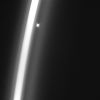
The Rings-N00065684.jpgShining through the Rings... (1)60 visiteUn Sole - il nostro Sole - splende nello Spazio di Saturno e, fra pochi istanti, si immergerà negli Anelli.
Due sugestive immagini CASSINI che riprendono un Sole piccolo e lontano, ma comunque luminoso...
|
|
| 4548 immagini su 379 pagina(e) |
 |
|
|
|
|
373 | |
|
|
|
|





