| Piú viste - SOLAR SYSTEM |

Mimas-W00011156.jpgMimas in the night60 visiteOriginal caption:"W00011156.jpg was taken on October 13, 2005 and received on Earth October 14, 2005. The camera was pointing toward MIMAS - at approximately 710.418 Km away - and the image was taken using the CB2 and IRP90 filters. This image has not been validated or calibrated".
|
|

Prometheus-N00041980.jpg"Family Group": Prometheus, Dione and Titan60 visiteOriginal caption:"N00041980.jpg was taken on October 17, 2005 and received on Earth October 18, 2005. The camera was pointing toward PROMETHEUS - approximately 2.358.256 Km away - and the image was taken using the CL1 and CL2 filters. This image has not been validated or calibrated".
|
|

Europa-PIA00723.jpgBeautiful Europa...60 visiteThis global view of Europa shows the location of a four-frame mosaic of images taken by NASA's Galileo spacecraft, set into low-resolution data obtained by the Voyager spacecraft in 1979. Putting new data into its surrounding context is a technique that allows scientists to better understand features observed on planetary surfaces. The Galileo spacecraft obtained these images during its first orbit of Jupiter at a distance of about 156.000 km (such approx. 96.300 miles) on June 27, 1996. The finest details that can discerned in this picture are about 1,6 Km (1 mile) across. North is to the top.
|
|

Europa-mosaic-PIA01407.jpgDifferent surface features of Europa60 visite1. Triple bands and dark spots were the focus of some images from Galileo's eleventh orbit of Jupiter. Triple bands are multiple ridges with dark deposits along the outer margins. Some extend for thousands of kilometers across Europa's icy surface. They are cracks in the ice sheet and indicate the great stresses imposed on Europa by tides raised by Jupiter, as well as Europa's neighboring moons, Ganymede and Io. The dark spots or "lenticulae" are spots of localized disruption.
2. The Conamara Chaos region reveals icy plates which have broken up, moved, and rafted into new positions. This terrain suggests that liquid water or ductile ice was present near the surface. On Galileo's twelfth orbit of Jupiter, sections of this region with resolutions as high as 10 meters per picture element will be obtained.
3. Mannann'an Crater is a feature newly discovered by Galileo in June 1996. Color and high resolution images (to 40 meters per picture element) from Galileo's fourteenth orbit of Jupiter will offer a close look at the crater and help characterize how impacts affect the icy surface of this moon.
4. Cilix, a large mound about 1.5 kilometers high, is the center of Europa's coordinate system. Its concave top and what may be flow like features to the southwest of the mound are especially intriguing. The origin of this feature is unknown at present. Color, stereo, and high resolution images (to 65 meters per picture element) from Galileo's fifteenth orbit of Jupiter will offer new insights and resolve questions about its origin.
5. Images of Agenor Linea (white arrow) and Thrace Macula (black arrow) with resolutions as high as 30 meters per picture element will be obtained during Galileo's sixteenth orbit of Jupiter. Agenor is an unusually bright lineament on Europa. Is the brightness due to new ice, and if so, does it represent recent activity? Could the dark region of Thrace Macula be a flow from ice volcanism?
6. Images of Europa's south polar terrain obtained during Galileo's seventeenth orbit of Jupiter will offer insights into the processes which are active in this region. Is the ice crust thicker near Europa's poles than near the equator? The prominent dark line running from upper left to lower right through the center of this image is Astypalaea Linea. It is a fault about the length of the San Andreas fault in California and is the largest such fault known on Europa. Images with resolutions of 48 meters per picture element will be obtained to examine its geologic structure.
7. This long lineament, Rhadamanthys Linea. is spotted with dark "freckles". Are these freckle features formed by icy volcanism? Is this an early form of a triple band? Stereo and high resolution (to 46 meters per picture element) obtained during Galileo's eighteenth orbit of Jupiter may indicate whether the lineament is the result of volcanic processes or is formed by other surface processes.
8. During Galileo's nineteenth orbit of Jupiter, images of Europa will be taken with very low sun illuminations, similar to taking a picture at sunset or sunrise. The object will be to search for backlit plumes issuing from icy volcanic vents. Such plumes would be direct evidence of a liquid ocean beneath the ice. Resolutions will be as high as 40 meters per picture element. This picture was simulated image from Galileo data obtained during the spacecraft's second orbit of Jupiter in September 1996.
North is to the top of the pictures. During orbit 13, the Galileo spacecraft was behind the sun from our vantage point on Earth so it did not obtain or transmit data from that orbit. The left two images in the bottom row were obtained by NASA's Voyager 2 spacecraft in 1979; the remaining images were obtained by the Solid State Imaging (SSI) system on NASA's Galileo spacecraft in 1996.
|
|
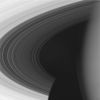
The Rings-PIA07613.jpgThe C-Ring60 visiteOriginal caption:"The Cassini spacecraft looks close at Saturn to frame a view encompassing the entire C-Ring. In the dark region closer to the planet lies the much dimmer D-Ring. The bright B-Ring wraps around the left side of the scene, while Saturn's shadow darkens the Rings at bottom. For reference, Saturn’s Ring sequence from its surface outwards is "D", "C", "B", "A", "F", "G" then "E".
The image was taken in visible light with the Cassini spacecraft wide-angle camera on Sept. 4, 2005, at a distance of approx. 627.000 Km (390.000 miles) from Saturn. The image scale is 34 Km (about 21 miles) per pixel".
|
|
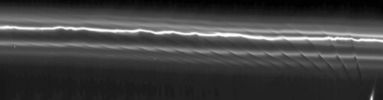
The Rings-PIA07750.jpgSurfing the waves of the F-Ring (from 1,1 MKM)60 visiteOriginal caption:"This mosaic of 15 Cassini images of Saturn's F-Ring shows how the moon Prometheus creates a gore in the Ring once every 14 h and 42', as it approaches and recedes from the F-Ring on its eccentric orbit. The individual images have been processed to make the Ring appear as if it has been straightened, making it easier to see the Ring's structure. The mosaic shows a Region 147.000 Km (about 91.000 miles) along the Ring (horizontal direction in the image); this represents about 60° of Longitude around the Ring. The Region seen here is about 1500 Km (900 miles) across (vertical direction). The first and last images in the mosaic were taken approximately 2,5 hours apart.
Each dark channel, or "gore," is clearly visible across more than 1,000 kilometers (600 miles) of the ring and is due to the gravitational effect of Prometheus (102 kilometers, or 63 miles across), even though the moon does not enter the F ring. The channels have different tilts because the ring particles closer to Prometheus (overexposed, stretched, and just visible at the bottom right of the image) move slower with respect to the moon than those farther away. This causes the channels to shear with time, their slopes becoming greater, and gives the overall visual impression of drapes of ring material. The channels at the right are the youngest and have near-vertical slopes, while those at the left are the oldest and have near-horizontal slopes. This phenomenon has not previously been detected in any other planetary ring system, but computer simulations of the system prove that the disturbance is caused by a simple gravitational interaction. The eccentric orbit of Prometheus is gradually moving so that the moon will eventually come even closer in its closest approach to the eccentric F ring. Scientists calculate that its perturbations of the F ring will reach a maximum in December 2009".
|
|
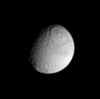
Tethys-PIA07622.jpgOdysseus and Melanthius60 visiteOriginal caption:"Cassini offers up this nice view of the craters Odysseus (at the top) and Melanthius (at the bottom) on Saturn's moon Tethys. Melanthius appears to have an elongated mountain range, rather than a single central peak, at its center.
This is the trailing hemisphere of Tethys, being centered on terrain at roughly 270° Longitude. North on Tethys is up.
This image was taken with the Cassini spacecraft narrow-angle camera on Sept. 20, 2005, through a filter sensitive to wavelengths of ultraviolet light centered at 338 nanometers. This view was obtained at a distance of approx. 1,4 MKM (about 900.000 miles) from Tethys and at a phase angle of 50°. Resolution in the original image was 8 Km (about 5 miles) per pixel. The image has been magnified by a factor of 2 to aid visibility".
|
|

Dione-N00042630.jpgDione behind the Rings60 visiteOriginal caption:"N00042630.jpg was taken on November 03, 2005 and received on Earth November 05, 2005. The camera was pointing toward DIONE at approximately 2.460.100 Km away, and the image was taken using the P120 and UV3 filters. This image has not been validated or calibrated".
|
|

Japetus-N00043118.jpgJapetus' "smile"...60 visiteOriginal caption:"N00043118.jpg was taken on November 16, 2005 and received on Earth November 17, 2005. The camera was pointing toward IAPETUS at approximately 806.360 kilometers away, and the image was taken using the CL1 and IR1 filters".
|
|

Rhea-N00043262~0.jpgApproaching Rhea (1)60 visiteN00043262.jpg was taken on November 26, 2005 and received on Earth on the same date. The camera was pointing toward Rhea from a distance of about 291.020 Km. The image was taken using the UV2 and CL2 filters.
|
|

Epimetheus&Janus-N00043535.jpgJanus and Epimetheus (2)60 visiteN00043535.jpg was taken on November 29, 2005 and received on Earth November 29, 2005. The camera was pointing toward Epimetheus that, at the time, was approximately 1.103.937 Km away, and the image was taken using the CL1 and CL2 filters.
|
|

Saturn-N00044405.jpgPhotographic Defect, Photo-Artifact or UFO in-transit? (3)60 visitevedi il commento al frame precedente
|
|
| 4548 immagini su 379 pagina(e) |
 |
|
|
|
|
371 | |
|
|
|
|





