| Piú viste - SOLAR SYSTEM |

Titan-Huygens_Landing_Site-13-PIA07871.jpgHuygens Landing Site60 visiteCaption NASA originale:"This mosaic from the Descent Imager/Spectral Radiometer camera on the European Space Agency's Huygens probe combines 17 image triplets, projected from an altitude of 800 mt (approx. 2.625 feet).
The area covered is approximately 1,3 Km across (North at the top of the image). The smallest visible objects visible are less than 5 mt across and the dark channels are 30 to 40 meters (approx. 98 to 131 feet) wide.
The images were then stitched together using one of several projection algorithms (in this case 'gnomonic') to produce a full mosaic. The images used to construct this mosaic were taken on Jan. 14, 2005".
Commento: a nostro parere si tratta di immagini complesse (e piuttosto confuse), estremamente difficili da interpretare in maniera convincente (almeno sulla base di ricostruzioni come queste due che Vi abbiamo proposto).
|
|

Prometheus-PIA07540.jpgThe "double night" of Prometheus60 visiteCaption NASA originale:"Saturn's moon Prometheus is seen here emerging from the darkness of Saturn's shadow. This shepherd moon, like most of Saturn's moons, always keeps the same face pointing toward the Planet. An observer on the moon's Saturn-facing side would never see the Sun directly overhead at noon, for the Planet would always be in the way (creating an eclipse). Instead, the Sun would rise in the east, but as noon approached the eclipse would begin, bringing darkness a second time. Night comes twice on Prometheus.
This image was taken in visible light with the Cassini spacecraft narrow-angle camera on June 3, 2005, at a distance of approx. 2,1 MKM (such as 1,3 MMs) from Saturn. The image scale is 13 Km (such as 8 miles) per pixel".
|
|

Mimas-PIA06259.jpgMimas: surface geology through "false colors" (Herschel Crater)60 visiteHerschel Crater, a 140-Km-wide (about 88 miles) impact feature with a prominent central peak, is visible in the upper right of each image. The unusual bluer materials are seen to broadly surround Herschel Crater. However, the bluer material is not uniformly distributed in and around the Crater. Instead, it appears to be concentrated on the outside of the Crater and more to the West than to the North or South.
The origin of the color differences is not yet understood. It may represent ejecta material that was excavated from inside Mimas when the Herschel impact occurred.
The bluer color of these materials may be caused by subtle differences in the surface composition or the sizes of grains making up the icy soil.
The images were obtained when the Cassini spacecraft was above 25°South, 134° West latitude and longitude.
The Sun-Mimas-spacecraft angle was 45° and North is at the top.
|
|

Mimas-PIA06256.jpgMimas: spectacular overview60 visiteThe most detailed images ever taken of Saturn's moon Mimas show it to be one of the most heavily cratered Saturnian moons, with little (if any) evidence for internal activity. Mimas has been so heavily cratered that new impacts can only overprint or even completely obliterate other older craters. Mimas is about 397 Km across.
The moon displays an unexpected array of crater shapes. The highest crater walls tower 6 Km above the floors and show signs of material sliding down slope. Indeed, many of the large craters - more than 15 Km in diameter - appear to be filled in with rough-surfaced material, likely the result of landslides triggered by subsequent impacts elsewhere on Mimas' surface. Some of these deposits have craters superimposed on them, demonstrating that the landslides themselves may be quite old.
Grooves, some of which are over a Km deep, cut across the surface for more than 100 Km. These are some of the only indications that there might have once been internal activity under this ancient, battered surface.
|
|

Hyperion-N00040174.jpgHyperion (2)60 visitePoco più di 123.000 Km ci separano dalla superficie di Hyperion: il rilievo maggiormente interessante sembra costituito da una sorta di cratere a forma di ellisse (irregolare) il quale presenta delle pareti frastagliate ed altissime, mentre la sua base è completamente crivellata da altri crateri di grandi, medie e piccole dimensioni. Non abbiamo immagini anaglifiche di questa luna, ma la sensazione - sebbene, per ora, meramente visuale - che, proprio nella zona centrale di questo bacino (da impatto?) ellittico, vi sia una montagna (un picco?), è decisamente forte.
I rilievi scientifici che possiamo svolgere guardando questi frames possono essere - al momento - di natura solo speculativa. Comunque ne evidenziamo uno su tutti: che l'attuale configurazione superficiale di Hyperion possa essere il risultato della sola attività (intensa e martellante, almeno in epoche passate) di bombardamento meteorico a noi, in tutta onestà, sembra un'ipotesi MOLTO azzardata.
|
|
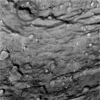
Tethys-N00040100.jpgTethys Fly-By (10)60 visiteMolto migliore, in termini di definizione e risoluzione, questo nuovo frame, ottenuto da una distanza di circa 19.800 Km dalla superficie di Tethys. I Rilievi che ci mostra (ed in particolare ci riferiamo ad una stranissima catena montuosa visibile sul suo margine superiore) sono affascinanti e piuttosto inquietanti. L'impressione che ricaviamo dal rilievo al quale si faceva cenno, infatti, è quella di una montagna la cui sommità - nella cerchiatura grigia - è non solo piuttosto "sottile", ma anche "fortemente inclinata" rispetto al piano dell'orizzonte sul quale poggia ed al quale accede (notare l'ombra che viene proiettata sul suolo).
|
|

Hyperion-N00040374.jpgHyperion (22)60 visiteCassini è a soli 4800 Km - circa - da Hyperion: anche questo frame è davvero di grandissimo fascino e di imparagonabile attrattiva (sebbene, come avremo modo di vedere e parlarne - grazie all'aiuto del Dr Feltri - in Reserved Area, siamo a "rischio" di falso "planetario"...)
|
|

Hyperion-N00040382.jpgHyperion (23)60 visiteSono solo 2555 i Km che dividono Cassini da questa zona di Hyperion la quale sembra stendersi fra un rilievo montuoso a Nord, due grandi crateri (da impatto, probabilmente) ad Est e, a Sud, un'area che sembra essere ricoperta da abbondantissimi depositi di questo materiale di colore scuro.
E' un vero peccato che Cassini non riesca a scrutare proprio "dentro" al grande cratere il cui bordo copre il lato Sud del frame...
|
|
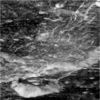
Dione-N00041227.jpgDione's Fly-By (12): from about 6.000 Km60 visitenessun commento
|
|

Dione-N00041239.jpgDione's Fly-By (14): from about 3.300 Km60 visitenessun commento
|
|

Dione-N00041245.jpgDione's Fly-By (17): from about 1.360 Km60 visitenessun commento
|
|

Dione-N00041251.jpgExtremely high "albedo" on some of Dione's surface features (2)60 visitevedi il commento svolto per il frame precedente
|
|
| 4548 immagini su 379 pagina(e) |
 |
|
|
|
|
370 | |
|
|
|
|





