| Piú viste - SOLAR SYSTEM |

Titan-PIA06125_modest.jpgTitan's fly-by "A"60 visiteCaption originale tratta dal Sito "Cassini-Huygens": "These 3 pictures were created from a sequence of images acquired by Cassini's imaging science subsystem on Oct. 25, 2004, 38 hours before its closest approach to Titan. (...) The processed images reveal sharp boundaries between dark and light regions on the surface; there are no shadows produced by topography in these images. The bright area on the center right is Xanadu, a region that has been observed previously from Earth and by Cassini. To the west of Xanadu lies an area of dark material that completely surrounds brighter features in some places. Narrow linear features, both dark and bright, can also be seen. It is not clear what geologic processes created these features, although it seems clear that the surface is being shaped by more than impact craters alone".
|
|

Titan-Close Up 3.jpgTitan's fly-by "A" - Close-up 360 visiteQualche altra immagine di Titano e delle sue dense nuvole grigio-gialle, come potete vedere nelle immagini a colori. A questo punto dobbiamo solo aspettare le immagini ancora più ravvicinate e poi vedremo cosa succederà al secondo passaggio ravvicinato (fly-by "B"), fra circa un mese e mezzo. Inutile dire che, già a questo punto, la discesa della Sonda Huygens su Titano diventa un evento di importanza storica.
|
|

The F-Ring - N00023767.jpgThe "F-Ring" of Saturn from approx. 544.000 Km60 visiteUna spettacolare ripresa (una delle tantissime, a dire il vero) del misterioso "F-Ring" di Saturno da una distanza - relativamente - breve: poco più di mezzo milione di Km. Svariati dettagli di questo enigmatico anello sono chiaramente visibili e, in particolare, potete vedere i cosiddetti "clumps", ossìa una specie di "grumi" di roccia e detriti che rendono irregolari alcune sezioni dell'anello (in particolare ce ne sono 4 assai ben visibili in basso ed alla Vostra Dx).
Sul margine superiore interno dell'Anello, alla Dx dell'Osservatore, si vede un puntino bianco che potrebbe essere (ma di questo non ne siamo certi) un altro "Ring Master" oppure, se preferite, una "Shepherd Moon". Due modi e due nomi diversi per indicare una piccolissima Luna di Saturno che, con la sua sola presenza, contribuisce a mantenere in equilibrio il sistema degli anelli - da un lato - e, talvolta, ad "incresparlo" - dall'altro.
|
|

Tethys-PIA06518_modest.jpgTethys from approx. 7.900.000 Km60 visiteCaption NASA originale: "Two large craters and hints of several smaller ones are visible in this Cassini image of Saturn's icy moon Tethys (1060 Km across).
The image was taken in visible light with the Cassini spacecraft narrow angle camera on Sept. 23, 2004, at a distance of 7.9 MKMs from Tethys and at a Sun- Tethys-spacecraft, or phase, angle of 80°. The image scale is 48 Km per pixel. The image has been contrast-enhanced and magnified by a factor of four to aid visibility".
|
|
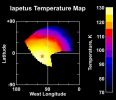
Japetus-temp.2-PIA07005_modest.jpgJapetus Temperature Map60 visiteCaption NASA originale:"Temperatures reach nearly 130 Kelvin (-226 F) at noon on the equator on the dark material that covers most of this side of Japetus, making high noon on Japetus's dark side probably the warmest place in the Saturn System. This is much warmer than temperatures on the moon Phoebe - as measured by the composite infrared spectrometer in June 2004 - which peaked near 112 Kelvin (-258 F). That's because, although Phoebe is almost as dark as Japetus's dark material and absorbs nearly as much sunlight, Phoebe rotates much more quickly (once every 9 hours, compared to 79 days for Japetus). That means the surface has less time to heat up during the day. Temperatures on Japetus' bright material are much colder, peaking near 100 Kelvin (-280 F), both because the bright material absorbs less sunlight and because it is further from the equator on this side of Japetus".
|
|
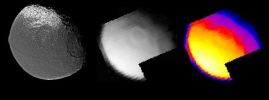
Japetus-temp.3-PIA07004_modest.jpgJapetus Thermal Radiation Image60 visiteCaption NASA originale:"This image of the infrared heat radiation from Saturn's moon Japetus was obtained by the Cassini composite infrared spectrometer instrument 16 hours before Cassini's closest approach to this mysterious moon, on December 31, 2004. The thermal radiation is shown as both a grayscale image, equivalent to what we would see if our eyes were sensitive to infrared wavelengths near 15 microns and as a color-coded temperature map. A previously-released mosaic obtained by Cassini's imaging camera shortly before the composite infrared spectrometer observation, with similar scale and orientation, is also shown for comparison. Temperatures in the large crater near the center of the disc are slightly different from those in surrounding areas, because sloping surfaces within the crater are warmer where they are tilted towards the Sun and cooler when tilted away from the Sun".
|
|

Triton-PIA02212_modest.jpgTriton from Voyager 2 (false colors?)60 visiteCaption NASA originale:"The smallest features that can be seen in this false color image of Neptune's largest satellite, Triton, are about 47 Km across. The image, taken by Voyager 2 early in the morning of Aug. 23, 1989, is a composite of three images taken through ultraviolet, green, and violet filters. The image offers an example of the kinds of puzzles scientists face on the eve of an encounter: mottling in the bright southern hemisphere may be the result of topography, if Triton's crust is predominantly water ice, which is rigid at Triton's surface temperature. Alternatively, the mottling could be due to markings on a smooth surface, if the crust is composed of nitrogen, carbon monoxide, or methane ice, since they are soft at the same temperature". Nota: in questo frame la NASA parla chiaramente di "false colors" mentre nel successivo dice "natural colors". Ora a noi i "colors" di Tritone, nei due frames, sembrano identici.
Sono dunque entrambi "natural" o "false"? Dov'è la verità?
|
|

B-Mercury-PIA02946.jpgCraters on the morning terminator...60 visiteCaption NASA originale:"As Mariner 10 passed by Mercury on its second encounter with the planet on September 21, 1974, this picture (FDS 166850) of a large circular (350 Km - or 220 mile diameter) basin was obtained near the morning terminator. The basin appears to have been flooded with the plain material and then subsequently cratered by numerous large events. Filling of the basin, presumably by lava flows analogous to those of the lunar maria, partially inundated small craters which had formed along the basin rim (lower left) and in some places overflowed the basin rim and spilled onto the surrounding terrain (top)".
|
|

B-Mercury-PIA02939.jpgDark-rimmed crater and extensive "Ejecta Blanket"60 visiteCaption NASA originale:"Mariner 10 took this picture (FDS 166840) from a distance of 63.400 Km (39.300 miles) about one hour after it passed under the South Pole of Mercury. The dark-rimmed crater at upper left is 67 Km (42 miles) in diameter. It is surrounded by an extensive ejecta blanket and exhibits a bright ray pattern, which extends into and beyond the larger crater (120 Km - or 75 miles) to its right and near the picture's center. The dark-rimmed crater is similar to crater Tycho on Earth's moon. The center of this picture is located 33° South Lat. and 158° West Long. North is to the top".
|
|

Tethys-PIA06590.jpgTethys from approx. 1,9 MKM60 visiteCaption NASA originale:"This Cassini view of Saturn's moon Tethys shows several large craters near the moon's eastern limb. These craters have fanciful names such as Phemius, Polyphemus and Ajax. The moon's massive rift-like canyon system, Ithaca Chasma, is in the darkness to the west. The image has been rotated so that north on Tethys is up and this view shows mainly the moon's trailing hemisphere. The image was taken in visible blue light with the Cassini spacecraft narrow angle camera on Jan. 19, 2005, at a distance of approximately 1,9 MKM (approx. 1,2 MMs) from Tethys and at a phase angle of 111°. Resolution in the original image was 11 Km (approx. 7 miles) per pixel. The image has been contrast-enhanced and magnified by a factor of two to aid visibility".
|
|

Tethys-PIA06632.jpgTethys (infrared vision) from approx. 1,4 MKM60 visiteCaption NASA originale:"In this infrared view, Saturn's cratered moon Tethys shows a faint, dark band across its equatorial region. North is up in this view.
The image was taken with the Cassini spacecraft narrow-angle camera on March 11, 2005, through a filter sensitive to wavelengths of infrared light centered at 930 nnmts. The view was acquired at a distance of approximately 1,4 MKM from Tethys and at a phase angle of 80°. Resolution in the original image was 8 Km per pixel.
The image has been contrast-enhanced and magnified by a factor of two to aid visibility".
|
|

Rhea-PIA06641.jpgTirawa impact basin on Rhea60 visiteCaption NASA originale:"The large Tirawa impact basin on Saturn's moon Rhea is visible at the two o'clock position in this Cassini image. This view shows principally the trailing hemisphere on Rhea and is centered on the moon's equator. North is up and tilted 25° to the left.
The image was taken with the Cassini spacecraft narrow-angle camera on March 13, 2005, through a filter sensitive to wavelengths of ultraviolet light centered at 338 nnmts.
The image was obtained at a distance of approximately 1,7 MKM(such as 1,1 MMs) from Rhea and at a phase angle of 90°. Resolution in the original image was 10 Km (approx. 6 miles) per pixel. The image has been contrast-enhanced and magnified by a factor of two to aid visibility".
|
|
| 4548 immagini su 379 pagina(e) |
 |
|
|
|
|
369 | |
|
|
|
|





