| Piú viste - SOLAR SYSTEM |

012-vg2_p23938.jpgThe "Great Red Spot" of Saturn61 visitenessun commento
|
|

Titan-Dunes-PIA08738.jpgLongitudinal Dunes?61 visiteCaption NASA originale:"This image from Cassini's radar instrument was acquired by the Cassini radar instrument in synthetic aperture mode during a Sept. 7, 2006, flyby of Titan. The image shows long, dark ridges similar to those seen in previous flybys. These are interpreted to be "Longitudinal Dunes". Dunes are mostly an equatorial phenomenon on Titan and the material forming them may be solid organic particles or ice coated with organic material. Spaced up to 3 Km(about 2 miles) apart, these dunes curve around bright features that may be high-standing topographic obstacles, in conformity with the wind patterns.
The interaction between the 2 types of features is complex and not well understood, but clearly the topography and the dunes have influenced each other in other ways as well.
This image is centered at 44° West Long., 8° North Lat. and covers approx. 160 by 325 Km (such as about 99 by 202 miles) on Titan's surface. The smallest details in this image are about 500 mt (approx. 550 yards) across".
|
|

023-vg2_4391335-3.jpgAnomalies near Japetus (Object "A" - detail super-mgnf)61 visitenessun commento
|
|

039-vg1_3493040.jpgMimas (Herschel Crater) and other controversial features61 visiteIncommentabile...
|
|

The Rings-W00017896.jpgAn enormous "clump" in Saturn's Rings? No: that's Enceladus!61 visiteCaption NASA:"W00017896.jpg was taken on September 15, 2006 and received on Earth September 17, 2006. The camera was pointing toward the Rings of Saturn that, at the time, were approximately 2.227.319 Km away.
The image was taken using the CL1 and IRP90 filters. This image has not been validated or calibrated".
Wispy fingers of bright, icy material reach tens of thousands of kilometers outward from Saturn's moon Enceladus into the E-Ring, while the moon's active South Polar jets continue to fire away. This astonishing, never-before-seen structure is made visible with the Sun almost directly behind the Saturn System from Cassini's vantage point. The phase angle here is 175°, a viewing geometry in which structures made of tiny particles brighten substantially. These features are very likely the result of particles injected into Saturn orbit by the Enceladus geysers: those injected in the direction of the moon's orbital motion end up on larger, slower orbits and trail Enceladus in its orbit, and those injected into the opposite direction end up smaller, faster orbits and lead Enceladus. (Orbital motion is counter-clockwise.) In addition, the configuration of wisps may hint at an interaction between Saturn's magnetosphere and the torrent of particles issuing from Enceladus.
In addition to the wisps, another unexpected detail is the dark gore in the center of the ring, following the moon in its orbit, likely brought about by the sweeping action of Enceladus as it orbits in the center of the E ring.
The view looks down onto Enceladus (505 kilometers, or 314 miles across) from about 15 degrees above the ringplane. Tethys (1,071 kilometers, or 665 miles across) is visible to the left of Enceladus.
The image was taken in visible light with the Cassini spacecraft wide-angle camera on Sept. 15, 2006, at a distance of approximately 2.1 million kilometers (1.3 million miles) from Enceladus. Image scale is 128 kilometers (80 miles) per pixel.
|
|
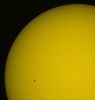
The Sun~0.jpgIn the Sun...61 visiteDa "NASA - Picture of the Day", del 21 Settembre 2006:" Though it's 93 MMs away, the Sun still hurts your eyes when you look at it.
But bright Sunlight (along with accurate planning and proper equipment!) resulted in this sharp silhouette of spaceship and space station.
The amazing telescopic view, recorded on September 17, 2006, captures Shuttle Orbiter Atlantis and the International Space Station in orbit over planet Earth.
At a range of 550 Km from the observing site near Mamers, Normandy, France, Atlantis (left) has just undocked and moved about 200 mt away from the Space Station.
Tomorrow (Sept. 22, 2006), yet another satellite of planet Earth can be seen in silhouette - the Moon will eclipse the Sun. This last eclipse of 2006 will be seen as an annular solar eclipse along a track that crosses Northern South America and the South Atlantic".
|
|

Titan-Lakes-Unnamed_North_Polar_Lakes-02-PIA01942.jpgTitanian Northern Lakes (3)61 visiteCaption NASA originale:"Using its radar system, the Cassini spacecraft has imaged new lakes on Titan.
The large dark patch seen on this image, at high latitudes surrounding Titan's North Pole, is most likely a hydrocarbon lake. Several dark channels can be seen; the longest one at the left meanders over almost 100 Km (about 62 miles), and appears to drain into the lake. Some dark channels are remarkably straight, suggesting possible faulting in the subsurface. The bright landforms jutting into the lake indicate that old, eroded landforms may have flooded.
This radar image was acquired by the Cassini radar instrument in synthetic aperture mode on Oct. 9, 2006. The image is centered near 73° North Latitude and 343° West Longitude; it measures about 300 by 140 Km (such as about 190 by 90 miles). Smallest details in this image are about 500 mt (approx. 1.640 feet) across".
|
|

The Rings-PIA08285.jpgNot the Sun, but Aldebaran!61 visitenessun commento
|
|

The Rings-PIA08287.jpgNot the Sun, but Aldebaran!61 visiteCaption NASA originale:"Cassini took a series of images on Sept. 9, 2006 as it watched the bright red giant star Aldebaran slip behind Saturn's Rings.
This type of observation is known as a "stellar occultation" and uses a star whose brightness is well known. As Cassini watches the rings pass in front, the star's light fluctuates, providing information about the concentrations of ring particles within the various radial features in the Rings.
Here, Cassini watches the star through the part of the Rings masked by Saturn's shadow. The view looks toward the sunlit side of the Rings from about 20° below the Ring-Plane. Bright Aldebaran is over exposed, creating thin vertical lines ("effetto goccia") on its image.
The image was taken in visible light with the Cassini spacecraft narrow-angle camera on Sept. 9, 2006 at a distance of approx. 351.000 Km (such as about 218.000 miles) from Saturn. Image scale on the sky at the distance of Saturn is 2 Km (a little more than 1 mile) per pixel".
|
|

The Rings-PIA08295.jpgWhat's inside the Rings?61 visiteThe 2 prominent dark gaps in Saturn's A-Ring contain small embedded moons and a host of other intriguing features. Here, 3 unique ringlets are visible in the Encke Gap (about 325 Km wide). The innermost ringlet (topmost here) is faint but continuous. The center ringlet brightens substantially toward upper left and displays a few slight kinks. This ringlet is coincident with the orbit of Pan (about 26 Km across). The outermost ringlet is discontinuous, with two bright regions visible.
The narrower Keeler Gap (about 42 Km wide) hosts the moon Daphnis (7 Km across - not visible in this image), which raises waves in the Gap edges as it orbits Saturn. At lower left, faint ringlets flanking the bright F-Ring core are visible. These features were found by the Cassini spacecraft to be arranged into a spiral arm structure that winds around the Planet like a spring. The spiral may be caused by tiny moonlets or clumps of material that have smashed through the F-Ring core and liberated material.
This view looks toward the unlit side of the rings from about 23 degrees above the ringplane.
The image was taken in visible red light with the Cassini spacecraft narrow-angle camera on Sept. 11, 2006 at a distance of approximately 1.1 million kilometers (700,000 miles) from Saturn and at a Sun-Saturn-spacecraft, or phase, angle of 151 degrees. Image scale is about 6 kilometers (4 miles) per pixel.
|
|

Titan-Clouds-PIA09036.jpgTitanian Clouds and Surface61 visiteCaption NASA originale:"This image composite contains a radar image taken during a February 2005 (T3) flyby, and overlaid are images from the Visual and Infrared Mapping Spectrometer (VIMS) taken on Sept. 7, 2006, (T17) and Oct. 25, 2006 (T20).
The thin strip is the infrared image taken on the inbound leg of the T20 flyby and crosses the radar image near an area with a small, crater-like feature. In the radar image a faint fan of material seems to originate at the crater and the portion of the infrared image that crosses the faint fan shows both a large brightness contrast and very sharp boundaries. The fan-like deposit has such sharp boundaries and strong contrast with its surroundings that it supports the idea that the deposit seen in the radar images is a flow of material erupted from the small crater. This may be the strongest evidence yet of cryovolcanism on Titan.
The infrared image was taken at a distance of about 1100 Km (680 miles) from the surface of Titan and resolves features as small as 400 mt (1300 feet)".MareKromium
|
|

Titan-Regions-Fensal_and_Aztlan_Region-PIA08352.jpgFensal and Aztlan Region61 visiteAs Cassini continues its reconnoitering flybys of Titan, the imaging science team continues to improve its ability to tease out surface details hidden in the unprocessed images. This mosaic provides the best view yet obtained by Cassini's cameras, showing terrain on the moon's sub-Saturn Hemisphere -- the side of the moon that always faces toward Saturn. This mosaic has better resolution, both in pixel scale and from improved signal-to-noise, compared to previous views of the area.
"Signal-to-noise" is a term scientists use to refer to the amount of meaningful or useful information (signal) in their data versus the amount of background noise. A higher signal-to-noise ratio yields sharper, clearer views of Titan's surface.
The view is centered on terrain in the Fensal-Aztlan region on Titan, at 0,03° South Lat. and 22,18° West Long. The mosaic covers an area 3.500 Km (2.180 miles) North to South and 3.600 Km (2.240 miles) West to East. North is up.
|
|
| 4548 immagini su 379 pagina(e) |
 |
|
|
|
|
367 | |
|
|
|
|





