| Piú viste - SOLAR SYSTEM |

Titan-PIA07700.jpgThe Atmosphere of Titan61 visiteThe view of Titan (almost natural colors) has been greatly contrast-enhanced to better show some intriguing structure in the North of the Planet; such intriguing "clouds-structure" is also clearly visible in a violet light view (PIA07701) taken at about the same time.
The color view was created by combining images taken using red, green and blue spectral filters. The images were taken with the Cassini spacecraft wide-angle camera on Dec. 26, 2005, at a distance of approx. 193.000 Km (about 120.000 miles) from Titan and at a phase angle of 29°. The image scale is about 11 Km (roughly 7 miles) per pixel.
|
|

Titan-PIA07707.jpgSmiling Titan...61 visiteThis infrared view shows features on the Leading Hemisphere of Titan, including the bright, crescent-shaped Hotei Arcus (right of center), which is also informally called "the Smile" by researchers.
The view is centered on the bright Region called Xanadu. Above center is the large crater Minerva, which is surrounded by darker material.
This image was taken with the Cassini spacecraft narrow-angle camera on Jan. 13, 2006 using a spectral filter sensitive to wavelengths of infrared light centered at 938 nnmts. The image was acquired at a distance of approx. 1,3 MKM (800.000 miles) from Titan and at a phase angle of 41°. Image scale is about 7 Km (approx. 5 miles) per pixel.
|
|

Rhea-PIA08120.jpgRhea, from 245.000 Km and in "extreme" false colors...61 visiteBright, wispy markings stretch across a region of darker terrain on Rhea. In this extreme false-color view, the roughly North-South fractures occur within strips of material (which appear greenish here) that are a different color from the surrounding cratered landscape. To create the false-color view, ultraviolet, green and infrared images were combined into a single black and white picture that isolates and maps regional color differences. Most of the large-scale variations in brightness across the surface are removed by this process. This color map was then superimposed over a clear-filter image. The origin of the color differences is not yet understood, but it may be caused by subtle differences in the surface composition or grain sizes making up the icy soil. Wispy markings were seen on the trailing Hemispheres of both Rhea and Dione, in images taken by Voyager spacecrafts, and were hypothesized by some researchers to be the result of material extruded onto the surface by ice volcanism.
|
|

Rhea-PIA08121.jpgThe incoherent surface of Rhea61 visiteThis intense false-color view highlights and enhances color variations across the cratered and cracked surface of Saturn's moon Rhea.
To create the false-color view, ultraviolet, green and infrared images were combined into a single black and white picture that isolates and maps regional color differences. This "color map" was then superposed over a clear-filter image. The origin of the color differences is not yet understood, but it may be caused by subtle differences in the surface composition or grain sizes making up the icy soil.
This view shows terrain on the trailing hemisphere of Rhea. North is up.
The images were taken using the Cassini spacecraft narrow-angle camera on Jan. 18, 2006, at a distance of approx. 268.000 Km (about 166.000 miles) from Rhea and at a Sun-Rhea-spacecraft, or phase, angle of 115°. Image scale is about 2 Km (roughly 1,2 miles) per pixel.
|
|
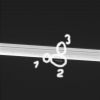
The Rings-N00051339.jpgHiding in the Rings?61 visitePortate l'immagine sino al full-size e poi verificate anche Voi:
Cerchiatura Bianca n. 1: si tratta di un clump, di un difetto dell'immagine (photoartifact) o di una shepherd moon non ancora catalogata?
Cerchiatura Bianca n. 2: evidentemente si tratta di una luna "mossa", ma quale luna di Saturno si esprime fotograficamente lasciando due strisce, per giunta disallineate?
Cerchiatura Bianca n. 3: secondo noi un'altra luna (o comunque un corpo celeste di qualche tipo) si intuisce appena, quasi del tutto eclissato dagli Anelli.
|
|

Tethys-N00051464.jpgTethys61 visitecaption originale:"N00051464.jpg was taken on February 25, 2006 and received on Earth February 26, 2006. The camera was pointing toward Tethys that, at the time, was approximately 152.812 Km away.
The image was taken using the UV1 and CL2 filters.
This image has not been validated or calibrated".
Nota: un frame davvero splendido, che ci mostra non solo la "tessitura" della superficie di Tethys (curiosamente lineare, almeno in apparenza), ma anche i dettagli di alcuni rilievi le cui immagini chiare e ravvicinate (ma davvero "chiare"!) farebbero sicuramente la felicità di tanti Studiosi di Scienze Planetarie. Ed ora guardate bene: siete certi che l'origine dei crateri che vediamo sia proprio - senza alcun dubbio - "da impatto"?...
|
|

Mimas&Saturn-PIA08122.jpgThe King and I...61 visiteA small and battered reminder of the Solar System's violent youth, the ice moon Mimas hurtles around its gas giant parent, Saturn.
With its "poor dimensions" (Mimas is only about 397 Km across), this little moon is dwarfed by the immensity of Saturn (the Ringed Gas Planet is more than 150 times as wide as Mimas).
Mimas is seen here against the night side of Saturn and Saturn itself is faintly lit by sunlight reflecting off its Rings.
The image was taken in visible light with the Cassini spacecraft narrow-angle camera on Jan. 20, 2006, at a distance of approx. 1,4 MKM (such as about 900,000 miles) from Mimas and at a Sun-Mimas-spacecraft, or phase, angle of 145°. Image scale is about 9 Km (approx. 5 miles) per pixel.
|
|

Titan-PIA08126.jpgShining through the Rings...61 visiteCaption originale:"Titan's smoggy atmosphere glows brilliantly in scattered Sunlight, creating a thin, gleaming crescent beyond Saturn's Rings. At this slight angle above the Ring-Plane, the thin F-Ring shines brightly. Light from Titan's eastern and western limbs (edges) penetrates the Cassini Division, which looks like a thin gap from this angle.
The image was taken in visible light with the Cassini spacecraft narrow-angle camera on Jan. 18, 2006, at a distance of approx. 1 MKM (such as about 600.000 miles) from Saturn. Planet-sized Titan (5.150 Km, or 3,200 miles across) was 2,2 MKM (about 1,4 MMs) from Cassini at that time. The image scale is 13 Km (8 miles) per pixel on Titan".
Nota: crediamo che sia la prima volta in cui la NASA, nel fornire i dati contingenti sul frame (ivi, in particolare, la distanza Sonda-Oggetto Ripreso), aggiunge la precisazione "...at that time...".
Ci teniamo a sottolineare che questo tipo di precisazione (a nostro parere fondamentale per far capire a tutti i Lettori - e soprattutto ai più giovani - che la "staticità" non appartiene al Cosmo) l'abbiamo introdotta noi, come Lun-Ex-It, in sede di integrazione dei dettati (captions) originali dei frames relativi a Saturno ed al suo Sistema.
|
|

Saturn-N00054985.jpgThe "Sea of Clouds" near Saturn's Terminator61 visiteCaption originale:"N00054985.jpg was taken on March 13, 2006 and received on Earth March 15, 2006. The camera was pointing toward Saturn that, at the time, was approximately 2.562.202 Km away, and the image was taken using the RED and CL2 filters. This image has not been validated or calibrated".
|
|
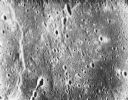
B-A-Mercury-PIA02961.jpgMercury, in HR61 visiteCaption NASA originale:"Taken only minutes after Mariner 10 made its closest approach to the planet Mercury on March 29, 1974, this is one of the highest resolution pictures obtained during the Mission. Craters as small as 150 mt (roughly 500 feet) across can be seen. The picture, taken from a distance of about 5900 Km (such as approx. 3700 miles), measures 50 by 40 Km (such as approx. 931 by 25 miles). The relativity level surface contrasts with the abundant relief seen in some close-up views on the opposite side of the planet. The long, narrow area of hills and scarps to the left resembles ridges in the mare of Earth's Moon. Abundant craters in various stages of degradation dot the surface".
|
|

C-Mercury-HR-PIA02416.jpgA slice" of Mercury... (HR)61 visiteCaption NASA originale:"A limping Mariner 10 spacecraft was coaxed into a third and final encounter with Mercury in March of 1975. Due to several problems with the aging spacecraft, only ~450 useful images of the planet were acquired, though many are at significantly higher resolution than previous encounters. This is one of the highest resolution images of Mercury acquired by Mariner 10: Frame 528922, ~90 m/pixel.
The vertical (tall narrow) format of the third encounter images resulted from problems with the tape recorder and transmitter on the spacecraft. Only the middle quarter of each frame could be sent back".
|
|

DiscoveryScarp-PIA02446.jpgThe "Discovery Scarp"61 visiteCaption NASA originale:"One of the most prominent lobate scarps (Discovery Scarp), photographed by Mariner 10 during it's first encounter with Mercury, is located at the center of this image (extending from the top to near bottom). This scarp is about 350 Km long and transects two craters 35 and 55 Km in diameter. The maximum height of the scarp south of the 55-Km crater is about 3 Km. Notice the shallow older crater (near the center of the image) perched on the crest of the scarp. (FDS 17389 and 27399)".
|
|
| 4548 immagini su 379 pagina(e) |
 |
|
|
|
|
365 | |
|
|
|
|





