| Piú viste - SOLAR SYSTEM |

Tethys-N00047239.jpgTethys' "Eye"!61 visiteOriginal caption:"N00047239.jpg was taken on December 24, 2005 and received on Earth December 25, 2005. The camera was pointing toward TETHYS that, at the time, was approximately 196.167 kilometers away, and the image was taken using the CL1 and GRN filters".
|
|

Janus-N00047441.jpgA "Hat-Trick" of Moons...61 visiteOriginal caption:"N00047441.jpg was taken on December 30, 2005 and received on Earth December 31, 2005. The camera was pointing toward JANUS that, at the time, was approximately 2.353.449 Km away and the image was taken using the CL1 and CL2 filters".
|
|

Saturn-N00047654.jpgWhite ice-clouds on Saturn's upper atmosphere (2)61 visiteOriginal caption:"N00047654.jpg was taken on January 02, 2006 and received on Earth January 03, 2006. The camera was pointing toward Saturn that, at the time, was approximately 2.732.434 Km away, and the image was taken using the CL1 and CL2 filters. This image has not been validated or calibrated".
Note: anche questa seconda immagine (molto suggestiva) ci mostra che, negli strati superiori dell'atmosfera di Saturno, sembra esserci spazio per il passaggio di nuvole bianche - presumibilmente formate da ghiaccio d'acqua - le quali, nelle loro caratteristiche esteriori, ci ricordano i cirri ed i cirro-strati che, di tanto in tanto, vediamo anche nei nostri cieli.
Se, al di sotto di queste nuvole, piova o nevichi, non ci è dato saperlo ma, a quanto sembra, questa possibilità - già verificata per le nuvole di Giove - è tutt'altro che remota.
|
|

Tethys-PIA07667.jpgTethys and Saturn, in "natural colors"61 visiteOriginal caption:"Tethys floats before the massive, golden-hued globe of Saturn in this natural color view. The thin, dark line of the Rings curves around the horizon at top.
Visible on Tethys are the huge craters Odysseus (top) and Melanthius (bottom). The view looks toward the anti-Saturn side of Tethys.
Images taken using red, green and blue spectral filters were combined to create this color view. Tethys is apparently darker than Saturn at these wavelengths. The edge of the Planet appears fuzzy, which may indicate that we are seeing haze layers that are separated from the main cloud deck.
The images were acquired by the Cassini spacecraft narrow-angle camera on Dec. 3, 2005, at a distance of approx. 2,5 MKM (about 1,6 MMs) from Saturn. The image scale is about 15 Km (app.x 9 miles) per pixel on Saturn and about 13 Km (app.x 8 miles) per pixel on Tethys".
|
|

Enygma-W00012847.jpgEnygma (1)61 visiteDallo spazio di Saturno, una sequenza di 4 frames che, se da un lato ci ricorda la procedura di allineamento e messa a fuoco delle telecamere della Sonda Cassini (frames 1 e 2), da un altro punto di vista ci richiama alla mente immagini misteriose, inesplicabili e, forse, anche un pizzico inquietanti (frames 3 e 4).
Che cosa stiamo guardando? Una stella lontana, uno delle tante Lune di Saturno o...Che cosa?
Original caption:"W00012847.jpg was taken on January 05, 2006 and received on Earth January 06, 2006. The camera was pointing toward SKY, and the image was taken using the CL1 and BL1 filters. This image has not been validated or calibrated".
|
|
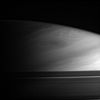
Saturn-PIA07674.jpgLooking for the "Hexagon"61 visiteOriginal caption:"As Northern Winter ends on Saturn and the Cassini spacecraft's view of the North Pole improves, the swirls and eddies visible until now only in the South are gradually coming into view in the Northern Hemisphere.
Scientists will be looking for the North Polar "Hexagon" that was seen by Voyager.
The Hexagon was a jet stream, deflected by a storm into a six-lobed pattern, that circled the Planet at 76° North Latitude.
This picture shows extensive storm activity and gives scientists hope that the Hexagon is still there. The shadows of the Rings of Saturn cut across the lower part of the image.
The image was taken in polarized infrared light with the Cassini spacecraft narrow-angle camera on Dec. 8, 2005, at a distance of app.x 3,2 MKM (about 2 MMs) from Saturn. The image scale is 37 Km (about 23 miles) per pixel".
|
|

Epimetheus-PIA07680.jpgSinking in a Sea of Darkness...61 visiteThe Cassini spacecraft captured this glimpse of icy Epimetheus just before the small moon disappeared behind the bulk of Saturn's atmosphere.
The image was taken in visible light with the Cassini spacecraft narrow-angle camera on Dec. 20, 2005, at a distance of approx. 2,3 MKM (about 1,4 MMs) from Epimetheus and 2,2 MKM (about 1,3 MMs) from Saturn. The image scale is roughly 14 Km (about 9 miles) per pixel on Epimetheus and approx. 13 Km (about 8 miles) per pixel on Saturn.
|
|

Rhea-PIA07686.jpgRhea (enhanced but real colors) from about 341.000 Km61 visiteOriginal caption:"This close view of Rhea prominently shows two large impact basins on the ancient and battered moon. The great age of these basins is suggested by the large number of smaller craters that are overprinted within them.
Terrain visible in this view is on the side of Rhea that faces away from Saturn. North on Rhea is up and tilted 30° to the left. This enhanced color view was created by combining images taken using filters sensitive to ultraviolet, visible green and infrared light.
The images were taken with the Cassini spacecraft narrow-angle camera on Dec. 23, 2005, at a distance of approximately 341.000 Km (approx. 212.000 miles) from Saturn and at a Sun-Saturn-spacecraft, or phase, angle of 42°. The image scale is approx. 2 Km (a little more than 1 mile) per pixel".
|
|

Rhea-N00049540.jpgRhea and Companions (2)61 visiteOriginal caption:"N00049540.jpg was taken on January 27, 2006 and received on Earth January 29, 2006. The camera was pointing toward Rhea that, at the time, was approximately 3.012.654 Km away, and the image was taken using the CL1 and CL2 filters".
|
|

Tethys-PIA07698.jpgSmiling Tethys...61 visiteCaption originale:"The profile of Ithaca Chasma forms a great scar in the icy crescent of Tethys. The chasm stretches more than a 1.000 Km (about 620 miles) over Tethys' surface, from North to South.
The image was taken in visible light with the Cassini spacecraft narrow-angle camera on Dec. 25, 2005 at a distance of approximately 313.000 Km (about 195.000 miles) from Tethys and at a Sun-Tethys-spacecraft, or phase, angle of 151°. Image scale is about 2 Km (approx. 1 mile) per pixel".
|
|

Titan-Full_Disk-PIA02145-1.jpgTitan: Visual + IMS (1)61 visiteThe three mosaics shown here were composed with data from Cassini's visual and infrared mapping spectrometer taken during the last 3 Titan flybys, on Oct. 28, 2005 (1), Dec. 26, 2005 (2), and Jan. 15, 2006 (3).
These false-color images were constructed from images taken at the following wavelengths: 1,6 microns (blue), 2,01 (green), and 5 microns (red).
The viewing geometry of the December flyby is roughly on Titan's opposite Hemisphere from the flybys in October and January.
There are several important features to note in the images. The first is that the South Polar cloud system was very bright during the December flyby, while during the October and January flybys, it is barely visible, indicating that the atmosphere over Titan's South Pole is very dynamic.
|
|

Titan-Map-PIA02147.jpgGlobal Titan Map (Visual + IMS)61 visiteThis global infrared map of Titan was composed with data from Cassini's visual and infrared mapping spectrometer taken during the last two Titan flybys, on Dec. 26, 2005, and Jan. 15, 2006.
There are several important features to note in this Map:
1) the globe of Titan exhibits 2 major types of terrain: one is very bright, and a darker one seems to be concentrated near the Equator;
2) Titan has two very bright Regions: the large one known as Tui Reggio, located at approx. 25° South Lat. and 130° West Long., and the other as Hotei Arcus, at 20° South Lat. and 80° West Long. These regions are thought to be surface deposits, probably of volcanic origin, and may be water and/or carbon dioxide frozen from the volcanic vapor; the western margins of Tui Reggio have a complex flow-like structure consistent with eruptive phenomena;
3) the reddish feature at the South Pole is Titan's South Polar cloud system, which was very bright during the December flyby;
4) The Sinlap Crater is clearly visible at approx. 13° North Lat. and 16° West Long. The poorly resolved Regions between Longitudes of 30° and 150° East will be filled in during subsequent flybys.
|
|
| 4548 immagini su 379 pagina(e) |
 |
|
|
|
|
364 | |
|
|
|
|





