| Piú viste - SOLAR SYSTEM |

Pseudo-UFO.gifLook: a "Pseudo-UFO"!!! (GIF-Movie - credits: Dr Gianluigi Barca)62 visiteGrazie all'ottimo Lavoro del Dr Gigi Barca, ecco che possiamo illustrarVi in maniera precisa, puntuale ed adeguata un nuovo (e triste) esempio di (dis)informazione becera e malfatta: molti Appassionati, infatti, spinti dalle solite (in un sol tempo sensazionalistiche e clamorosamente superficiali) dichiarazioni di qualche "pseudo-ricercatore", starebbero osservando lo "sbuffo" (!) lasciato da un'astronave che si allontana dall'Anello "G" di Saturno.
Ebbene NO: SBAGLIATO! A costo di risultare - purtroppo è così... - "antipatici" a molti, dobbiamo fare ancora una volta i de-bunkers. "Sbuffo" di plasma-energia (alla Star-Trek)?
No, cari Amici. Proprio no.
Si tratta del solito effetto prismatico che si produce quando la luce proveniente da un corpo molto luminoso (ivi, ipotizziamo, Rhea od Encelado - o, comunque, una luna di Saturno, e questo lo capirebbe anche uno studente di Astronomia alle primissime armi...) passa attraverso la porzione esterna delle ottiche che lo riprendono.
Osservare l'Universo è bellissimo; cercare il Mistero nell'Universo, si sa, fa parte della Natura dell'Uomo.
Così come fa pure parte della Natura Umana (per lo meno: della Natura di alcuni...) lo "sparare scemenze" senza neppure pensare un attimo a ciò che si guarda ed a ciò che si dice.
Peccato. Peccato perchè è sempre facendo così che si crea ignoranza e delusione. Certo, "smontando", "razionalizzando" e "spiegando" - come tentiamo di fare noi - non si matura molta "audience" ma, detto sinceramente, di un'audience che poggia sul "niente", in fondo, a noi non importa nulla.
Un grande complimento al Dr Barca per l'ennesimo OTTIMO Lavoro!
MareKromium
|
|
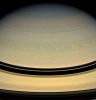
Saturn-PIA09910.jpgThe "Head" of Saturn (Natural Colors; credits: NASA/Space Science Institute)62 visiteCaption NASA:"Bright puffs and ribbons of cloud drift lazily through Saturn's murky skies. In contrast to the bold red, orange and white clouds of Jupiter, Saturn's clouds are overlain by a thick layer of haze. The visible cloud tops on Saturn are deeper in its atmosphere due to the Planet's cooler temperatures.
This view looks toward the unilluminated side of the Rings from about 18° above the Ring-Plane. Images taken using red, green and blue spectral filters were combined to create this natural color view. The images were acquired with the Cassini spacecraft wide-angle camera on April 15, 2008 at a distance of approx. 1,5 MKM (such as about 906,000 miles) from Saturn.
Image scale is roughly 84 Km (about 52 miles) per pixel".MareKromium
|
|

Pandora-N00111362.jpgPandora?62 visiteCaption NASA:"N00111362.jpg was taken on May 30, 2008 and received on Earth May 31, 2008. The camera was pointing toward PANDORA, and the image was taken using the CL1 and CL2 filters. This image has not been validated or calibrated".MareKromium
|
|

Saturn-PIA10413.jpgSwirling Clouds (MULTISPECTRUM; credits: Lunexit)62 visiteCaption NASA:"Sinuous clouds and hurricane-sized vortices mingle in Saturn's Northern Skies. This view looks toward a Region located at 70° North Latitude on Saturn.
Despite the level of detail visible here, the Region shown is wide enough to contain the planet Mars comfortably.
The image was taken with Cassini's CB1 spectral filter, which is sensitive to wavelengths of visible red light centered at 619 nanometers. The view was acquired with the spacecraft's narrow-angle camera on May 23, 2008 at a distance of approx. 1,2 MKM (about 775.000 miles) from Saturn.
Image scale is roughly 7 Km (about 4 miles) per pixel".MareKromium
|
|

20000411.jpgEros' North Polar Region (natural colors; credits: Lunexit)62 visiteFor much of the past five weeks, imaging activities on the NEAR Shoemaker Spacecraft have focused on the high Northern Latitudes of Eros.
The point at which the Sun is directly overhead - known as the "subsolar point" - has been steadily moving from Eros' Northern Regions toward the Equator as the Asteroid's seasons progress.
As this happens, the Northern Hemisphere is illuminated less and less, and previously dark Southern Latitudes progressively come into view.
In this image, taken March 19, 2000, from a range of 205 Km (approx. 127 miles), the asteroid's North Pole is in the upper right of the frame. The whole scene is 7,4 Km (4,6 miles) across.
(Image 0128883708)MareKromium
|
|

Enceladus-N00118362.jpgThe Unbelievable Surface of Enceladus, from about 1500 Km! (the Monolith of Enceladus)62 visiteCaption NASA:"Caption NASA:"N00118365.jpg was taken on August 11, 2008 and received on Earth August 12, 2008. The camera was pointing toward ENCELADUS that, at the time, was approximately 1574 Km away.
The image was taken using the CL1 and CL2 filters and it has not been validated or calibrated".
Nota Lunexit: indicato dalla freccia, una probabile struttura colonnare - individuata grazie all'ombra straordinariamente lunga che proietta - che riteniamo simile (se non altro concettualmente) al Monolito di Phobos ed alle Cuspidi di Blair.MareKromium
|
|
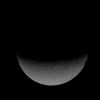
Enceladus-N00118330.jpgCrescent Enceladus (natural colors; credits: Lunexit)62 visiteCaption NASA:"N00118330.jpg was taken on August 11, 2008 and received on Earth August 12, 2008. The camera was pointing toward ENCELADUS that, at the time, was approximately 113.865 kilometers away.
The image was taken using the CL1 and CL2 filters and it has not been validated or calibrated".MareKromium
|
|

M0132557824F4-pseudoparabola.pngThe "Pseudo-Dish" is gone...62 visiteUn nuovo "tassello", nella Saga delle Leggende di 433-Eros: la "Parabola".
In questo frame, che riprende il nostro "oggetto misterioso" da un angolo visuale opposto rispetto a quello solito (e cioè l'angolo visto e stravisto nelle immagini che popolano Internet), anche l'Osservatore più sbadato potrà vedere e verificare che il rilievo che, per alcuni Appassionati di Anomaly Hunting, sembrava e/o assomigliava e/o era un oggetto discoidale (una sorta di "Parabola per la Trasmissione e/o la Ricezione di Segnali", si è detto e scritto), è in realtà un boulder vagamente rettangolare, che accede ad un outcrop di modeste dimensioni.
Maggiori dettagli ed informazioni al riguardo seguiranno nell'articolo che chiuderà la "Trilogia di 433-Eros", di prossima pubblicazione su TruePlanets.
Per Vostra opportuna informazione, il "Rilievo Controverso" (chiamiamolo in questo modo "neutro", così non facciamo torto a nessuno) si trova alle seguenti coordinate: 14,46° Latitudine Nord e 256,77° Longitudine Est). MareKromium
|
|

Enceladus-N00118469.jpgStars?62 visitenessun commentoMareKromium
|
|

Saturn-PIA10478.jpgSaturn and Mimas (natural colors; credits: NASA/JPL/Space Science Institute )62 visiteCaption NASA:"The Cassini Spacecraft looks beyond Saturn's limb toward the icy face of Mimas, the innermost of the Planet's major moons.
This view looks toward the sunlit side of the rings from about 3° below the Ring-Plane. Mimas is about 396 Km (approx. 246 miles) across.
Images taken using red, green and blue spectral filters were combined to create this natural color view. The images were acquired with the Cassini Spacecraft narrow-angle camera on Sept. 4, 2007 at a distance of approx. 2,7 MKM (such as about 1,7 MMs) from Saturn and 2,8 MKM (such as about 1,8 MMs) from Mimas.
Image scale is roughly 16 Km (about 10 miles) per pixel on Saturn and approx. 17 Km (such as about 11 miles) per pixel on Mimas". MareKromium
|
|

20010206full.jpgBoulders, Outcrops and the "Skyline" of 433-Eros62 visiteUn frame - semplicemente - bellissimo, ad elevata risoluzione (osservate i macigni che si trovano a ridosso dell'orizzonte e del Terminatore se volete apprezzare pienamente la qualità - ALTA! - del frame).MareKromium
|
|

Titan-W00049900.jpgLost in the Space of Saturn... (natural colors; credits: Lunexit)62 visiteTitano: il disco, appena percettibile, splende di un leggero color giallo. Siamo a circa 1,8 MKM dalla "Luna Nebbiosa".MareKromium
|
|
| 4548 immagini su 379 pagina(e) |
 |
|
|
|
|
359 | |
|
|
|
|





