| |

| Piú viste - SOLAR SYSTEM |

ZZ-ZZ-ZZ-ZZ-ZZ-ZZ-ZZ-ZZ-ZZ-ZZ-ZZ-ZZ-APOLLO 12 AS 12-46-6831 HR-1.jpgAS 12-46-6831 (detail mgnf - HR) - A Lunar "Mirror"?178 visiteForse si tratta solo di un curioso (sebbene molto accentuato) "effetto di illuminazione", ossìa un artefatto fotografico il quale è il risultato della combinazione di diversi elementi, tra cui evidenziamo:
1) l'oggetto ripreso è sfuocato (ampiamente);
2) esso, rispetto alla dimensione media delle rocce che lo circondano, è decisamente più grande;
3) la sua "tessitura superficiale" è liscia (forse una roccia piatta?);
4) probabilmente esso non è ricoperto da polveri e
5) la sua albedo (che deriva - anche - da quanto sopra) è molto alta.
Può anche darsi che si tratti di un corpo metallico - come scriviamo sul frame - e, addirittura, una dotazione degli Astronauti. Lo si vede molto bene anche nei due frames successivi e la sensazione (nulla di più) che si ottiene è che possa trattarsi di un oggetto sferico che poggia sopra un basamento ad arco.
|
|

ZZ-ZZ-ZZ-ZZ-ZZ-ZZ-ZZ-ZZ-ZZ-ZZ-ZZ-ZZ-APOLLO 14 AS 14-66-9301-1.jpgAS 14-66-9301 - New Discoveries near the "Blue Flare"? (2)177 visiteLe valutazioni, assai immaginifiche, ma ampiamente sostanziate, del Dr Sartarelli, ci sembrano plausibili. La nostra opinione al riguardo è, come sempre (purtroppo) molto aperta e possibilista, poichè non abbiamo elementi decisivi né per aderire in toto alle costruzioni del nostro Amico, nè per confutarle; tuttavia ci sentiamo di dire che alcuni dei "punti" fatti dal Dr Sartarelli sono assolutamente inequivocabili e che, ad essi, si possono aggiungere le nostre valutazioni. Eccole:
1) è vero: Mitchell (l'Astronauta inquadrato con la telecamera fra le mani) effettivamente sembra che stia riprendendo l'orizzonte e NON la Blue Flare (...Ed is still doing a TV pan. Note the ridge behind him, still partially in shadow. Cone Crater is on a portion of this ridge that is off the picture to the right, virtually up-Sun (east) of the landing site...);
2) non è la prima volta che, operando uno stretching dei frames ad Alta Risoluzione o addirittura dei frames Originali NON Compressi, si riesce a portare alla luce l'esistenza di "strutture effimere" (con ciò intendendosi dei rilievi semi-trasparenti i quali, secondo alcuni - Hoagland su tutti - sono dei "cristal remnants” – ruderi cristallini). Occorre però precisare che uno stretching eccessivo può concorrere nella creazione – o creare ex novo – dei photoartifact i quali, a volte, possono essere confusi con dette “strutture effimere”;
3) la Blue Flare, come notava il Dr Sartarelli, non è l’unica “presenza anomala” del frame. Ad un’attenta analisi del frame si possono notare altri dettagli curiosi (su tutti, una coppia di “sfere” bianche ed azzurre al suolo), ma in un caso come questo occorre precisare che il frame non è esattamente “a fuoco” e quindi i rilievi ad albedo elevata, allorché ripresi fuori fuoco, tendono naturalmente ad apparire come “sfere” o “cilindri” illuminati, molto suggestivi ma estremamente ingannevoli;
4) l’area nei pressi di Cone Crater è molto accidentata (abbiamo due ore di riprese filmate “Live from the Moon” – Apollo 14” che lo dimostrano ampiamente) e, su aree accidentate, le alternanze “luce-ombra-luce” sono frequentissime e, ancora una volta, ingannevoli;
5) il Dr Sartarelli ha ragione quando evidenzia, nel suo detail mgnf, alcune incongruenze nella tessitura del suolo lunare inquadrato e la presenza – fortemente probabile (se non addirittura certa) – di alterazioni digitali postume;
6) altri dettagli minori (tipo la “protuberanza”) sono, a nostro parere, intriganti ma insostanziabili: troppo piccoli per essere risolti da uno stretching accettabile.
Conclusioni: l’ipotesi di base del Dr Sartarelli è accettabile e presenta degli elementi di supporto tali da renderla, secondo noi, sufficientemente plausibile.
La problematica delle “strutture effimere” è oltremodo complessa e, a ben guardare, in parte è accettabile (ed esistono elementi oggettivi al suo supporto) ed in parte è fortemente speculativa (il Lavoro del Prof. Hoagland e della sua Scuola, ad esempio, parte da premesse accettabili e poi si perde in speculazioni pure; il Lavoro del Dr Sartarelli parte anch’esso da premesse accettabili e poi si mantiene su livelli di plausibilità – il massimo ottenibile con i pochi dati a disposizione).
In questo caso specifico, a nostro parere, c’è effettivamente “qualcosa” nell’area in questione, ma “che cosa” sia (strutture effimere, ruderi di manufatti colonnari “cancellati digitalmente” o altro), purtroppo, è un mistero che, almeno per molto tempo, resterà ancora tale.
Complimenti per il Lavoro svolto ed un Grazie di cuore al Dr Sartarelli, da parte di tutti noi.
|
|
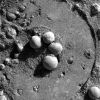
ZZ-ZZ-ZZ-ZZ-ZZ-IMAGE059.jpgHard Rock or Soft Rock?177 visiteDall'Amico e Socio Matteo Fagone (PianetaMarte.net), una interessante - e controversa - serie di riflessioni ed ipotesi collegate a quanto viene mostrato in questo intrigante frame Marziano proveniente dalla Regione di Meridiani.
Buona Lettura!
“Come sapete si è già parlato molto a proposito di queste Stranezze Marziane e già sono state proposte alcune ipotesi sulla loro possibile natura ed origine.
Ricapitolando: potrebbe trattarsi di formazioni sedimentarie prodotte dall'azione dell'acqua, allorché essa si è combinata con altri elementi ora andati perduti.
Oppure potremmo essere davanti a veri e propri fossili. Fossili che ci riporterebbero a Forme di Vita indigene, ormai estinte da ere, anche se c'è qualcuno che ipotizza che i “Mirtilli Marziani” possano essere delle Forme di Vita tuttora attive (“vive”, insomma), fondate su principi organici e metabolici profondamente diversi rispetto a quelli propri dell'ambiente terrestre.
Difficile prendere una posizione definitiva visto il ventaglio di opzioni disponibili (tutte, sebbene ciascuna abbia i propri “pro” ed i propri “contro”, relativamente accettabili).
Ma lasciamo stare questo aspetto della problematica – peraltro affascinante – e soffermiamoci su un aspetto che ora possiamo meglio prendere in considerazione, grazie a questo bellissimo frame: quanto sono dure le sferule? Insomma, se le potessimo prendere in mano si frantumerebbero alla minima pressione? O dovremmo “impegnarci” per schiacciarle? Oppure, nonostante i nostri sforzi “distruttivi”, essere rimarrebbero intatte?
E se invece si appiattissero (così come sembra essere accaduto qualche volta)?
Non si tratta di interrogativi oziosi poichè le implicazioni connesse alle risposte che potremmo dare sono oltremodo serie: di cosa sono fatte le “sferule”? Sono strutture elastiche o rigide?
Vediamo: l'elasticità è direttamente legata – anche – alla temperatura dell'ambiente esterno. Se su Marte facesse davvero molto freddo (come si suppone da sempre), con valori medi ben al di sotto dello zero, dovremmo dedurre che la maggior parte delle strutture elastiche o semirigide eventualmente esistenti sulla superficie del Pianeta Rosso si sarebbero dovute irrigidire in toto per poi diventare oltremodo compatte e dure.
Se questo fosse vero, però, dette strutture, in maniera proporzionale al loro irrigidimento, avrebbero dovuto anche diventare fragili.
Fragili al punto da frantumarsi all’esercizio di pressioni anche (relativamente) modeste, ma questo non pare che accada: strano, non è vero?
Avete notato che alcune delle sferule riprese in questa immagine sono praticamente sprofondate nel terreno? Qualsiasi genere di pressione esse abbiano ricevuto (modesta, ma non insignificante – pensate alla pressione esercitata dal passaggio delle ruote del Rover o dall’imposizione dello Spettrometro Mossbauer) non è stata comunque sufficiente a frantumarle.
Esse sono state spinte dentro il terreno.
Cosa vuol dire?
Riflettete: sono le sferule ad essere solide e compatte, sebbene rigide? O è il terreno Marziano il quale, sebbene compatto (ma certo NON ghiacciato), risulta essere particolarmente soffice (e quindi capace di assecondare la pressione eventualmente ricevuta)?
O forse si tratta di un concorso di cause?
Riguardiamo il frame, teniamo a mente queste considerazioni e quindi diciamo che: forse le temperature superficiali medie di Marte non sono poi così basse come si ritiene e, quindi, le sferule potrebbero essere composte di materiali semirigidi (attenzione: semirigidi potrebbe anche voler dire “organici”…).
E se il suolo fosse realmente (come sembra da svariate immagini) “relativamente soffice”, quale sostanza sarebbe capace di ottenere un tale “miracolo” (visto il “gelo” che dovrebbe caratterizzare l’ambiente Marziano superficiale)?
E se la superficie del Pianeta Rosso fosse realmente “impregnata” di ghiaccio acqua?
Esistono anche delle sacche “quasi superficiali” del prezioso liquido (come su Encelado)?
E se così fosse, come mai queste acque quasi-superficiali non spariscono?
Esistono forse degli elementi ulteriori, contenuti nel suolo Marziano, i quali sono capaci di “ingabbiare” l’acqua esistente impedendole, però, sia di fuoriuscire e zampillare, sia di ghiacciare completamente e sia di evaporare in toto?
Possiamo supporre che su Marte esista un Ciclo dell'Acqua Aperto?...
Voi che dite?!?”.
|
|

Sedna-03.jpgSedna from the Hubble Space Telescope (1)176 visiteLa collocazione di Sedna, secondo alcuni Astronomi, è quella di KBO (Kuiper's Belt Object), ma la sua orbita suggerisce scenari diversi. Sebbene non sia ancora possibile tracciarla in grande dettaglio, sappiamo che si tratta di un'orbita fortemente ellittica con un punto di maggior lontananza dal Sole (afelio) pari a 75 UA ed un periodo orbitale (un altro modo di indicare l'anno di Sedna) pari a circa 10.500 anni terrestri.
E' questo dato che ci permette di collocare Sedna ben oltre la Fascia di Kuiper e dunque (ampiamente) all'interno della Nube di Oort, anche nota come "La Fucina delle Comete".
|
|

ZZ-ZZ-ZZ-ZZ-ZZ-ZZ-ZZ-ZZ-ZZ-ZZ-ZZ-ZZ-APOLLO 17 AS 17-136-20856 HR-2.jpgAS 17-136-20856 (HR-1) - Strange and unexplainable things...176 visiteUna roccia ad albedo molto elevata (che, nel frame, ci appare addirittura di color bianco) oppure un photoartifact (una scoloritura della pellicola ad esempio, o una porzione di film danneggiata)? E che dire, poi, delle due rocce che vediamo in basso: rocce assurde nelle loro forme e che paiono proiettare - specie quella più a Sx - ombre impossibili (troppo lunghe ed incongrue rispetto ai corpi che le avrebbero create) sul suolo Lunare.
Ahinoi...Frame incommentabile.
|
|

Saturn-W00065995-98-MF-LXTT.jpgHigh-Latitude Superstorm-Cell on Saturn (Superdefinition and Natural Colors; credits for the additional process. and color.: Dr Marco Faccin - Lunexit Team)176 visitenessun commentoMareKromium
|
|

The_Rings-PIA12820.gifTilting Saturn's Rings (a Computer Animation by NASA/JPL/Cornell)176 visiteCaption NASA:"This animated graphic shows in a series of three images how Saturn's Rings, after they became tilted relative to Saturn's Equatorial Plane, would have transformed into a Corrugated Ring.
Images taken after Saturn's August 2009 equinox from NASA's Cassini Spacecraft revealed alternating light and dark bands extending from Saturn's D-Ring, completely across the C-Rg, and right up to the inner B-Rg Ege. These brightness variations are almost certainly caused by the changing slopes in the rippled Rng-Plane, much like the corrugations of a tin roof.
This series of images shows how such a vertical corrugation can be produced from an initially inclined ring by the natural tendency for inclined orbits to wobble systematically and slowly at different rates, depending on their distance from Saturn. The top image shows a simple inclined ring (the central planet is omitted for clarity), while the lower two images show the same ring at two later times, where the ring particles' wobbling orbits have sheared this inclined sheet into an increasingly tightly-wound spiral corrugation.
Cassini images show the corrugation extends for about 19.000 Km (11.799 miles). Based on detailed studies of this structure, scientists conclude that a broad swath of the Rings became suddenly tilted in the early 1980s, likely because Cometary Debris crashed into them.
The corrugation's radial extent implies that the impacting material was a dispersed cloud of debris instead of a single object. The corrugation's amplitude of about 2 to 20 meters (7 to 60 feet) indicates that the debris' total mass was around 1 Trillion Kg (or 1 Billion Metric Tons)".
MareKromium
|
|
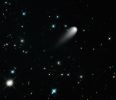
Comets-Comet_ISON-HST-30Apr-V_I-L-800.jpgComet ISON (Hubble Space Telescope's View)176 visiteAdvanced amateur astronomers are already getting good images of Comet ISON, which currently shines at around +12th magnitude in the constellation Cancer. And although NASA’s Deep Impact/EPOXI mission is down for the count, plans are afoot for the Curiosity rover and the Mars Reconnaissance Orbiter to attempt imaging the comet when it makes its closest approach to the Red Planet on October 1st at 0.0724 Astronomical Units (A.U.) or 10,830,000 kilometres distant. If MSL is successful, it would be the first time that a comet has been observed from the surface of another world.
Currently, ISON sits about a magnitude below the projected light curve, (see below) but that isn’t all that unusual for a comet. Already, there’s been increasing talk of “ISON being a dud,” but as Universe Today’s Nancy Atkinson pointed out in a recent post, these assertions are still premature. The big question is what ISON will do leading up to perihelion, and if it will survive its passage 1.1 million kilometres above the surface of the Sun on November 28th to become a fine comet in the dawn skies in the weeks leading up to Christmas.
ISON is already starting to show a short, spikey tail in amateur images. Tsutomu Seki estimated it to be shining at about magnitude +11.1 on September 16th. Keep in mind, a caveat is in order when talking about the magnitudes of comets. Unlike stars, which are essentially a point source, the brightness of a comet is spread out over a large surface area. Thus, a comet may appear visually fainter than the quoted magnitude, much like a diffuse nebula. Although +6th magnitude is usually the limit for naked eye visibility, I’ll bet that most folks won’t pick up ISON with the unaided eye from typical suburban sites until it breaks +4th magnitude or so.
The forward scattering of light also plays a key role in the predicted brightness of a comet. The November issue of Astronomy Magazine has a great article on this phenomenon. It’s interesting to note that ISON stacks up as a “9” on their accumulated point scale, right at the lower threshold of comet “greatness,” versus a 15 for sungrazing Comet C/1965 S1 Ikeya-Seki. Another famous “9” was Comet C/1996 B2 Hyakutake, which passed 0.1018 A.U. or 15.8 million kilometres from Earth on March 25, 1996.
ISON will pass 0.429 A.U. or 64.2 million kilometres from Earth the day after Christmas. Bruce Willis can stay home for this one.
Here is a blow-by-blow breakdown of some key dates to watch for as ISON makes its plunge into the inner solar system:
-September 25th: ISON crosses the border from the astronomical constellation of Cancer into Leo.
-September 27th: ISON passes 2 degrees north of the planet Mars.
-October 1st: The 12% illuminated waning crescent Moon passes 10 degrees south of Mars & ISON.
-Early October: ISON may break +10th magnitude and become visible with binoculars or a small telescope.
-October 4th: New Moon occurs. The Moon then exits the dawn sky, making for two weeks of prime viewing.
-October 10th: ISON enters view of NASA’s STEREO/SECCHI HI-2A CAMERA:
-October 16th: ISON passes just 2 degrees NNE of the bright star Regulus, making a great “guidepost” to pin it down with binoculars.
-October 18th: The Full Moon occurs, after which the Moon enters the morning sky.
-October 26th: A great photo-op for astro-imagers occurs, as ISON passes within three degrees the Leo galaxy trio of M95, M96, & M105.
-October 30th: The 17% illuminated Moon passes 6 degrees south of ISON.
-Early November: Comet ISON may make its naked eye debut for observers based at dark sky sites.
-November 3rd: A hybrid (annular-total) solar eclipse occurs, spanning the Atlantic and Central Africa. It may just be possible for well placed observers to catch sight of ISON in the daytime during totality, depending on how quickly it brightens up. The Moon reaching New phase also means that the next two weeks will be prime view time for ISON at dawn.
-November 5th: ISON crosses the border from the astronomical constellation of Leo into Virgo.
-November 7th: ISON passes less than a degree from the +3.6 magnitude star Zavijava (Beta Virginis).
-November 8th: ISON passes through the equinoctial point in Virgo around 16:00 EDT/20:00 UT, passing into the southern celestial hemisphere and south of the ecliptic.
-November 14th: ISON passes less than a degree from the 10th magnitude galaxy NGC 4697.
-November 17th: The Moon reaches Full, passing into the morning sky.
-November 18th: ISON passes just 0.38 degrees north of the bright star Spica.
-November 22nd: ISON crosses into the astronomical constellation of Libra.
-November 23rd: ISON sits 4.7 degrees SSW of the planet Mercury and 4.9 SSW of Saturn, respectively.
-November 25th: ISON pays a visit to another famous comet, passing just 1.2 degrees south of short period comet 2P/Encke which may shine at +8th magnitude.
-November 27th: ISON enters the field of view of SOHO’s LASCO C3 coronagraph.
-November 28th: ISON reaches perihelion at ~18:00 PM EST/ 23:00 UT.
After that, all bets are off. The days leading up to perihelion will be tense ones, as ISON then rounds the Sun on a date with astronomical destiny. Will it join the ranks of the great comets of the past? Will it stay intact, or shatter in a spectacular fashion? Watch this space for ISON updates… we’ll be back in late November with our post-perihelion guide!
Be sure to also enjoy recently discovered Comet C/2013 R1 Lovejoy later the year.
(source: http://www.universetoday.com/104818/comet-ison-a-viewing-guide-from-now-to-perihelion/#ixzz2fpLTKJwD)
Read more: http://www.universetoday.com/104818/comet-ison-a-viewing-guide-from-now-to-perihelion/#ixzz2fpLG75usMareKromium
|
|

NeptuneandTriton-PIA00344.jpgNeptune and Triton175 visiteCaption NASA originale:"Composite view showing Neptune on Triton's horizon. Neptune's South Pole is to the left; clearly visible in the planets' Southern Hemisphere is a Great Dark Spot, a large anticyclonic storm system located about 20° South. The foreground is a computer generated view of Triton's maria as they would appear from a point approximately 45 Km above the surface. The terraces visible in this image indicate multiple episodes of 'cryovolcanic' flooding. This three-dimensional view was created from a Voyager 2 image by using a 2-dimensional photoclinometric model. Relief has been exaggerated roughly 30-fold, the actual range of the relief is about 1 Km. Would Neptune appear to be rising or setting? Neither, due to the motion of Triton relative to Neptune, it would appear to move laterally along the horizon, eventually rising and setting at high latitudes".
|
|

Europa-Craters-Mannann_an_Crater-PIA01402-PCF-LXTT-IPF.jpgFeatures of Mannann'an Crater (Absolute Natural Colors; credits for the additional process. and color.: Dr Paolo C. Fienga/Lunar Explorer Italia/Italian Planetary Foundation)174 visiteThis composite view taken by the NASA - Galileo Spacecraft, shows a portion of the Rim and the Interior of the Impact Crater known as Mannann'an, which is located on Jupiter's moon, Europa. A high resolution image (20 meters per picture element) was combined with a lower resolution one (80 meters per picture element), to produce this composite picture. The color data here can be used to distinguish between Regions where the Ice located on the Surface of Europa is purer (---> cleaner) from other areas where the Ice itself, instead, is more contaminated (---> dirty; mixed with other elements); the reddish/brown Surface Material visible to the West (Left side - Sx) of the frame is thought to be "dirty" Ice, while the white/bluish areas visible inside the Crater should be made of "cleaner" Ice. The Rim of Mannann'an is (barely visible) on the left of the composite, approx. at the boundary between the area with the higher concentration of reddish/brown Surface Material and the area where the white Surface Material is dominant. The high resolution data show several small Surface Features inside this Impact Crater, including Concentric Fractures and a Spider-like set of Fractures near the right (East) edge of the image.
North is to the top of the picture and the Sun illuminates the scene from the East (right - Dx). The image, which is centered at 3° North Latitude and 240° West Longitude, covers an area of approximately 18 by 4 Km (such as about 11,12 by 2,48 miles). The finest details that can be discerned in this picture are about 40 meters (44 yards) across. The images were taken by the Solid State Imaging Camera onboard Galileo, when the Spacecraft flew by Europa on March 29th, 1998, at a distance of 1934 Km (such aapprox. 1201 miles) from its Surface.
This frame (which is an Original NASA - Galileo Spacecraft false colors image composite published on the NASA - Planetary Photojournal with the ID n. PIA 01402) has been additionally processed and then re-colorized, according to an educated guess carried out by Dr Paolo C. Fienga (LXTT-IPF), in Absolute Natural Colors (such as the colors that a human eye would actually perceive if someone were onboard the NASA - Galileo Spacecraft and then looked outside, towards the Surface of the Jovian moon Europa), by using an original technique created - and, in time, dramatically improved - by the Lunar Explorer Italia Team. Different colors, as well as different shades of the same color, mean, among others, the existence of different Elements present on the Surface of Europa, each having a different Albedo (---> Reflectivity) and Chemical Composition.MareKromium
|
|

Jupiter-PIA23437.jpgIo's Shadow174 visiteCaption NASA Originale:"Jupiter's volcanically active moon Io casts its shadow on the planet in this dramatic image from NASA's Juno Spacecraft. As with solar eclipses on the Earth, within the dark circle racing across Jupiter's cloud tops one would witness a full solar eclipse as Io passes in front of the Sun.
Such events occur frequently on Jupiter because it is a large planet with many moons. In addition, unlike most other planets in our solar system, Jupiter's axis is not highly tilted relative to its orbit, so the Sun never strays far from Jupiter's equatorial plane (+/- 3°). This means Jupiter's moons regularly cast their shadows on the planet throughout its year.
Juno's close proximity to Jupiter provides an exceptional fish-eye view, showing a small fraction near the planet's Equator. The shadow is about 2.200 miles (such as approx. 3.540,55 Km) wide, approximately the same width as Io, but appears much larger relative to Jupiter.
A little larger than Earth's Moon, Io is perhaps most famous for its many active volcanoes, often caught lofting fountains of ejecta well above its thin (?) Atmosphere.
Citizen scientist Kevin M. Gill created this enhanced-color image using data from the spacecraft's JunoCam imager. The raw image was taken on Sept. 11, 2019 at 8:41 p.m. PDT (11:41 p.m. EDT) as the Juno spacecraft performed its 22nd close fly-by of Jupiter. At the time the image was taken, the spacecraft was about 4.885 miles (approx. 7.861,64 Km) from the cloud tops at a Latitude of 21° North".
Nota: e per chi ha visto il famoso "2010 Odissea Due: l'Anno del Contatto", questa immagine dovrà "ricordare" qualcosa...MareKromium
|
|

A - Saturn_s sky before the Streak (2).jpgSaturn's Sky just before the "Streak" (2) - N00008769173 visiteDato che riteniamo di essere stati i primi ad individuare questa notevole Anomalia (la quale, peraltro, difficilmente, verrà riconosciuta come tale dalla NASA o dalle altre Agenzie Spaziali coinvolte nel Progetto Cassini/Huygens) riteniamo giusto rivendicare il nostro buon diritto di Scopritori e, quindi, la battezziamo con il nome di "Saturn-Cass/Huy-PCF-1-05/08/2004-Anomaly".
|
|
| 4548 immagini su 379 pagina(e) |
|
|
|
|
|
20 | |
|
|
|
|
|
|





