| |

| Piú viste - SOLAR SYSTEM |

Image055-Mercury.jpgThe secret of Hun-Kal181 visiteNel 1976, un tal Bruce C. Murray pubblicò su una rivista scientifica un articolo su Mercurio (prefazione di Carl Sagan), a cui era allegata l'immagine che Vi proponiamo.
All'immagine si accompagnava questo commento:"La superficie ricca di crateri di Mercurio è stata ripresa per la prima volta verso la fine del mese di Marzo 1974 dalle macchine fotografiche situate a bordo di Mariner 10. L'immagine (HR) mostra una tipica regione fortemente craterizzata, molto simile alla superficie della Luna, in prossimità dell'equatore del Pianeta. Le immagini inviate da Mariner 10 hanno reso possibile correlare un sistema di riferimento precedentemente basato sulle longitudini ad una specifica caratteristica topografica per eseguire una mappa dettagliata. Nel 1970 l'UAI ha definito l'origine delle longitudini planetografiche come il meridiano passante per il punto subsolare nel primo perielio del 1950. Si è ora concordato che il meridiano dei 20° passa per il centro di un piccolo cratere caratteristico che si trova immediatamente a fianco del grande cratere situato quasi al centro di quest'immagine. Il piccolo cratere, il cui diametro è di 1,5 chilometri e che si trova a 0,58 gradi a sud dell'equatore, è ai piedi del fianco esterno del grande cratere in una posizione equivalente alle ore otto su un quadrante d'orologio. È stato chiamato Hun Kal, che significa 20 nel linguaggio dei Maya, i quali usavano un sistema numerico a base 20. La fotografia è riprodotta con il nord a destra per poter includere quanto più possibile dell'inquadratura ripresa da Mariner 10".
|
|

ZZ-ZZ-ZZ-ZZ-ZZ-ZZ-ZZ-ZZ-ZZ-ZZ-ZZ-ZZ-APOLLO 16 AS 16-116-18603 I-HR-1.jpgAS 16-116-18603 - The "Artifacts" (1)181 visitenessun (ulteriore) commento
|
|

ZZ-Mercury-Craters-Unnamed_Craters-PIA14191-PCF-LXTT.jpgUnnamed Craters (Absolute Natural Colors; credits for the additional process. and color: Dr Paolo C. Fienga - Lunexit Team)181 visiteImage Mission Elapsed Time (MET): 209889250
Image ID: 65107
Instrument: Narrow Angle Camera (NAC) of the Mercury Dual Imaging System (MDIS)
Center Latitude: 1,7° North
Center Longitude: 354,3° East
Resolution: approx. 246 mt/pixel
Scale: this image is approx. 390 Km acrossMareKromium
|
|

ZZ-ZZ-ZZ-ZZ-ZZ-ZZ-ZZ-ZZ-Pluto-nh_01_stern_05_pluto_hazenew-PCF-LXTT-IPF-2.jpgA "Blue-rayed" Farewell to Pluto181 visiteNew Horizons is a NASA mission to study the dwarf planet Pluto, its moons, and other objects in the Kuiper Belt, a region of the solar system that extends from about 30 AU, near the orbit of Neptune, to about 50 AU from the Sun.
It was the first mission in NASA’s New Frontiers program, a medium-class, competitively selected, and principal investigator-led series of missions. (The program also includes Juno and OSIRIS-REx.)
New Horizons was the first spacecraft to encounter Pluto, a relic from the formation of the solar system. By the time it reached the Pluto system, the spacecraft had traveled farther away and for a longer time period (more than nine years) than any previous deep space spacecraft ever launched.
The design of the spacecraft was based on a lineage traced back to the CONTOUR and TIMED spacecraft, both also built by the Applied Physics Laboratory at Johns Hopkins University.
Besides its suite of scientific instruments, New Horizons carries a cylindrical radioisotope thermoelectric generator (a spare from the Cassini mission) that provided about 250 watts of power at launch (decaying to 200 watts by the time of the Pluto encounter).
After reaching initial Earth orbit at about 105 × 130 miles (167 × 213 kilometers), the Centaur upper stage fired (for a second time) for nine minutes to boost the payload to an elliptical orbit that stretched to the asteroid belt.
A second firing of the Star 48B solid rocket accelerated the spacecraft to a velocity of about 36,400 miles per hour (58,536 kilometers per hour), the highest launch velocity attained by a human-made object relative to Earth. The spacecraft was now set on a trajectory to the outer reaches of the solar system.
Controllers implemented course corrections on Jan. 28, Jan. 30, and March 9, 2006. A month later, on April 7, 2006, New Horizons passed the orbit of Mars.
A fortuitous chance to test some of the spacecraft’s instruments – especially Ralph (the visible and infrared imager and spectrometer) – occurred June 13, 2006, when New Horizons passed by a tiny asteroid named 132524 APL at a range of about 63,300 miles (101,867 kilometers).
The spacecraft flew by the solar system’s largest planet, Jupiter, for a gravity assist maneuver on Feb. 28, 2007, with the closest approach at 05:43:40 UT. The encounter increased the spacecraft’s velocity by about 9,000 miles per hour (14,000 kilometers per hour), shortening its trip to Pluto by three years.
During the flyby, New Horizons carried out a detailed set of observations over a period of four months in early 2007. These observations were designed to gather new data on Jupiter’s atmosphere, ring system, and moons (building on research from Galileo) and to test out New Horizon’s instruments.
Although observing the moons from distances much farther than Galileo, New Horizons was still able to return impressive pictures of Io (including eruptions on its surface), Europa, and Ganymede.
After the Jupiter encounter, New Horizons sped toward the Kuiper Belt, performing a course correction on Sept. 25, 2007.
The spacecraft was put in hibernation mode starting June 28, 2007, during which time the spacecraft’s onboard computer kept tabs on mission systems, transmitting special codes indicating that operations were either nominal or anomalous. During hibernation, most major systems of New Horizons were deactivated and revived only about two months every year. The second, third, and fourth hibernation cycles were Dec. 16, 2008, Aug. 27, 2009, and Aug. 29, 2014.
New Horizons passed the halfway point to Pluto on Feb. 25, 2010.
The discovery of new Pluto moons Kerberos and Styx during the mission added to concerns that there might be debris or dust around Pluto. Mission planners devised two possible contingency plans in case debris increased as the spacecraft approached Pluto, either using its antenna facing the incoming particles as a shield or flying closer to Pluto where there might be less debris.
On Dec. 6, 2014, ground controllers revived New Horizons from hibernation for the last time to initiate its active encounter with Pluto. At that time, it took four hours and 25 minutes for a signal to reach Earth from the spacecraft.
The spacecraft began its approach phase toward Pluto on Jan. 15, 2015, and its trajectory was adjusted with a 93-second thruster burn on March 10. Two days later, with about four months remaining before its close encounter, New Horizons finally became closer to Pluto than Earth is to the Sun.
Pictures of Pluto began to reveal distinct features by April 29, 2015, with detail increasing week by week into the approach. A final 23-second engine burn on June 29, 2015, accelerated New Horizons toward its target by about 11 inches per second (27 centimeters per second) and fine-tuned its trajectory.
There was concern on July 4, 2015, when New Horizons entered safe mode due to a timing flaw in the spacecraft command sequence. Fortunately, the spacecraft returned to normal science operations by July 7.
Three days later, data from New Horizons was used to conclusively answer one of the most basic mysteries about Pluto: its size. Mission scientists concluded that Pluto is about 1,470 miles (2,370 kilometers) in diameter, slightly larger than prior estimates. Its moon Charon was confirmed to be about 750 miles (1,208 kilometers) in diameter.MareKromium
|
|

ZZ-ZZ-ZZ-ZZ-ZZ-ZZ-ZZ-ZZ-ZZ-ZZ-ZZ-ZZ-APOLLO 17 AS 17-133-20207 HR.jpgAS 17-133-20207 - Lunar "Nefertiti"?180 visiteC'è chi l'ha vista "disegnata" fra le colline di Marte e chi ne ha scorto il delicato profilo nelle dense nuvole che caratterizzano gli strati superiori dell'atmosfera di Giove e Saturno...
Noi - scherzosamente - Vi proponiamo una versione "lunare e stilizzata", ma comunque molto suggestiva, della bella Nefertiti, semi-sepolta nella polvere della Luna.
Ad onor del vero - e per onestà intellettuale - Vi diciamo che siamo tutti convinti del fatto che la tendenza all'antropomorfizzazione sia innata in ognuno di noi; tuttavia, guardando un particolare come questo (sempre individuato dal Dr Gianluigi Barca), il sospetto che esso possa davvero rappresentare la porzione superiore di una scultura rappresentativa di una qualche "Divinità" dell'Antico Egitto, effettivamente, ci assale un pò...
E che dire, poi, degli "occhi" di questa "statua"? Non Vi ricordano anche - ed almeno un pò - i tratti caratteristici di un "Grigio"?!?...
|
|

IMAGE068-AS16-107-17420.jpgAS 16-107-17420 (HR) - Flag and Solar Wind Collector179 visite...Sia la Bandiera Americana, sia il Solar Wind Collector ma anche, e soprattutto, la "tessitura" del suolo ai piedi di Charlie Duke.
Una tessitura che è identica (anche in termini di albedo e colore) a quella della porzione visibile (ancorchè mossa) e quindi interpretabile del frame precedente".
Mistero risolto? Forse si, forse no: si tratta di interpretazioni, in fondo, e la strada dell'interpretazione, a condizione che venga seguita usando sempre la Prudenza e la Buona Fede, è comunque una strada accettabile e percorribile. Almeno per noi.
Bravi tutti, quindi! E Voi? Voi che dite?!?
Caption NASA originale:"Charlie begins a pan taken North of the LM with this frame showing part of the U.S. Flag on the left and the Solar Wind Collector (SWC) at center".
|
|

ZZ-ZZ-ZZ-ZZ-ZZ-ZZ-ZZ-ZZ-ZZ-ZZ-ZZ-ZZ-APOLLO 17 AS 17-136-20784 I-HR-extreme detail mgnf.jpgAS 17-136-20784 (extreme detail mgnf) - Another strange "boulder"...179 visitenessun commento
|
|
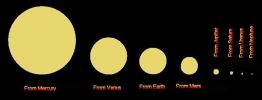
000-The_Sun_from_Space.JPGThe Sun from all the Planets of the Solar System179 visiteCome appare (o meglio: "Quanto grande" dovrebbe apparire) il Disco Solare allorchè osservato da un Mondo diverso dalla Terra?
Senza pretesa di assolutezza matematica, questa Tavola dovrebbe fornirVi un'idea più precisa della questione su cui tanto ci siamo arrovellati sino ad ora.
Nota: i diversi diametri sono stati ipotizzati ragionando in termini di UA (Unità Astronomiche), laddove 1 UA = distanza Sole / Terra = 149.597.970 Km
ergo la distanza fra il Sole e Mercurio viene fatta mediamente pari a (circa *) 0,4 UA
fra il Sole e Venere è mediamente pari a (circa) 0,7 UA
fra il Sole e Marte è mediamente pari a (circa) 1,5 UA
fra il Sole e Giove è mediamente pari a (circa) 5,2 UA
fra il Sole e Saturno è mediamente pari a (circa) 9,5 UA
fra il Sole ed Urano è mediamente pari a (circa) 19,6 UA
fra il Sole e Nettuno è mediamente pari a (circa) 30 UA
fra il Sole ed il Sistema Binario Plutone-Caronte è mediamente pari a (circa) 39 UA
* diciamo circa perchè le orbite dei diversi Pianeti attorno al Sole NON descrivono cerchi perfetti (e quindi con raggio - distanza dal Sole - fisso), bensì delle ellissi più o meno allungate (le quali implicano l'esistenza di un "perielio" - o punto di massima vicinanza del Corpo Celeste considerato rispetto al Sole - ed un "afelio" - o punto di massima lontananza del Corpo Celeste considerato rispetto al Sole.MareKromium
|
|
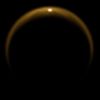
Titan-Lakes-Unnamed_North_Polar_Lake-PIA12481.jpgReflection of Sunlight off a Titanian Northern Lake (Natural Colors; credits: NASA/JPL/University of Arizona/DLR)179 visiteThis image shows the first flash of sunlight reflected off a lake on Saturn's moon Titan. The glint off a mirror-like surface is known as a specular reflection. This kind of glint was detected by the visual and infrared mapping spectrometer (VIMS) on NASA's Cassini spacecraft on July 8, 2009. It confirmed the presence of liquid in the moon's northern hemisphere, where lakes are more numerous and larger than those in the southern hemisphere. Scientists using VIMS had confirmed the presence of liquid in Ontario Lacus, the largest lake in the southern hemisphere, in 2008.
The northern hemisphere was shrouded in darkness for nearly 15 years, but the sun began to illuminate the area again as it approached its spring equinox in August 2009. VIMS was able to detect the glint as the viewing geometry changed. Titan's hazy atmosphere also scatters and absorbs many wavelengths of light, including most of the visible light spectrum. But the VIMS instrument enabled scientists to look for the glint in infrared wavelengths that were able to penetrate through the moon's atmosphere. This image was created using wavelengths of light in the 5 micron range.
By comparing the new image to radar and near-infrared light images acquired from 2006 to 2008, Cassini scientists were able to correlate the reflection to the southern shoreline of a Titan lake called Kraken Mare. The sprawling Kraken Mare covers about 400,000 square kilometers (150,000 square miles). The reflection appeared to come from a part of the lake around 71 degrees north latitude and 337 degrees west latitude.
It was taken on Cassini's 59th flyby of Titan on July 8, 2009, at a distance of about 200,000 kilometers (120,000 miles). The image resolution was about 100 kilometers (60 miles) per pixel. Image processing was done at the German Aerospace Center in Berlin and the University of Arizona in Tucson.
MareKromium
|
|

009.jpgSpace Heat-Shields - The "Anomaly"...according to NASA!178 visite7 - IL METODO
L'Heat-Shield, dunque (ed a nostro parere), è stato "sovrapposto", nelle varie foto all’oggetto originale che si trovava sul bordo di Bonneville.
Ma da dove proviene la tecnologia che consente fotomontaggi così verosimili?
La risposta ci arriva da...Pathfinder. Nel corso di quella missione (1997) vennero messi a punto dei meccanismi operazionali - destinati alla navigazione automatica - i quali consentivano l’acquisizione in tempo reale delle coordinate spaziali relative agli spostamenti del robottino Sojourner.
Successivi sviluppi portarono, nel 1999, all’affinamento di vari protocolli operativi, testati poi con successo in Arizona nel 2002.
Attualmente le fotocamere dei Mars Rovers, dunque, acquisiscono in pochi secondi le coordinate tridimensionali dell’area fotografata (riconvertendole in dati DEM) e consentendo ai Tecnici del Controllo Missione una riproduzione virtuale (dell'area da essi ripresa) talmente PERFETTA da risultare - di fatto - indistinguibile rispetto all'ORIGINALE.
|
|

ZZ-ZZ-ZZ-ZZ-ZZ-ZZ-ZZ-ZZ-ZZ-ZZ-ZZ-ZZ-APOLLO 12 AS 12-46-6831 HR-1.jpgAS 12-46-6831 (detail mgnf - HR) - A Lunar "Mirror"?177 visiteForse si tratta solo di un curioso (sebbene molto accentuato) "effetto di illuminazione", ossìa un artefatto fotografico il quale è il risultato della combinazione di diversi elementi, tra cui evidenziamo:
1) l'oggetto ripreso è sfuocato (ampiamente);
2) esso, rispetto alla dimensione media delle rocce che lo circondano, è decisamente più grande;
3) la sua "tessitura superficiale" è liscia (forse una roccia piatta?);
4) probabilmente esso non è ricoperto da polveri e
5) la sua albedo (che deriva - anche - da quanto sopra) è molto alta.
Può anche darsi che si tratti di un corpo metallico - come scriviamo sul frame - e, addirittura, una dotazione degli Astronauti. Lo si vede molto bene anche nei due frames successivi e la sensazione (nulla di più) che si ottiene è che possa trattarsi di un oggetto sferico che poggia sopra un basamento ad arco.
|
|

ZZ-ZZ-ZZ-ZZ-ZZ-ZZ-ZZ-ZZ-ZZ-ZZ-ZZ-ZZ-APOLLO 14 AS 14-66-9301-1.jpgAS 14-66-9301 - New Discoveries near the "Blue Flare"? (2)177 visiteLe valutazioni, assai immaginifiche, ma ampiamente sostanziate, del Dr Sartarelli, ci sembrano plausibili. La nostra opinione al riguardo è, come sempre (purtroppo) molto aperta e possibilista, poichè non abbiamo elementi decisivi né per aderire in toto alle costruzioni del nostro Amico, nè per confutarle; tuttavia ci sentiamo di dire che alcuni dei "punti" fatti dal Dr Sartarelli sono assolutamente inequivocabili e che, ad essi, si possono aggiungere le nostre valutazioni. Eccole:
1) è vero: Mitchell (l'Astronauta inquadrato con la telecamera fra le mani) effettivamente sembra che stia riprendendo l'orizzonte e NON la Blue Flare (...Ed is still doing a TV pan. Note the ridge behind him, still partially in shadow. Cone Crater is on a portion of this ridge that is off the picture to the right, virtually up-Sun (east) of the landing site...);
2) non è la prima volta che, operando uno stretching dei frames ad Alta Risoluzione o addirittura dei frames Originali NON Compressi, si riesce a portare alla luce l'esistenza di "strutture effimere" (con ciò intendendosi dei rilievi semi-trasparenti i quali, secondo alcuni - Hoagland su tutti - sono dei "cristal remnants” – ruderi cristallini). Occorre però precisare che uno stretching eccessivo può concorrere nella creazione – o creare ex novo – dei photoartifact i quali, a volte, possono essere confusi con dette “strutture effimere”;
3) la Blue Flare, come notava il Dr Sartarelli, non è l’unica “presenza anomala” del frame. Ad un’attenta analisi del frame si possono notare altri dettagli curiosi (su tutti, una coppia di “sfere” bianche ed azzurre al suolo), ma in un caso come questo occorre precisare che il frame non è esattamente “a fuoco” e quindi i rilievi ad albedo elevata, allorché ripresi fuori fuoco, tendono naturalmente ad apparire come “sfere” o “cilindri” illuminati, molto suggestivi ma estremamente ingannevoli;
4) l’area nei pressi di Cone Crater è molto accidentata (abbiamo due ore di riprese filmate “Live from the Moon” – Apollo 14” che lo dimostrano ampiamente) e, su aree accidentate, le alternanze “luce-ombra-luce” sono frequentissime e, ancora una volta, ingannevoli;
5) il Dr Sartarelli ha ragione quando evidenzia, nel suo detail mgnf, alcune incongruenze nella tessitura del suolo lunare inquadrato e la presenza – fortemente probabile (se non addirittura certa) – di alterazioni digitali postume;
6) altri dettagli minori (tipo la “protuberanza”) sono, a nostro parere, intriganti ma insostanziabili: troppo piccoli per essere risolti da uno stretching accettabile.
Conclusioni: l’ipotesi di base del Dr Sartarelli è accettabile e presenta degli elementi di supporto tali da renderla, secondo noi, sufficientemente plausibile.
La problematica delle “strutture effimere” è oltremodo complessa e, a ben guardare, in parte è accettabile (ed esistono elementi oggettivi al suo supporto) ed in parte è fortemente speculativa (il Lavoro del Prof. Hoagland e della sua Scuola, ad esempio, parte da premesse accettabili e poi si perde in speculazioni pure; il Lavoro del Dr Sartarelli parte anch’esso da premesse accettabili e poi si mantiene su livelli di plausibilità – il massimo ottenibile con i pochi dati a disposizione).
In questo caso specifico, a nostro parere, c’è effettivamente “qualcosa” nell’area in questione, ma “che cosa” sia (strutture effimere, ruderi di manufatti colonnari “cancellati digitalmente” o altro), purtroppo, è un mistero che, almeno per molto tempo, resterà ancora tale.
Complimenti per il Lavoro svolto ed un Grazie di cuore al Dr Sartarelli, da parte di tutti noi.
|
|
| 4548 immagini su 379 pagina(e) |
|
|
|
|
|
19 | |
|
|
|
|
|
|





