| |

| Piú viste - SOLAR SYSTEM |

Aeroshell - Mars Artwork.jpgThe Aeroshell184 visitenessun commento
|
|

Sedna-07.jpgSedna's orbit in comparison with other bodies of the Solar System184 visiteL'orbita di Sedna, secondo una ricostruzione NASA:"...falls inside what was previously thought to be the inner edge of the Oort Cloud. The Oort Cloud is a spherical distribution of cold, icy bodies lying at the limits of the Sun's gravitational pull. Sedna's presence among them clearly suggests that this Oort Cloud might be much closer than scientists believed...".
Errori su errori: ecco che cos'è - giustamente - la Scienza. Fare delle ipotesi e poi, se qualcosa non 'torna', accettare l'errore e ricominciare. Con la Nube di Oort sembra che questo processo sia stato facile, ma quando si parla della Luna, di Marte e dei Satelliti maggiori di Giove e Saturno, i dubbi e le ammissioni circa la commissione di errori lasciano il posto a 'Monolitiche Certezze'. Perchè?!?
|
|

Titan-Clouds-PIA06157.jpgTitanian Clouds (Absolute Natural Colors; credits for the additional process. and color.: Dr Paolo C. Fienga - Lunexit Team)184 visiteCaption NASA originale:"The Clouds seen here are at about 38° South Latitude on Titan. The Clouds across the middle of the frame extend about 250 Km (approx. 155 miles). The image scale is about 0,6 Km (approx. 0,4 miles) per pixel". MareKromium
|
|

Titan-PIA22481-1.jpgThe Great Seas and Lakes of Titan184 visiteCaption NASA:"During NASA's Cassini mission's final distant encounter with Saturn's giant moon Titan, the Spacecraft captured this view of the truly enigmatic moon's North Polar landscape of Lakes and Seas, which are filled with liquid Methane and Ethane.
Punga Mare (about 240 miles, or approx. 386,2 Km, across) is seen just above the center of the mosaic, with Ligeia Mare (roughly 300 miles, or about 48,3 Km, wide) below center and vast Kraken Mare stretching off 730 miles (such as approx. 1.174,8 Km) to the left of the mosaic. Titan's numerous smaller and still Unnamed Lakes can be seen around the seas and scattered around the right side of the mosaic. Among the ongoing mysteries about Titan is how these Seas and Lakes are formed.
Another mystery at Titan has been the weather. With its extremely dense Atmosphere, Titan has a Methane Cycle much like Earth's Water Cycle of evaporation, cloud formation, rainfall, surface runoff into Rivers, and collection in Lakes and Seas.
During Titan's Southern Summer, the Cassini Spacecraft also observed Cloud activity over the South Pole.
However, typical of observations taken during Northern Spring and Summer, the view here reveals only a few small clouds. They appear as bright features just below the center of the mosaic, including a few above Ligeia Mare.
The images in this mosaic were taken with the ISS Narrow-Angle Camera, using a spectral filter sensitive to wavelengths of Near-InfraRed Light centered at 938 nanometers.
They were captured on Sept. 11, 2017, during Cassini's last encounter with Titan. Four days later, Cassini was deliberately plunged into the Atmosphere of Saturn.
The view was obtained at a distance of approximately 87.000 miles (a little less than 140,013 Km) from Titan. Image scale is about 0,5 miles (approx. 800 meters) per pixel.
The image is an Orthographic Projection centered on 67,19° North Latitude and 212,67° West Longitude.
Note: an Orthographic View is most like the view seen by a distant observer looking through a telescope".MareKromium
|
|

SOU-SOL039-13.jpgLook at that!!! (Part III)184 visiteFine dell'investigazione.
Sol 39 della Sonda Soujourner-Pathfinder: i primi due frames - che, secondo la NASA - sono due frames DIVERSI e si riferirebbero a periodi DIVERSI del giorno Marziano (o "Sol"), sono, in vero, lo STESSO frame, a colori mutati (uno, il primo, che tende al rosa e l'altro al blu-verde) e poi capovolti.
Sovrapponendoli, la "furbata" salta fuori.
E allora? Chi sono i "Complottisti"??? Quelli che sparano a caso ed a prescindere, o quelli che esaminano, vedono e poi smascherano la più grande Agenzia Spaziale del Mondo? Noi abbiamo beccato la NASA a mentire, pure spudoratamente. Ed i Complottisti saremmo noi??? E la NASA, allora, cos'é?MareKromium
|
|

8-Venus.jpgVenus from 2.700.000 Km (Galileo Probe)183 visiteUna meravigliosa visione di Venere, davvero simile alla Terra vista dalla Luna, mentre la fitta coltre di nuvole che la ricopre riflette i raggi del Sole. Come avevamo detto in sede di commento alle prime foto, Venere suggerisce un'idea di "tranquillità e benessere".
Un Mondo bianco e azzurro apparentemente simile al nostro ma, come avete visto insieme a noi, in realtà violento ed assolutamente inospitale.
Un Mondo comunque bellissimo da guardare, ammirare e studiare, ma ... Restando lontan!
...Molto lontani...
|
|

IMAGE071.jpgMartian "Rocky Traditions"... - di Alessio Feltri (2)183 visiteO SONO I TECNICI NASA AD ESSERE CONSERVATORI?
Naturalmente trovare forme uguali è solo un primo passo. Il secondo è quello di depurare le immagini dalle immancabili sovrapposizioni censorie della NASA, quelle sì alquanto povere di fantasia, visto che si risolvono sempre nel dare ad ogni cosa un aspetto “lapideo”. Ma si sa, nessuno è perfetto, per cui succede, come nel caso del precedente frame Viking, che siano presenti on-line due versioni ufficiali grottescamente divergenti. Nella tavola la foto in alto è quella taroccata, mentre quella in basso è quella (quasi) vera. Anche tenendo conto delle lievi differenze di illuminazione e ripresa, ho segnalato alcuni punti:
1) Uno dei soliti comunissimi ed enigmatici “ombrellini” marziani semitrasparenti è stato coperto con una specie di pietrone informe.
2) Il canale anteriore pentatubolare cavo è stato “saldato” piuttosto goffamente alla formazione sottostante.
3) La complessa inserzione radiale del canale nella “gobba” retrostante è stata impietosamente occultata.
4) La parte posteriore è stata completamente ridisegnata.
A questo punto la domanda è lecita: sono i gusci ad essere uguali o sono i censori a renderli tali? Ai lettori l’ardua sentenza.
|
|

NEPTUNE2.jpgNeptune from Voyager 2182 visiteAnche Nettuno, al pari dei suoi 3 "Gemelli Gassosi", è dotato di un sistema di anelli, ma esso è molto più sottile rispetto a quelli posseduti dagli altri tre Giganti.
Nettuno, inoltre, al pari di Giove, possiede un "Occhio". Se Giove, infatti, è caratterizzato dalla sua "Macchia Rossa", Nettuno è caratterizzato, a sua volta, da una "Macchia Blu", in tutto e per tutto simile, comunque (e colore a parte), a quella del suo Gemello Gigante.
|
|

Venusian_Surface-Venera_13-06-DPM-PCF-LXTT-IPF-1.jpgTerra Incognita (Additional Credits: Don P. Mitchell - perspective visualization - and Dr Paolo C. Fienga - Colorization)182 visiteFollowing yesterday's APOD, we have decided to take you once again on the Surface of the Planet Venus (as imaged by the Soviet Lander Venera 13) and we are proud to show you the result of a combined effort: the perspective imaging of the Venusian Surface as seen from the the Lander (a work carried out by the American Researcher Dr Don P. Mitchell) with the Absolute Natural Colorization of the landscape and Sky (this job carried out by the Italian Researcher Dr Paolo C. Fienga). The result, as you can see, is a deeply suggestive (and, maybe, even a little scary...) vision of what has been called by many Scientists and Researchers, "The Venusian Inferno": such as a World that, from every point of view, seems to be completely hostile to the human concept of Life itself.
And here is a brief story of what happened that day, such as March 1st, 1982, when the Descent Module of the Venera 13 Spacecraft landed on Venus, as told us by Dr Don P. Mitchell himself:"...Two optical-mechanical cameras repeatedly scanned 180° or 60° through Clear and Colored Filters and at higher resolution than the Venera 9/10 System. The camera system was developed by Dr A.S. Selivanov's Team at the Institute of Space Device Engineering. The main Spacecraft, flying on a Fly-By Trajectory, remained in radio contact with the Lander for 127 minutes. It relayed the video to Earth as a phase-modulated digital signal, at 9 bits per pixel. The Venera 13 (and Venera 14 too) Lander/s transmitted digital images with a depth of 9 bits and an approximately logarithmic encoding of photometric brightness. Multiple panoramas were scanned by the camera, including some with red, green or blue glass filters in place. The entire transmission was relayed to Earth in real time, and also replayed from digtal tape recordings onboard the Venera 13 Spacecraft. This peculiar tecnique permitted the reconstruction of an almost noiseless version from the multiple transmissions. An accurate conversion of that encoding to linear brightness has also been derived, using calibration information included with the images (to be noted is the improved rendering of shape and details in very dark and very light portions of the image). The original Soviet versions of this frame included a full panorama from Clear-Filter images, and color panoramas from the red, green and blue-filter images. The signal to noise was poorer for the color images, because they were much darker. I (meaning Dr Don P. Mitchell) combined the two types of panoramas by adding the Chroma Signal (in CIE Lab Color Space) from the color images with the luminance from the clear images, thus obtaining simply spectacular results. Furthermore, the Venera 13 panoramas were just spherical projections and therefore they had to be remapped to perspective projections and overlayed (using Adobe Photoshop CS2) to produce views that were good enough to give us a better subjective impression of the Venusian Surface. In the overhead view, notice the subtle shadowing existing around the Lander. The Surface illumination is from the uniformly bright hemisphere of the Sky, but the Lander (as you can better see in the spherical projections) blocks part of the Sky from nearby Ground. In addition to the above, please notice that in this frame the thick yellow-orange color of the Sky is due to Rayleigh Scattering of the Sunlight by the thick Venusian Atmosphere and, possibly, by an additional (still) unknown blue-absorbing Gas Component. Brightness has been normalized. Please remember that the variations in the color of the Surface and Sky that you may certainly notice once you will have compared different color images taken by the different Soviet Venera Class Landers that made it to the Venusian Surface, are due to differing Atmospheric Depths and Opacities, as well as to the differing Sun Angles existing at the different Landing Sites...".
MareKromium
|
|
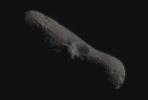
20000217a-PCF-LXTT-IPF.jpgOrbiting 433-Eros (Absolute Natural Colors; credits for the additional process. and color: Dr Paolo C. Fienga/Lunar Explorer Italia/Italian Planetary Foundation)182 visiteCaption NASA:"This picture of 433-Eros, the first of an Asteroid taken from an orbiting spacecraft, is a mosaic of 4 images obtained by NEAR on February 14, 2000, immediately after the Spacecraft's insertion into orbit. We are looking down over the North Pole of Eros at one of the largest craters on the surface, which measures 4 miles (about 6 Km) across. Inside the crater walls are subtle variations in brightness that hint at some layering of the rock in which the crater formed. Narrow grooves that run parallel to the long axis of Eros cut through the South-Eastern part of the crater rim. A house-sized boulder is present near the floor of the crater; it appears to have rolled down the bowl-shaped crater wall. A large number of boulders is also present on other parts of the Asteroid's surface. The surface of the Asteroid is heavily cratered, indicating that 433-Eros is relatively old.
(Mosaic of images 0125956839, 0125957025, 0125957087, 0125957273)MareKromium
|
|

Jupiter-PIA23606.jpgThe "Eye" of Jupiter182 visiteCaption NASA Originale:"Swirling in Jupiter's Atmosphere for hundreds of years, the Great Red Spot is captured in this pair of close-up images from Juno's JunoCam Camera. The giant storm churns through Jupiter's Atmosphere, creating the turbulent flows to its West. On the West-side of the Great Red Spot itself, a sliver of red material is being pulled off the periphery. This is a recent, frequent, phenomenon first observed in ground-based data in 2017.
Two images have been mosaicked together by citizen scientist Kevin M. Gill to create this enhanced color composite. When they were taken on Feb. 12, 2019 at 10:24 a.m. PDT (1:24 p.m. EDT) and 10:29 a.m. PDT (1:29 p.m. EDT), Juno was about 43.500 miles (such as about 70.006,464 Km) above Jupiter's cloud tops. Features as small as 31 miles (approx. 49,889 Km) can be resolved in the images, allowing us to see structure in the interior of the Great Red Spot, as well as the fine texture of the white clouds in the South Tropical Zone below".MareKromium
|
|

Comets-Shoemaker-Levy_9_before_collision.jpgThe Shoemaker-Levy 9 Comet just before colliding with Jupiter181 visiteCaption NASA originale:"The comet's original single nucleus was torn to pieces by Jupiter's strong gravity during a close encounter with the Solar System's largest planet in 1992. The pieces are seen in this composite of HST images to be "pearls" strung out along the comet's orbital path.
In July of 1994 these pieces collided with Jupiter in a rare and spectacular series of events".
|
|
| 4548 immagini su 379 pagina(e) |
|
|
|
|
|
18 | |
|
|
|
|
|
|





