| Piú viste - DEEP SKY |

UnevenPassion.jpgThe "Uneven Passion" (by Marco Faccin)68 visitenessun commentoMareKromium
|
|

NGC-6302.jpgNGC 6302 - The "Butterfly Nebula"68 visite"...Illi robur et aes triplex
Circa pectus erat, qui fragilem truci
Commisit pelago ratem
Primus..."
(Orazio)
"...Triplice bronzo e rovere
Quel fero cor cigneano,
Che fidò il primo un fragile
Pino all'immane Oceano..."
(trad. di Vincenzo Monti)MareKromium
|
|

NGC-6888~1.jpgNGC 6888 - The "Crescent Nebula"68 visite"...Nemo unquam imperium flagitio quaesitum bonis artibus exercuit..."
(Tacito)
"...Nessuno ha mai esercitato bene il potere che acquisì malamente (con frode o violenza)..."MareKromium
|
|

NGC-4710-HST.jpgNGC 4710 - Spiral Galaxy68 visite"...If you indeed cry out for insight,
And raise your voice for understanding,
Then you will find the Knowledge of God..."
Proverbs - 2:3, 5MareKromium
|
|

Epsilon_Aurigae.jpgEpsilon Aurigae68 visite"...Nothing disappears without a trace..."
Albert HolsteenMareKromium
|
|

M-034-0.jpgM 34 - Open Star Cluster68 visite"...Integritatis fama alterum patrimonium est..."
(Publio Siro)
"...La fama (derivante dal possesso) di Integrità (Morale) è un secondo patrimonio..."MareKromium
|
|

M-003-2.jpgM 3 - Globular Star Cluster67 visite"...Mi farò strada, fra cento miliardi di stelle, la mia Anima le attraverserà e, su una di esse, vivrà in eterno... Vi sono, dicono, cento miliardi di galassie: tocco l'Infinito con le mani, aggiungo stella a stella, sbucherò da qualche parte, sono sicuro, vivremo per l'Eternità... Ma già qui, vivo vite parallele, ciascuna con un centro, con un'avventura, e qualcuno che mi scalda il cuore..."
(F. Battiato - "Vite Parallele")
|
|

M-093-2.jpgM 93 (NGC 2447) - Open Star Cluster67 visite"...Do not be conformed to this world, but be transformed by the renewing of your minds..."
(Romans 12:2)
|
|

M-030-1.jpgM 30 - Globular Star Cluster67 visite"...Ho visto cose che voi Umani non potreste neppure immaginare. Navi da guerra in fiamme al largo dei bastioni di Orione...E ho visto i Raggi 'B' splendere nel buio delle notti di Tannoiser. Ed ora, tutti questi...ricordi... svaniranno, come lacrime, nella pioggia.
Andiamo: è tempo di morire..."
(dal film "Blade Runner")
|
|
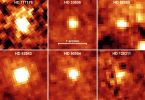
Various HD Class Stars-PIA07098_modest.jpgSuns like our Sun...67 visiteNASA's Spitzer Space Telescope recently captured these infrared images of six older stars with known planets. The yellow, fuzzy blobs are stars circled by disks of dust, or "debris disks," like the one that surrounds our own Sun. Though astronomers had predicted that stars with planets would harbor debris disks, they could not detect such disks until now: Spitzer was able to sense these dusty disks via their warm infrared glows. Specifically, the presence of the disks was inferred from an excess amount of infrared emission relative to what is emitted from the parent star alone. The stars themselves are similar in age and temperature to our Sun. In astronomical terms, they are stellar main sequence stars, with spectral types of F, G or K. These planet-bearing stars have a median age of 4 billion years. For reference, our Sun is classified as a G star, with an age of approximately 5 billion years. The disks surrounding these planetary systems are comprised of cool material, with temperatures less than 100 Kelvin (-173 degrees Celsius). They are10 times farther away from their parent stars than Earth is from the Sun, and are thought to be analogues of the comet-filled Kuiper Belt in our solar system.
|
|

NGC-2647.jpgNGC 2647 - Star "nursery"67 visite"...Eravamo partiti con l'intenzione di tracciare una Nuova Via: volevamo portare un messaggio ai Popoli, alle Genti di questo Mondo. Un messaggio che rimanesse impresso nella Storia e, forse, anche nella Leggenda.
Siamo giunti, alla fine e dopo grandi tribolazioni, con il seguire delle strade già tracciate.
Strade vecchie e polverose. E nessun messaggio è arrivato, nessuna pagina di Storia è stata scritta o riscritta.
Nessuna leggenda verrà raccontata.
Voi ora leggete e sorridete, ma fate attenzione: questa non è la mia storia.
Questa storia, è la Vostra".
P.C. Floegers - "Conversations"
|
|
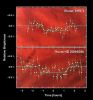
PlanetsLight-PIA07491.jpgThe language of "Planetary Light"67 visiteThis graph of data from NASA's SST shows changes in the infrared light output of 2 star-planet systems located hundreds of LY away. The data were taken while the planets, called HD 209458b and TrES-1, disappeared behind their stars in what is called a "secondary eclipse." The dip seen in the center of each graph represents the time when the planets were eclipsed, and tells astronomers exactly how much light they emit.
Why a secondary eclipse? When a planet transits, or passes in front of, its star, it partially blocks the light of the star. When the planet swings around behind the star, the star completely blocks its light. This drop in total light can be measured to determine the amount of light coming from just the planet.
Why infrared? In visible light, the glare of a star overwhelms its planetary companion and the little light the planet reflects. In infrared, a star shines less brightly and its planet gives off its own internal light, or heat radiation, making the planet easier to detect. By observing these secondary eclipses at different infrared wavelengths, astronomers can obtain the planet's temperature, and, in the future, they may be able to pick out chemicals sprinkled throughout a planet's atmosphere. The technique also reveals whether a planet's orbit is elongated or circular".
|
|
| 1891 immagini su 158 pagina(e) |
 |
|
|
|
|
139 | |
|
|
|
|





