| Piú viste - Original NASA Frames - Jupiter and the "Jupiter System" through Voyager 1 and 2 |
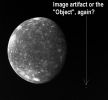
45-vg1_1639948.jpgCallistus: the "dark moon" and another (?) "strange companion" (b/w)59 visiteCome segnalatoci dal nostro Ricercatore Esterno, Dr G. Barca, anche nelle prossimità di Callisto sembra esserci uno "strano compagno". Che sia lo stesso oggetto che avevamo incontrato nei pressi di "Io"?
Le porte della Fantasia sono aperte: allora, escludendo (con riserva e sino a prova contraria) l'ipotesi per cui il "puntino bianco" sia un image-artifact, che cosa potrà mai essere? Un'altra "luna provvisoria", questa volta di Callisto? Un altro "corpo vagante" - magari una "futura cometa"?
O forse si tratta di un qualcosa di Alieno che sta osservando (e seguendo?) la Sonda Voyager 1?
Come sempre, noi Vi diamo tutti gli elementi disponibili: al resto provate a rispondere Voi stessi...
|
|

10-vg1_p21231.jpgIn the vicinities of the "Great Red Spot" (natural colors)58 visitenessun commento
|
|

16-vg1_1636548.jpgSwirling Atmosphere...57 visitenessun commento
|
|

31-vg1_1637750.jpgIo and His volcanoes... (2)57 visitenessun commento
|
|

507-PIA01517.jpgThe equatorial Region of Ganymede57 visiteCaption NASA originale:"This picture is relevant to a Regione near the Equator of Ganymede, and has relatively subdued colors in the visible part of the spectrum. The most striking features are the bright ray craters which have a distinctly bluer color, appearing white against the redder background.
Ganymede's surface is known to contain large amounts of surface ice and it appears that these relatively young craters have spread bright fresh ice materials over the surface.
Likewise, the lighter color and reflectivity of the grooved areas suggest that here, too, there is cleaner ice. We see ray craters with all sizes of ray patterns, ranging from extensive systems, down to craters which have only faint remnants of bright ejecta patterns.
This variation suggests that, as on the Moon, there are processes which act to darken ray material - probably the so-called "gardening", by micrometeoroid impacts".
|
|

00-vg1_p20938.jpgJupiter, in true colors56 visiteUn nuovo viaggio in quelle che sono (ormai) le "Memorie dell'Astronautica".
Si tratta di Giove e del suo stupendo Sistema di lune, attraverso gli occhi di due grandissimi "Esploratori": le Sonde NASA, Voyager 1 e 2.
Voyager 1, il 15 Agosto 2006, ha raggiunto la (davvero "astronomica") distanza di 100 U.A. dal nostro Sole (o, se preferite, la distanza di circa 15 miliardi di Km dal Sole), confermandosi come l'oggetto fabbricato dall'Uomo "più distante" dal suo Mondo di origine.
Ecco un commento al riguardo da parte del Dr Edward Stone (ex Direttore del NASA JPL di Pasadena):"...what you can't predict is that the spacecraft isn’t going to wear out or break: Voyager 1 and 2 run 24 hours a day, 7 days a week, but they were built to last - Stone said.
The spacecrafts have really been put to the test during their nearly 30 years of space travel, flying by the outer planets, and enduring such challenges as the harsh radiation environment around Jupiter". - continua
|
|

02-vg1_p21151.jpgJupiter, in true colors56 visite"Interstellar space is filled with material ejected by explosions of nearby stars" Stone added. "and Voyager 1 will be the first human-made object to cross into it".
Voyager Project Manager Ed Massey of JPL says the survival of the two spacecrafts is a credit to the robust design of the spacecraft, and to the flight team, which is now down to only 10 people.
"But it’s these 10 people who are keeping these spacecrafts alive. They’re very dedicated. This is sort of a testament to them, that we could get all this done".
Between them, the two Voyagers have explored Jupiter, Uranus, Saturn and Neptune, along with dozens of their moons. In addition, they have been studying the Solar Wind, the stream of charged particles spewing from the sun at nearly a million miles per hour.
|
|

04-vg1_p21182.jpgJupiter, in true colors56 visitenessun commento
|
|

05-vg1_p21194.jpgThe elongated "Dark Spot" of Jupiter56 visiteSi tratta di un fenomeno anomalo il quale è stato osservato ed immortalato dalla Sonda Voyager 1, ma la cui spiegazione - in fondo - non è mai arrivata.
Le ipotesi più accreditatate sull'argomento parlano:
1) di una possibile "apertura" (rectius: uno "squarcio") nel tessuto compatto dell'Atmosfera Gioviana - determinato da cause ignote - tale per cui quello che vediamo NON è un sistema nuvoloso compatto e composto da nuvole più scure rispetto a quelle circostanti, bensì è un dettaglio di ciò che esiste al di sotto degli strati più esterni dell'Atmosfera Gioviana stessa;
2) di una turbolenza simile a quella (famosissima ed ultracentenaria) conosciuta come la "Macchia Rossa" di Giove ma, in questo caso, composta da nuvole "più dense" e - presumibilmente - formate da (o contenenti) elementi diversi (e più pesanti) rispetto a quelli che caratterizzano le Regioni circostanti;
3) una turbolenza Gioviana assolutamente analoga a tutte le altre, con l'unica differenza che, in questo caso, la colorazione più scura è semplicemente dovuta alle particolari condizioni di illuminazione di Giove al momento dello scatto.
|
|

06-vg1_p21224.jpgJovian turbulence (false colors)56 visitenessun commento
|
|

07-vg1_p21225.jpgJovian turbulence (natural colors)56 visitenessun commento
|
|

09-vg1_p21229c.jpgThe "Great Red Spot" of Jupiter (false colors)56 visitenessun commento
|
|
| 39 immagini su 4 pagina(e) |
2 |  |
|





