| Piú viste - 1-Ceres and 4-Vesta |

005-Ceres.jpgMoments of 1-Ceres (2)58 visiteFor 2 centuries it was the largest known rock in the Solar System. The Texas-sized asteroid Ceres, about 930 Km (about 580 miles) across, was the first asteroid ever detected. The space rock was identified in 1801 by astronomer Giuseppe Piazzi, a monk in Sicily and the founding director of the Palermo Astronomical Observatory. He noted over a few nights a shifting point in the sky that wasn't one of the planets, their moons or a star. Thus, he discovered the rock.
After discovering the asteroid, Piazzi was invited to join the Celestial Police, a group of 24 international astronomers looking for what they called "guest planets" between Mars and Jupiter. The Celestial Police noted that the spacing between planets was fairly regular, but that there was a large gap between Mars and Jupiter.
Soon other small bodies were discovered in that region (Pallas in 1802, Juno in 1804 and Vesta in 1807), so the Celestial Police concluded that not just one, but many minor planets had to exist in a Main Asteroid Belt.
|
|

006-Ceres.jpg1-Ceres (natural colors, from HST - credits: NASA/ESA et al.)58 visiteThe Hubble image of Ceres on the reveals bright and dark regions on the asteroid's surface that could be topographic features, such as craters, and/or areas containing different surface material. Large impacts may have caused some of these features and potentially added new material to the landscape. The Texas-sized asteroid holds about 30 to 40% of the mass in the Asteroid Belt.
Ceres' round shape suggests that its interior is layered like those of terrestrial planets such as Earth. The asteroid may have a rocky inner core, an icy mantle, and a thin, dusty outer crust. The asteroid may even have water locked beneath its surface. It is approx. 590 miles (950 Km) across and was the first asteroid discovered in 1801.
The observation was made in visible and ultraviolet light between December 2003 and January 2004 with the HST Advanced Camera for Surveys. The color variations in the image show either a difference in texture or composition on Ceres' surface.
Astronomers need the close-up views of the Dawn spacecraft to determine the characteristics of these regional differences.
MareKromium
|
|

007-Ceres-PIA10235.jpg1-Ceres (natural colors, from HST - credits: NASA/ESA et al.)58 visiteCaption NASA:"This is a NASA Hubble Space Telescope color image of 1-Ceres, the largest object in the Asteroid Belt.
Astronomers enhanced the sharpness in these Advanced Camera for Surveys images to bring out features on Ceres' surface, including brighter and darker regions that could be asteroid impact features.
The observations were made in Visible and UV Light between December 2003 and January 2004.
The colors represent the differences between relatively red and blue regions. These differences may simply be due to variation on the surface among different types of material.
Ceres' round shape suggests that its interior is layered like those of terrestrial planets such as Earth. Ceres may have a rocky inner core, an icy mantle, and a thin, dusty outer crust inferred from its density and rotation rate of 9 hours. Ceres is approximately 590 miles (about 950 Km) across and was first discovered in 1801".MareKromium
|
|

099-DawnTrajectory.jpgThe "Dawn" Mission to 4-Vesta and 1-Ceres57 visiteGerman mathematician Karl F. Gauss calculated from Piazzi's few observations that 1-Ceres circled around the Sun once every 4,6 years or about 4 years, 220 days. The asteroid has a very primitive surface, say scientists on NASA's Dawn mission, which will launch in 2007 and examine 1-Ceres in 2015. The asteroid, like a young planet, contains water-bearing minerals, and possibly a very weak atmosphere and frost. Infrared observations show that the surface is warm.
NASA's HST observed that 1-Ceres' surface has a large spot, which could be a crater formed when another asteroid struck Ceres.
A second explanation may be that the spot is a brighter substance in the asteroid's soil. In July 2001, an object larger than 1-Ceres was found in the vast Kuiper Belt of asteroids, stretching from 30 to 100 AU (2,8 to 9,3 BMs away from the Sun.) This brightest and therefore biggest non-planet space rock, 2001 KX76, could be as big as 1300 Km across.
Per maggiori informazioni sulla Missione "Dawn", visitate il Sito:
http://dawn.jpl.nasa.gov/mission/index.asp
|
|
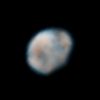
021-Vesta-2.jpg4-Vesta, from HST57 visiteHubble observation of Vesta: picture taken with the Wide Field Planetary Camera 2 on May 14 and 16, 2007.
MareKromium
|
|

004-Ceres.jpgMoments of 1-Ceres (1)56 visiteDa "NASA - Picture of the Day", del 21 Agosto 2006:"Is 1-Ceres an Asteroid or a Planet?
Although a trivial designation to some, the recent suggestion by the Planet Definition Committee of the International Astronomical Union would have 1-Ceres reclassified from Asteroid to Planet.
A change in taxonomy might lead to more notoriety for the frequently overlooked world. Ceres, at about 1000 Km across, is the largest object in the main Asteroid Belt between Mars and Jupiter. Under the newly proposed criteria, Ceres would qualify as a planet because it is nearly spherical and sufficiently distant from other planets. Pictured above is the best picture yet of Ceres, taken by the Hubble Space Telescope as part of a series of exposures ending in 2004 January. Currently, NASA's Dawn mission is scheduled to launch in 2007 June to explore Ceres and Vesta, regardless of their future designations".
|
|

021-Vesta-3.jpgMoments of 4-Vesta56 visiteTo prepare for the Dawn spacecraft's visit to Vesta, astronomers used Hubble's Wide Field Planetary Camera 2 to snap new images of the asteroid. These images were taken on May 14 and 16, 2007. Each frame shows time in hours and minutes based on Vesta's 5,34-hour rotation period. Using Hubble, astronomers mapped Vesta's Southern Hemisphere, a Region dominated by a giant impact crater formed by a collision billions of years ago. The crater is 285 miles (456 Km) across, which is nearly equal to Vesta's 330-mile (530-Km) diameter.
Hubble's sharp "eye" can see features as small as about 37 miles (60 Km) across. The images show the difference in brightness and color on the asteroid's surface. These characteristics hint at the large-scale features that the Dawn spacecraft will see when it arrives at Vesta in 2011.
Hubble's view reveals extensive global features stretching longitudinally from the Northern Hemisphere to the Southern Hemisphere.
The images also show widespread differences in brightness in the east and west, which probably reflects compositional changes. Both of these characteristics could reveal volcanic activity throughout Vesta. The size of these different regions varies. Some are hundreds of miles across.
The brightness differences could be similar to the effect seen on the Moon, where smooth, dark regions are more iron-rich than the brighter highlands that contain minerals richer in calcium and aluminum. When Vesta was forming 4.5 billion years ago, it was heated to the melting temperatures of rock. This heating allowed heavier material to sink to Vesta's center and lighter minerals to rise to the surface.
Astronomers combined images of Vesta in two colors to study the variations in iron-bearing minerals. From these minerals, they hope to learn more about Vesta's surface structure and composition. Astronomers expect that Dawn will provide rich details about the asteroid's surface and interior structure.
MareKromium
|
|
|
| 55 immagini su 5 pagina(e) |
 |
|
5 |
|





