| Piú viste - 1-Ceres and 4-Vesta |

090-Craters-Cornelia_Crater-PIA16489-PCF-LXTT-IPF.jpgCornelia Crater (Absolute Natural Colors; credits for the additional process. and color.: Dr Paolo C. Fienga/Lunar Explorer Italia/Italian Planetary Foundation)110 visiteThis frame shows us a consistent number of examples of long, narrow and sinuous Gullies that scientists on NASA's Dawn Mission have found on the Giant Asteroid 4-Vesta. The Impact Crater shown here is called Cornelia and the Gullies inside it - called "Type-B" Gullies - are different substantially from the straighter, wider, shorter Gullies that Planetary Scientists have found on different Celestial Bodies (like the ones located on the Rims of many Martian Impact Craters, for instance) and which are designated as "Type-A" Gullies (and the reason of such a distinction is found in the circumstance that these two Gully-types have different formation mechanisms). This picture was obtained by the NASA - Dawn Spacecraft Framing Camera on January 11, 2012; North is up.
This frame (which is an Original NASA - Dawn Spacecraft b/w image published on the NASA - Planetary Photojournal with the ID n. PIA 16489) has been additionally processed and then colorized, according to an informed speculation carried out by Dr Paolo C. Fienga (LXTT-IPF), in Absolute Natural Colors (such as the colors that a human eye would actually perceive if someone were onboard the NASA - Dawn Spacecraft and then looked outside, towards the Surface of the Giant Asteroid 4-Vesta), by using an original technique created - and, in time, dramatically improved - by the Lunar Explorer Italia Team. Different colors, as well as different shades of the same color, mean, among others, the existence of different Elements present on the Surface of 4-Vesta, each having a different Albedo (---> Reflectivity) and Chemical Composition.MareKromium
|
|

020-1-Ceres-PIA22641.jpgUnusually-looking Surface Feature on 1-Ceres109 visiteCaption NASA Originale:"This image was obtained by NASA's Dawn Spacecraft on July 17, 2018 from an altitude of about 25 miles (such as approx. 40,23 Km).
The center of this picture is located at about 31,0° South Latitude and 248,9° East Longitude".MareKromium
|
|

056-Vesta-3D-PIA14314.jpgThe South Pole of 4-Vesta in 3D107 visiteCaption NASA:"This anaglyph image of the South Polar Region of the Asteroid 4-Vesta was put together from two clear filter images, taken on July, 9th, 2011 by the framing camera instrument aboard NASA's Dawn Spacecraft. Each pixel in this image corresponds to roughly 2,2 miles (about 3,5 Km)".MareKromium
|
|

008-Ceres-Dumas_300-PCF-LXTT.jpg1-Ceres from Keck Observatory107 visitenessun commentoMareKromium
|
|

050-Vesta-HR_Video.gif4-Vesta: Full Rotation (a GIF-Movie by NASA / JPL / UCLA / MPS / DLR / PSI)106 visiteAs Dawn continued its approach to 4-Vesta on June 20, 2011, it occasionally quit thrusting and turned to the spinning Asteroid to perform a "rotation characterization," seeing all longitudes as 4-Vesta rotated beneath the Spacecraft.MareKromium
|
|

011-1-Ceres-Full_Rotation.gif1-Ceres: Full Rotation (GIF-Movie - Credits: NASA/JPL)105 visitenessun commentoMareKromium
|
|

019-Vesta-5-PIA13427.jpg4-Vesta from Hubble Space Telescope104 visiteThe Asteroid 4-Vesta is somewhat like our Moon, with ancient Lava Beds (the dark patches) and powdery Debris (or Regolith), such as the pulverized remains of impacts (the orange-colored areas). A flattened area on one end of 4-Vesta is a giant Impact Crater formed by a collision that perhaps occurred billions of years ago.
The crater is approx. 460 Km (285,66 miles) across, which makes it close to 4-Vesta's roughly 530-Km (329,13-mile) diameter. The asteroid is about the size of Arizona.
4-Vesta is one of the largest of a reservoir of about 100.000 Asteroids, the leftover material from the formation of our Solar System.
Astronomers combined images of Vesta in Near-UltraViolet and blue light to make this picture movie. The Hubble observations were made on Feb. 25 and Feb. 28, 2010.MareKromium
|
|

018-Vesta-6-PIA13428.jpgSome of the "Faces" of 4-Vesta, from Hubble Space Telescope97 visiteNASA's Hubble Space Telescope snapped these images of the Asteroid 4-Vesta in preparation for the Dawn Spacecraft's visit in 2011. Each of the 4 Hubble images captures views of Vesta during its 5,34-hour rotation period. Hubble's sharp "eye" can see features as small as about 40 Km (24,84 miles) across in these images. Vesta was 211 MKM (approx. 131 MMs) from Earth when Hubble made the observations.
The images show the difference in brightness and color on the Asteroid's Surface. These characteristics hint at the large-scale features that the Dawn Spacecraft will see when it visits the potato-shaped asteroid.
Astronomers used the images, taken with Hubble's Wide Field Camera 3, to better determine 4-Vesta's Spin Axis. Based on the HST observations, astronomers calculated a slightly different, and more precise, Rotation Axis for Vesta. The new calculation will change the pattern of sunlight expected to illuminate the Asteroid when Dawn arrives.
Determining a more accurate Spin Axis for 4-Vesta will also help scientists refine the Dawn Spacecraft's orbit around the Asteroid. Dawn will orbit the rocky object for a year, beginning in July 2011. The Spacecraft will then travel to the "Dwarf Planet" 1-Ceres, arriving in 2015.
Hubble has kept its "eye" on 4-Vesta for more than 15 years, beginning in 1994. Hubble images of 4-Vesta in 1997 helped astronomers discover the Asteroid's very large Impact crater. Astronomers combined views of 4-Vesta in Near-UltraViolet and blue light to construct these images and the images were taken on Feb. 25, 2010.MareKromium
|
|
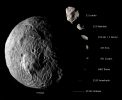
060-Vesta_and_Friends-PIA14316.jpg4-Vesta and "Friends"...88 visiteCaption NASA:"This composite image shows the comparative sizes of 8 (eight) Asteroids. Up until now, Lutetia, with a diameter of about 81 miles (approx. 130 Km), was the largest Asteroid visited by a Spacecraft.
Vesta, which is also considered a protoplanet because it's a large body that almost became a planet, dwarfs all other small bodies in this image, with its diameter sizing up at approximately 330 miles (about 530 Km)".
MareKromium
|
|

040-Vesta-PIA14122.jpgApproaching 4-Vesta82 visitenessun commentoMareKromium
|
|

022-Vesta-4.jpg4-Vesta (computer generated imaging - credits: Ben Zellner - Georgia Southern University -, Peter Thomas - Cornell University - and NASA)80 visiteUn'immagine decisamente bella, precisa, distinta. Ma è un'immagine "vera"? NO! Questa immagine dell'Asteroide 4-Vesta è "computer generated", così come sono "computer generated" TUTTE LE IMMAGINI CHE RITRAGGONO - IN CHIAVE PROSPETTICA - DELLE SEZIONI ISOLATE DELLA SUPERFICIE DI MARTE E CHE SONO STATE OTTENUTE DALLA SONDA ESA "MARS EXPRESS".
La differenza?
La differenza è nella "qualità" dell'immagine "computer generated": le immagini ESA sono - e lo ripeteremo sino alla nausea - alquanto dozzinali (Voi sapete che la pixellatura dei frames ESA ottenuti con questa tecnica è talmente grezza che, alla fine dell'opera, gli image-artifacts che li caratterizzano sono così tanti che, come è già accaduto tantissime volte, le sviste e le traveggole che essi ingenerano e suggeriscono sono davvero allucinanti); le immagini NASA, invece, sono di gran lunga più "smooth" (lisce, nel senso di prive di difettosità palesi ed artifacts) e, globalmente parlando, di fattura enormemente superiore.
Ma in ENTRAMBI I CASI SI TRATTA DI PSEUDO-IMMAGINI! Non lo dimenticate...
Caption NASA:"A 3-D computer model of the asteroid Vesta synthesized from Hubble topographic data. The crater's 8-mile high central peak can clearly be seen near the pole. The surface texture on the model is artificial, and is not representative of the true brightness variations on the asteroid. Elevation features have not been exaggerated". MareKromium
|
|

039-Vesta-PIA14121.jpgApproaching 4-Vesta80 visitenessun commentoMareKromium
|
|
| 55 immagini su 5 pagina(e) |
 |
3 | |
|





