| Piú viste - 1-Ceres and 4-Vesta |
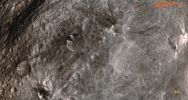
066-Vesta-PIA14324-PCF-LXTT.jpgBizarre-looking Surface Feature of 4-Vesta (Natural Colors; credits for the additional process. and color.: Dr Paolo C. Fienga - Lunar Explorer Italia) 177 visitenessun commentoMareKromium
|
|
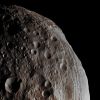
072-Vesta-Striations-PIA14678-PCF-LXTT.jpgStriations on Vesta (Absolute Natural Colors; credits for the additional process. and color.: Drr Gianluigi Barca and Paolo C. Fienga - Lunexit Team)177 visitenessun commentoMareKromium
|
|

081-Craters-Sextilia_Crater-PIA15085-PCF-LXTT.jpgSextilia Crater and Surroundings (Absolute Natural Colors; credits for the additonal process. and color.: Dr Paolo C. Fienga - Lunar Explorer Italia)159 visiteThis Dawn FC (framing camera) image is centered on the Sextilia Crater in Vesta's Southern Hemisphere. Craters on Vesta are named after Vestal virgins, priestesses of the Roman goddess Vesta. The Sextilia Crater is a large, approximately 15 Km diameter and distinctive Crater, therefore its name was used to name the whole Quadrangle in which it is located. Sextilia Crater is distinctive because it has a fresh, sharp Rim which is also scalloped in shape. It also contains Rocky Outcrops of both bright and dark material. These originate along its Rim and sides and slump towards the center of the Crater. There are some especially large slumps of material on the right side of it. Surrounding Sextilia Crater is the Hummocky (---> wavy/undulating) Terrain of Vesta's Southern Hemisphere and some dark and bright Rayed Craters.
This image is in Vesta's Sextilia Quadrangle and the center Latitude and Longitude of the image is 39,5° South and 155,7° East. NASA's Dawn Spacecraft obtained this image with its framing camera on October 10th 2011. This image was taken through the camera's clear filter. The distance to the surface of Vesta is approx. 702 Km and the image has a resolution of about 70 meters per pixel. This image was acquired during the HAMO (High Altitude Mapping Orbit) phase of the mission.MareKromium
|
|

080-Craters-Tuccia_Crater-TQ-PIA15081-PCF-LXTT.jpgTuccia Crater (Absolute Natural Colors; credits for the additional process. and color.: Drr Gianluigi Barca and Paolo C. Fienga - Lunexit Team)158 visiteThis Dawn FC (framing camera) image is dominated by bright Rayed Craters of different sizes. The most prominent bright Rayed Crater is the approximately 8 Km diameter crater in roughly the center of the image. This Crater is named Tuccia and the Quadrangle in which it is located is named after it. Towards the bottom of the image its bright rays extend for over 10 Km but towards the top the Rays are much less extensive. Tuccia Crater has a smaller, fresher, younger Crater on its Rim which also seems to have bright rays emanating from it. It is clear that this smaller Crater is younger because it overprints the larger one and has a fresher, sharper Rim than Tuccia's. Slightly above these Craters is a much smaller, roughly 2 Km diameter, bright Rayed Crater. To the left of this Crater there is a patch of bright material that is associated with Craters that are only a few pixels in diameter. There is also a good example of the Hummocky (---> wavy/undulating) Terrain of Vesta's South Polar Region (visible at the bottom left of the frame). Tuccia Crater has been emplaced onto this Hummocky Terrain.
This image is in Vesta's Tuccia Quadrangle and the center Latitude and Longitude of the image is 38,8° South and 200,2° East. NASA's Dawn Spacecraft obtained this image with its framing camera on October 17th 2011. This image was taken through the camera's clear filter. The distance to the Surface of Vesta is about 702 Km and the image has a resolution of about 70 meters per pixel. This image was acquired during the HAMO (High Altitude Mapping Orbit) phase of the mission.MareKromium
|
|

017-1-Ceres-Occator-Black_Shadow-02.jpgDark "Spot" inside Occator Crater (EDM)136 visiteMareKromium
|
|

062-Vesta-071811-PCF-LXTT.jpgFeatures of 4-Vesta (Natural Colors; credits for the additional process. and color.: Dr Paolo C. Fienga - Lunar Explorer Italia)135 visiteCaption NASA:"NASA's Dawn Spacecraft obtained this image with its framing camera on July 18, 2011. It was taken from a distance of about 6500 miles (approx. 10.500 Km) away from the Protoplanet 4-Vesta. The smallest detail visible is about 1,2 miles across (approx. 2 Km).MareKromium
|
|

054-Vesta-571329-PCF-LXTT.jpgApproaching 4-Vesta (Natural Colors; credits for the additional process. and color.: Dr Paolo C. Fienga - Lunar Explorer Italia)133 visiteCaption NASA:"NASA's Dawn Spacecraft obtained this image with its framing camera on July 17, 2011. It was taken from a distance of about 9500 miles (approx. 15.000 Km) away from the Protoplanet 4-Vesta. Each pixel in the image corresponds to roughly 0,88 miles (about 1,4 Km)".MareKromium
|
|
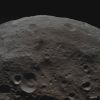
067-Vesta-PIA14694-1.jpgFeatures of 4-Vesta: Dark Material on Hilltops (Absolute Natural Colors; credits for the additional process. and color.: Dr Paolo C. Fienga - Lunexit Team) 131 visiteCaption NASA:"NASA's Dawn Spacecraft obtained this image with its framing camera on Aug. 18, 2011. This image was taken through the framing camera's clear filter aboard the Spacecraft. The image has a resolution of about 260 mts per pixel".
MareKromium
|
|

018-1-Ceres-PIA22764.jpgOccator Crater on the Limb...126 visitenessun commentoMareKromium
|
|

016-1-Ceres-Occator-Black_Shadow-01.jpgDark "Spot" inside Occator Crater (CTX Frame)118 visiteMareKromium
|
|
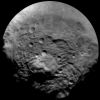
055-Vesta-PIA14315.jpgThe South Pole of 4-Vesta111 visiteCaption NASA:"This image, taken by the framing camera instrument aboard NASA's Dawn Spacecraft, shows the South Polar Region of 4-Vesta, which has a diameter of about 330 miles (approx. 530 Km). The image was taken through the clear filter on July, 9th, 2011, as part of a rotation characterization sequence, and it has a scale of about 2,2 miles (approx. 3,5 Km) per pixel.
To enhance details, the resolution was enlarged to .6 miles (roughly 1 Km) per pixel.
This Region is characterized by rough topography, a large Mountain, Impact Craters, Grooves and steep Scarps. The original image was map-projected, centered at 55°
South Latitude and 210° East Longitude".MareKromium
|
|
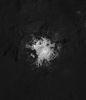
021-1-Ceres-Cerealia_Facula-Occator_Crater-PIA21924.jpgCerealia Facula111 visiteCaption NASA Originale"This mosaic of Cerealia Facula is based on images obtained by NASA's Dawn Spacecraft in its second extended mission, from an altitude as low as about 21 miles (such as approx. 33,79 Km). The contrast in resolution obtained by the two phases is visible here, reflected by a few gaps in the high-resolution coverage. This image is superposed to a similar scene acquired in the low-altitude mapping orbit of the mission from an altitude of about 240 miles (i.e. approx. 386,24 km).
The increased resolution afforded by the low altitude is revealing intimate details about the relationships between bright and dark materials across the Facula (---> Bright Spot), which will help resolve the mystery of its origin.
Cerealia Facula is located at about 19,7° North Latitude and 239,6° East Longitude".MareKromium
|
|
| 55 immagini su 5 pagina(e) |
2 |  |
|
|





