| Piú viste - The Best Frames from Viking Orbiter 1 and 2 |

vo1_020a62.jpgMars: according to Viking 1 Orbiter54 visiteThe results from the Viking experiments give our most complete view of Mars to date. Volcanoes, lava plains, immense canyons, cratered areas, wind-formed features and evidence of surface water are apparent in the Orbiter images. The Planet appears to be divisible into two main regions: Northern Low Plains and Southern Cratered Highlands. Superimposed on these Regions are the Tharsis and Elysium bulges - high-standing volcanic areas - and Valles Marineris, a system of giant canyons near the Equator.
The surface material at both landing sites can best be characterized as iron-rich clay. Measured temperatures at the landing sites ranged from 150 to 250 K, with a variation over a given day of 35 to 50 K. Seasonal dust storms, pressure changes, and transport of atmospheric gases between the polar caps were observed.
The biology experiment produced no evidence of life at either landing site.
|
|

vo1_032a18.jpgMars: according to Viking 1 Orbiter54 visitenessun commento
|
|

vo1_038a02.jpgMars: according to Viking 1 Orbiter54 visitenessun commento
|
|

vo1_043a04.jpgMars: according to Viking 1 Orbiter54 visitenessun commento
|
|
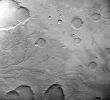
vo1_084a47.jpgMars: according to Viking 1 Orbiter54 visitenessun commento
|
|

vo1_087a14.jpgMars: according to Viking 1 Orbiter54 visitenessun commento
|
|

vo1_094a42.jpgMars: according to Viking 1 Orbiter54 visitenessun commento
|
|

vo1_097a62.jpgMars: according to Viking 1 Orbiter54 visitenessun commento
|
|

vo1_224a13.jpgMars: according to Viking 1 Orbiter54 visitenessun commento
|
|

vo1_225a05.jpgMars: according to Viking 1 Orbiter54 visitenessun commento
|
|

vo1_242a19.jpgPhobos, according to Viking 154 visitenessun commento
|
|

vo1_244a72.jpgPhobos, according to Viking 154 visitenessun commento
|
|
| 78 immagini su 7 pagina(e) |
 |
|
|
5 | |
|





