| Piú viste - The Best Frames from Viking Orbiter 1 and 2 |

MarsColors02-Viking.jpgThe Colors of Mars (2)56 visiteTo see the color differences, they must be artificially enhanced through computer processing at the same time, differences in brightness must be suppressed.
Two color maps are shown here, one that approximates the natural color (frame 3) and another in which the color differences arc artificially emphasized (frames 2 and 4).
|
|
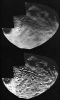
Phobos-05.jpgFractures radiating from Stickney Crater56 visiteCaption NASA originale:"Viking Orbiter 1 flew within 300 Km of Phobos in May 1977 to obtain this photomosaic. Raw pictures are at the top and computer-enhanced pictures, to show small surface detail, are at the bottom. The Northern Hemisphere of Phobos is visible from about 30° above the Equator (Phobos' orbit plane), with the side of Phobos facing Mars at the lower right. Phobos presents an illuminated area of about 17 Km from top to bottom and 23 Km across. The rim of Stickney, the largest crater on Phobos, is seen at the lower left, with a large network of grooves radiating from it.
A large, 2-km diameter crater with a slumped wall is seen just below the middle of the picture".
|
|

Volcanic_Features-Apollinaris_Patera-PCF-LXTT.jpgApollinaris Patera (Natural Colors; credits for the additional process. and color.: Dr Paolo C. Fienga - Lunexit Team)56 visiteThis Martian Volcano is found along the border between the ancient Martian Highlands and the younger Northern Lowlands.
It is characterized by a large caldera (~60 Km diameter), a basal scarp, and a large fan that emanates from the caldera and covers the Southern Flanks. Like other martian volcanoes it appears to have undergone episodes of both explosive and effusive eruptions. The color information in this mosaic of Apollinaris Patera comes from a series of color frames acquired by Viking 1 during orbit 468S (~350 m/pixel).
To sharpen details of morphology, the color mosaic was merged with a higher resolution (~180 mt/pixel) series of images acquired during orbit 088A.
For more information on Apollinaris Patera see:
- Robinson et al., Chronology, Eruption Duration, and Atmospheric Contribution of the Martian Volcano Apollinaris Patera, Icarus, 104, pp. 301-323, 1993.
- Scott, D.H., J.M. Dohm, D.J. Applebee, Geologic Map of Science Study Area 8, Apollinaris Patera Region of Mars, (Special MTM-10186 Quadrangle), USGS Misc. Investigations Series, MAP-I-2351, 1993.MareKromium
|
|

vo1_225a13.jpgMars: according to Viking 1 Orbiter55 visitenessun commento
|
|
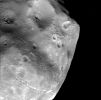
vo1_315a12.jpgPhobos, according to Viking 155 visitenessun commento
|
|

vo1_343a15.jpgPhobos, according to Viking 155 visitenessun commento
|
|

vo1_413s14.jpgMars, according to Viking 1 Orbiter55 visitenessun commento
|
|

vo1_608a06.jpgMars, according to Viking 1 Orbiter55 visitenessun commento
|
|

vo1_854a83.jpgStickney Crater, from Viking One55 visitenessun commento
|
|
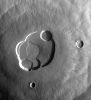
vo1_890a68.jpgMars: according to Viking 1 Orbiter55 visitenessun commento
|
|

vo2_248b57.jpgMars, according to Viking 2 Orbiter55 visitenessun commento
|
|

vo2_423b63.jpgDeimos, from Viking 255 visitenessun commento
|
|
| 78 immagini su 7 pagina(e) |
 |
|
4 | |
|
|





