| Piú viste - The Best Frames from Viking Orbiter 1 and 2 |

vo1_056a12.jpgMars: according to Viking 1 Orbiter58 visitenessun commento
|
|

Phobos.jpgPhobos, in natural colors58 visiteCaption NASA originale:"Color pictures of the two Martian moons have confirmed Earth-based spectra by also showing both satellites to be gray. The Viking imaging data showed the surfaces to be uniformly gray over the complete surface to a resolution of a few hundred meters. No significant color differences were seen on either surface, including areas around craters and those within the bright albedo features on Deimos. The color indicates composition is of a carbonaceous chondritic material. Phobos, here, is at a range of 4200 Km from the Viking 1 Orbiter.
In this picture, color differences have be en exaggerated.
Most of the color differences are due to noise or are artifacts of the processing, especially around craters and the limb".
|
|

vo1-PIA00300-PCF-LXTT.jpgOlympus Mons (Natural Colors; credits for the additional process. and color.: Dr Paolo C. Fienga - Lunexit Team)58 visitenessun commentoMareKromium
|
|

vo2_428b60.jpgDeimos, from Viking 257 visitenessun commento
|
|

vo2_479b71.jpgMars, according to Viking 2 Orbiter57 visitenessun commento
|
|

MarsColors04-Viking.jpgThe Colors of Mars (4)57 visiteAtmospheric phenomena and surface frost affect the Planet's appearance. South of approximately 40° Lat., the scene is dominated by the annual South Polar CO2 fee cap. Near-surface condensate clouds arc abundant in this Region, especially in Hellas. Because some of the data in the bright areas were saturated, the color balance is distorted; no attempt was made to correct this problem. North of about 20° Lat., condensate clouds are especially noticeable along the northernmost edge where emission angles were extreme. Other clouds are scattered locally throughout the Equatorial Region South and South-West of Valles Marineris.
This image dramatically enhances subtle color variations The violet/green ratio is used as the blue component of the final image, the albedo at the are en wavelength as the green component, and the red/green n ratio as the red component. Hence, the amount of red or blue is controlled primarily by the slope of the spectral reflectance curve: areas with high albedo are also green. Thus, high albedo blue areas (ice, fog, clouds) are blue-green in color, and high albedo red areas are orange and yellow; bright areas of average color are green. Green is absent in dark areas, so the colors represent the slope from violet to red; red areas have a steeper slope, increasing from violet to blue; blue areas have a shallower slope.
|
|

N-Deimos.jpgDeimos (Natural Colors; credits: NASA/JPL)57 visiteCaption NASA originale:"Color pictures of the two Martian moons have confirmed Earth-based spectra by also showing both satellites to be gray. The Viking imaging data showed the surfaces to be uniformly gray over the complete surface to a resolution of a few hundred meters. No significant color differences were seen on either surface, including areas around craters and those within the bright albedo features on Deimos.
The color indicates composition is of a carbonaceous chondritic material. Deimos, here, is at a range of 2100 km from the Viking 1 Orbiter. In these pictures, color differences have be en exaggerated; most of the color differences are due to noise or are artifacts of the processing, especially around craters and the limb".
|
|
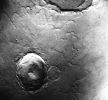
vo1_003a07.jpgMars: according to Viking 1 Orbiter56 visiteUna carrellata su alcuni bellissimi (e dimenticati) frames Viking 1 e Viking 2 i quali hanno il compito fondamentale (se non unico) di rammentarci che la tecnologia fotografica (e non solo), sin dalla metà degli Anni '70 (siamo nel 1975 per Viking 1 e nel 1976 per Viking 2), era già più che eccellente. Su Marte, e questo è il "messaggio" che vorremmo far passare - mentre guardate questi splendidi panorami orbitali - è che su Marte non siamo ancora andati (con Uomini) NON perchè non è possibile, o sicuro, o - magari - "profitable", come dicono in America.
Su Marte, oggi, AD 2006, non abbiamo ancora messo piede solo perchè - ... - non vogliamo.
Il resto (tutto il resto) è soltanto disinformazione, controinformazione e chiacchiere da bar.
|
|

vo1_252a63.jpgPhobos, according to Viking 156 visitenessun commento
|
|

vo1_357a64.jpgPhobos, according to Viking 156 visitenessun commento
|
|

vo1_783a42.jpgMars, according to Viking 1 Orbiter - Martian Cyclone56 visiteThis Viking 1 Orbiter image shows a "Low Pressure Cell" near the North Pole of Mars. This Cyclonic Storm is related to Mars' Polar Front, the boundary between the cold polar air and the warmer air to the south.
These clouds are low in the Atmosphere and most likely composed of water ice.
This image was taken in Martian Northern Mid-Summer at 6:55 MLT. The image is approx. 1150 Km across and north is at 11:30.
|
|

vo2_428b61.jpgDeimos, from Viking 256 visitenessun commento
|
|
| 78 immagini su 7 pagina(e) |
 |
3 | |
|
|
|





