| Piú viste - Mars Reconnaissance Orbiter (MRO) |

Psp_008210_2415_red~0.jpgKnobs and Small Craters with Ice in Northern Arcadia Planitia (natural colors; credits: Lunexit)69 visitenessun commentoMareKromium
|
|

Psp_009855_2625_red.jpgUnusually-looking "Mound" in the NPLD (natural colors; credits: Lunexit)69 visiteThe North Polar Layered Deposits (NPLD) are composed of a stack of ice-rich layers that is up to several kilometers thick. Each layer is thought to contain information about the climate that existed when it was deposited, so the stack of layers within the NPLD may represent a record of how climate has varied on Mars in the recent past.
We can see these internal layers exposed in the many troughs and scarps that have been cut by erosion into the stack. One of these troughs, visible in this image, contains a 500 meter (1640 feet) thick section of this layering.
However, the layers are not the only interesting thing being shown here. There is a conical mound part-way down the slope that is approximately 40 m (130 ft) high. One possible explanation for this anomaly is that it may be the remnant of a buried impact crater that is now being exhumed. As the NPLD accumulated, impacts occurred throughout its surface which were then buried by additional ice. These buried craters are generally inaccessible to us, but in a few rare locations, erosion that forms a trough (like this one) can uncover these buried structures. For reasons that are poorly understood right now, the ice beneath the site of the crater is more resistant to this erosion, so when material is removed in forming the trough the ice beneath the old impact site remains, creating this isolated hill.
An inspection of the full-resolution data shows that polygonal blocks, up to 10 mt (33 feet) across, make up this mound. Although covered with reddish dust, the blocks resemble ice-rich blocks seen in other exposures of the NPLD.MareKromium
|
|

PSP_008598_2155_RED_abrowse~0.jpgLineated Valley Fill in Coloe Fossae (MULTISPECTRUM; credits: Lunexit)69 visiteThis Region consists of several relatively straight and narrow canyons located near the boundary between the high-standing, heavily cratered areas of the Southern Hemisphere and the low, uncratered plains that cover most of the Northern Hemisphere of Mars.
Transitional areas such as this are known as the “Fretted Terrain” and are characterized by a complicated mix of cliffs, mesas, buttes, and canyons.
This image reveals a canyon with relatively steep and smooth walls. The floor of the canyon displays a complex set of ridges and grooves that are generally parallel to the canyon walls.
The material comprising the canyon floor is common observed in Fretted Terrain and is called "Lineated Valley Fill" (LVF).
The cause of the LVF texture is not well understood but may result from patterns of ice rich soils or ice loss. The linear alignment may be caused by the downhill movement of ice-rich soil, or glacial flow in dirty ice or ice-rich soil.MareKromium
|
|

PSP_009311_1735_RED.jpgPeri-Equatorial Surface Features (possible True Colors; credits: Lunar Explorer Italia)69 visiteMars Local Time: 15:27 (early afternoon)
Coord. (centered): 6,5° South Lat. and 33,9° East Long.
Spacecraft altitude: 264,3 Km (such as about 165,2 miles)
Original image scale range: 26,4 cm/pixel (with 1 x 1 binning) so objects ~52,9 cm across are resolved
Map projected scale: 25 cm/pixel
Map projection: EQUIRECTANGULAR
Emission Angle: 3,0°
Phase Angle: 57,1°
Solar Incidence Angle: 59° (meaning that the Sun is about 31° above the Local Horizon)
Solar Longitude: 101,9° (Northern Summer)
Credits: NASA/JPL/University of Arizona
Additional process. and coloring: Lunar Explorer ItaliaMareKromium
|
|

PSP_009332_2360_RED.jpgCentral Structure within an Unnamed Crater in the Northern Plains (possible True Colors; credits: Lunar Explorer Italia)69 visiteMars Local Time: 15:10 (early afternoon)
Coord. (centered): 55,6° North Lat. and 171,4° East Long.
Spacecraft altitude: 312,3 Km (such as about 195,2 miles)
Original image scale range: 31,2 cm/pixel (with 1 x 1 binning) so objects ~62,5 cm across are resolved
Map projected scale: 25 cm/pixel
Map projection: EQUIRECTANGULAR
Emission Angle: 0,3°
Phase Angle: 46,5°
Solar Incidence Angle: 46° (meaning that the Sun is about 44° above the Local Horizon)
Solar Longitude: 102,7° (Northern Summer)
Credits: NASA/JPL/University of Arizona
Additional process. and coloring: Lunar Explorer ItaliaMareKromium
|
|
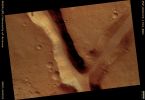
PSP_009379_1705_RED.jpgMargaritifer Chaos Valley Junction (possible True Colors; credits: Lunar Explorer Italia)69 visiteMars Local Time: 15:28 (early afternoon)
Coord. (centered): 9,4° South Lat. and 337,5° East Long.
Spacecraft altitude: 267,3 Km (such as about 167,0 miles)
Original image scale range: 26,7 cm/pixel (with 1 x 1 binning) so objects ~80 cm across are resolved
Map projected scale: 25 cm/pixel
Map projection: EQUIRECTANGULAR
Emission Angle: 0,1°
Phase Angle: 61,0°
Solar Incidence Angle: 61° (meaning that the Sun is about 29° above the Local Horizon)
Solar Longitude: 104,3° (Northern Summer)
Credits: NASA/JPL/University of Arizona
Additional process. and coloring: Lunar Explorer ItaliaMareKromium
|
|

Psp_009794_1875_red.jpgRelatively Fresh (and Rayed) Crater, Windstreaks and Fissure in Cerberus Fossae (Saturated Natural Colors; credits for the additional process. and color.: Dr Paolo C. Fienga - Lunar Explorer Italia)69 visiteMars Local Time: 15:29 (early afternoon)
Coord. (centered): 7,4° North Lat. and 165,3° East Long.
Spacecraft altitude: 274,7 Km (such as about 171,7 miles)
Original image scale range: 27,5 cm/pixel (with 1 x 1 binning) so objects ~82 cm across are resolved
Map projected scale: 25 cm/pixel
Map projection: EQUIRECTANGULAR
Emission Angle: 0,1°
Phase Angle: 52,4°
Solar Incidence Angle: 52° (meaning that the Sun is about 38° above the Local Horizon)
Solar Longitude: 119,1° (Northern Summer)
Credits: NASA/JPL/University of Arizona
Additional process. and coloring: Lunar Explorer ItaliaMareKromium
|
|

Psp_009802_1700_red.jpgGanges Cavus' Walls and Interior (possible True Colors; credits: Lunar Explorer Italia)69 visiteMars Local Time: 15:30 (middle afternoon)
Coord. (centered): 9,9° South Lat. and 308,4° East Long.
Spacecraft altitude: 264,1 Km (such as about 165,1 miles)
Original image scale range: 26,4 cm/pixel (with 1 x 1 binning) so objects ~52,8 cm across are resolved
Map projected scale: 25 cm/pixel
Map projection: EQUIRECTANGULAR
Emission Angle: 8,3°
Phase Angle: 67,2°
Solar Incidence Angle: 61° (meaning that the Sun is about 29° above the Local Horizon)
Solar Longitude: 119,4° (Northern Summer)
Credits: NASA/JPL/University of Arizona
Additional process. and coloring: Lunar Explorer ItaliaMareKromium
|
|
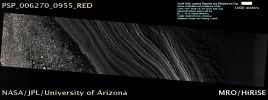
PSP_006270_0955_RED_abrowse~0.jpgSouth Polar Layered Deposits and Residual Ice Cap (natural colors; credits: Lunexit)69 visiteA wide variety of South Polar Terrains are on display in this spectacular HiRISE image. The reddish material on the left of the image is the SPLD. These deposits are a stack of layered, dusty water ice. Scientists believe that these layers record previous climatic conditions on Mars, much like terrestrial ice-sheets provide a record of climate change on the Earth.
This image shows the face of one of the many scarps or shallow cliffs that cut into the SPLD. These scarps expose the internal layers within the SPLD. You can see these climate-recording layers in the last2/3rds of the image, left side, running from lower-left to upper-right.
The terrain in the last third of the image is quite different in both appearance and composition. The bright, white-ish material is a thin covering of CO2 ice draped over the flat areas of the SPLD. This covering of CO2 is being eroded away by expanding flat-floored pits. Parts of the floors of these pits show the reddish brown coloring of the underlying SPLD.
These pits have eroded the CO2 ice layer to such an extent that only isolated mesas remain today and even these shrink in extent by a few meters each year.
These mesas also have several layers within them, indicting that they likely contain a climatic record, albeit a much shorter one than preserved in the SPLD.
Most of the isolated mesas have white-ish tops; however, some (near the foot of the SPLD scarp) have reddish tops. This may either be due to bright CO2 ice thinning to reveal the older (and darker) CO2 ice that makes up the main body of the mesa, or perhaps dust has settled out of the atmosphere to cover the brighter frost.
Remember that there was a large Martian Dust Storm earlier this year which could have caused either effect.MareKromium
|
|
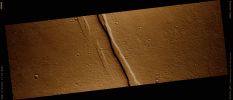
PSP_010491_1570_RED_abrowse.jpgGraben in Memnonia Fossae (Natural Colors; credits: Lunar Explorer Italia)69 visiteMars Local Time: 15:41 (middle afternoon)
Coord. (centered): 23,0° South Lat. and 219,6° East Long.
Spacecraft altitude: 258,7 Km (such as about 161,7 miles)
Original image scale range: 51,8 cm/pixel (with 1 x 1 binning) so objects ~ 1,55 mt across are resolved
Map projected scale: 50 cm/pixel
Map projection: EQUIRECTANGULAR
Emission Angle: 9,9°
Phase Angle: 73,9°
Solar Incidence Angle: 66° (meaning that the Sun is about 24° above the Local Horizon)
Solar Longitude: 145,4° (Northern Summer)
Credits: NASA/JPL/University of Arizona
Additional process. and coloring: Lunar Explorer ItaliaMareKromium
|
|
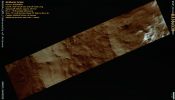
ESP_014324_0955_RED_abrowse.jpgSnow-Streaks on McMurdo Crater (Natural Colors; credits: Lunexit)69 visiteThe SPLD are a stack of ice and dust about 3 Km (a little less than 2 miles) thick. The many layers that make up this feature are of great interest to planetary scientists because, just as with ice sheets on Earth, they are thought to contain a record of the Planet’s climate in previous times.
As with the rest of Mars, impact craters form continuously on these Polar Deposits.
Rarely, a very large impact will occur and the crater will excavate all the way through this ice-sheet to the rocky terrain underneath. This is what happened in the case of McMurdo, a crater roughly 20 Km (about 12,5 miles) across which punched through the ice-sheet in the past.
This HiRISE image shows the wall of this Crater, only half of which has been preserved until current times.
You can see the many layers that comprise the SPLD exposed here.
Scientists study exposures like this to try to understand the length of the climatic record that is recorded in the icy material at the Poles of Mars.MareKromium
|
|
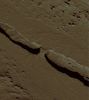
PSP_001420_2045_RED_browse-01~0.jpgSmall Channel in Tartarus Colles (EDM - Natural Colors; credits: Lunexit)69 visiteThe Channel between the Knobs has a variable depth as seen by the varying shadow lengths. The origin of the Channel is unknown, but it is probably NOT a Fluvial Channel because there are no obvious source or Deposit Regions; the Channel, therefore, is probably a Collapse Feature.
One portion of it, (see this EDM, approx. 375 meters across), contains a Bridge, and is probably a remnant of the original surface.
A depression that extends from the Channel Northwards — but which is not as deep as the majority of the Channel — might be in the process of collapsing and enlarging the Channel. MareKromium
|
|
| 2237 immagini su 187 pagina(e) |
 |
|
|
|
|
98 | |
|
|
|
|





