| |

| Piú viste - Mars Reconnaissance Orbiter (MRO) |
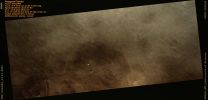
PSP_006962_2215_RED_abrowse.jpgPolygonal Terrain (Natural Colors; credits: Lunexit)70 visitenessun commentoMareKromium
|
|

ESP_014159_1670_RED_abrowse-02.jpg"Worm-like" Surface Feature in the Southern Highlands (EDM n. 2 - False Colors; credits: Dr G. Barca)70 visiteRingraziando gli Amici di Lunexit per gli interessanti commenti, dobbiamo precisare (onde evitare l'insorgere di spiacevoli malintesi) che, a nostro parere, questa Surface Feature non possiede nulla di "Biogenico".
Si tratta, sempre a nostro modo di vedere, del letto asciutto di un antichissimo torrente (o forse anche un laghetto, le cui acque erano comunque soggette a deboli correnti).
L'apparenza - da svariate centinaia di Km di altezza - è quella di un grosso "vermone", ma la sostanza ci dice che siamo davanti ad un antico rilievo di presumibili origini fluviali, sinuoso e (ovviamente) prosciugato, sul quale si elevano delle bizzarre (e sempre affascinanti) "ripples".
Relativamente a queste ripples, da notare la loro albedo (elevata) e la loro forma a "scafo", la cui origne, con ogni probabilità, può essere fatta risalire all'azione congiunta di correnti d'aria persistenti e periodicamente contrapposte.
La loro consistenza, a nostro parere, dovrebbe rendere queste ripples simili in tutto e per tutto a quei rilievi rocciosi - ma fragili - che prendono il nome di "yardangs".MareKromium
|
|
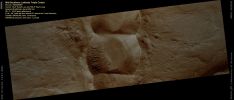
ESP_014329_1435_RED_abrowse.jpgTriple Crater (Natural Colors; credits: Lunexit)70 visitenessun commentoMareKromium
|
|

PSP_003234_2210-PCF-LXTT1.jpgThe "Face on Mars" (Natural Colors; credits for the additional process. and color.: NASA/JPL and Dr Paolo C. Fienga - Lunexit Team)70 visitenessun commentoMareKromium
|
|
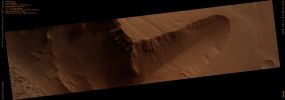
ESP_018374_1740_RED_abrowse.jpgWest Candor (Natural Colors; credits: Dr Paolo C. Fienga - Lunexit Team)70 visitenessun commentoMareKromium
|
|
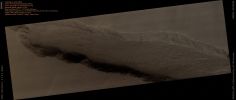
PSP_004412_1715_RED_abrowse-PCF-LXTT.jpgArsia "Dusty" Layers (Absolute Natural Colors; credits for the additional process. and color.: Dr Paolo C. Fienga - Lunexit Team)70 visiteThis image covers a Pit in the lower West Flank of Arsia Mons, one of the 4 giant Volcanos of the Tharsis Region.
Many Layers are exposed in the Pit, probably marking individual Lava Flows that overlapped (meaning: ONE Layer - ONE Flow), and provide information about the nature of the volcanic eruptions. This image was acquired in the middle of large regional Dust Storms on Mars, but the Atmosphere over this image is only moderately dusty because the altitude is 6,5 Km higher than the Planetary Mean (-----> media altitudine planetaria), so the air is quite thin and cannot hold as much Dust.
Although the Atmosphere is not too dusty, the Surface is buried by a Dust Layer that might be meters thick. These high-altitude locations on Mars have thick Dust Deposits because the thin air cannot blow away the Dust, or at least not as fast as it accumulates. On Earth the Oceans serve as "Dust Traps", while on Mars such Traps are the highest Volcanoes. MareKromium
|
|

Meridiani_Planum-PIA13598-PCF-LXTT.jpgOpportunity's "Martian Traverse" through Sol 2442 (Natural Colors; credits for the additional process. and color.: Dr Paolo C. Fienga - Lunexit Team)70 visiteThe white line on this map shows where NASA's Mars Rover Opportunity has driven from the place where it landed in January 2004 - inside Eagle Crater, at the lower left end of the track - to where it reached on the 2442nd Martian Day, or Sol, of its work on Mars (such as December 6, 2010).
The map covers an area about 14 Km (approx. 8,7 miles) wide.
South is at the top.
An Eastward drive of 124 meters (405 feet) on Sol 2442 brought Opportunity to within about 550 meters (1800 feet) of Santa Maria Crater.
Santa Maria, with a diameter about of about 90 meters (295 feet), is nearly as big as Endurance Crater, which Opportunity entered and explored from June to December 2004.
The Sol 2442 drive brought Opportunity's Total Odometry to 25,92 Km (such as 16,11 miles). The long-term destination of the Mission since mid-2008 has been Endeavour Crater, still more than 6 Km (about 3,7 miles) away. The western edge of Endeavour appears in the upper right, including Ridges that are part of the Crater's eroded Rim. This Crater is about 22 Km (approx. 14 miles) in diameter, dwarfing the largest crater that Opportunity has visited so far, Victoria, which is about 800 meters (approx. half a mile) in diameter. Opportunity explored the Rim and interior of Victoria from mid-2006 to mid-2008.
The base map for this traverse map is a mosaic combining images from the High Resolution Imaging Science Experiment camera and the Context Camera, both on NASA's Mars Reconnaissance Orbiter. It is used by Tim Parker of NASA's Jet Propulsion Laboratory, Pasadena, for mapping each of Opportunity's drives based on images taken by the rover after the drive.
Opportunity completed its three-month prime mission in April 2004 and has continued operations in extended missions since then. JPL, a division of the California Institute of Technology in Pasadena, manages the Mars Exploration Rover Project for the NASA Science Mission Directorate, Washington. The University of Arizona, Tucson, operates the High Resolution Imaging Science Experiment. Malin Space Science Systems, San Diego, operates the Context Camera.MareKromium
|
|

PSP_005658_1760_RED_abrowse-00-PCF-LXTT.jpgWinslow Crater (CTX Frame - Absolute Natural Colors; credits for the additional process. and color.: Dr Paolo C. Fienga - Lunexit Team)70 visitenessun commentoMareKromium
|
|

Chasma-Echus_Chasma-Fractures-ESP_033591_1805-PCF-LXTT-IPF.jpgFeatures of Echus Chasma (CTX Frame - Absolute Natural Colors; credits for the additional process. and color.: Dr Paolo C. Fienga/Lunar Explorer Italia/Italian Planetary Foundation)70 visiteIn this image, we can see a so-called "Intersection Area" created by a number of Fractures (or, perhaps, Fissures and/or Water or Lava-carved narrow Channels) which are all located on the Floor of Echus Chasma (an Equatorial Chasma found in the Lunae Planum High Plateau Region of Mars, slightly to the North of the gigantic Valles Marineris Canyon System, and approx. 100 Km long and 10 Km wide).
Echus Chasma contains several Valleys which range - as far as their depth is concerned - from about 1 to 4 Km, and it is now considered, by Planetary Scientists, to be the Water Source Region that allowed the formation and then the (relevant) water-supply of the Kasei Valles Outflow Channel: a large Valley that extends for thousands of kilometers towards the North of the Red Planet.
Mars Local Time: 14:36 (Early Afternoon)
Coord. (centered): 0,377° North Lat. and 279,483° East Long.
Spacecraft altitude: 269,1 Km (such as about 161,111 miles)
Original image scale range: 53,8 cm/pixel (with 2 x 2 binning) so objects ~ 1 mt and 62 cm across are resolved
Map projected scale: 50 cm/pixel
Map projection: EQUIRECTANGULAR
Emission Angle: 7,7°
Phase Angle: 47,6°
Solar Incidence Angle: 40° (meaning that the Sun was about 50° above the Local Horizon at the time the picture was taken)
Solar Longitude: 27,0° (Northern Spring - Southern Fall)
Credits: NASA/JPL/University of Arizona
Additional process. and coloring: Lunar Explorer Italia
This picture (which is a NASA - Original Mars Reconnaissance Orbiter b/w and NON-Map Projected frame identified by the serial n. ESP_033591_1805) has been additionally processed, magnified, contrast enhanced, Gamma corrected, and then colorized in Absolute Natural Colors (such as the colors that a human eye would actually perceive if someone were onboard the NASA - Mars Reconnaissance Orbiter and then looked down, towards the Surface of Mars), by using an original technique created - and, in time, dramatically improved - by the Lunar Explorer Italia Team.MareKromium
|
|

Chasma-Ophir_Chasma-PIA17702-PCF-LXTT-IPF.jpgFeatures of Ophir Chasma (EDM - Absolute Natural Colors; credits for the additional process. and color.: Dr Paolo C. Fienga/Lunar Explorer Italia/Italian Planetary Foundation)70 visiteThe really huge Landslides existing along the Walls of Ophir Chasma (which is nothing else but a deep Canyon located in the Coprates Quadrangle of Mars, at about 4° South Latitude and 72,5° West Longitude. It is approx. 317 km long and it was so named after a "Classical Albedo Feature") host a variety of Geologic Surfaces and Mineralogies.
Some of them possess a variety of Hydrated Sulfate Minerals that formed, eons ago, in the presence of Partially Acidic Liquid Water. This NASA - Mars Reconnaissance Orbiter's Contextual (or "CTX", for short) Image, which is representing an ancient (possibly and approximately 3 Billion Years-old) Landslide, shows us the presence, within it, of 2 (two) very distinct Surface Albedoes, which, in fact, mark a Transition Zone from one Sulfate Mineralogy to another (a circumstance that proves beyod doubts the occurrence, in a far and distant past, of some remarkable variations in the evolution of the visible Surface).
The Upper Slopes (such as the ones located towards the North) are light-toned, and this fact is due to the concurrent abundance of Hydrated Sulfate Minerals and Bright Surface Dust. On the other hand, the Surfaces that make up the Southern Portion of the Landslide, are darker in tone, and this is due to the greater abundance of Dark Sediment that, in time, formed "Strings of Sand Drifts" (extremely well visible in this Extra Detail Magnification). In addition to the above, the underlying Units of Bedrock consist of Darker Minerals that received a lesser hydration then the Northern ones, and this further circumstance implies the occurrence of a strong (and, perhaps, sudden) change in the Ancient Aqueous Environments that formed them.
Mars Local Time: 14:52 (Early Afternoon)
Coord. (centered): 4,328° South Lat. and 288,657° East Long.
Spacecraft altitude: 271,0 Km (such as about 168,291 miles)
Original image scale range: 27,1 cm/pixel (with 1 x 1 binning) so objects ~ 81 cm across are resolved
Map projected scale: 25 cm/pixel
Map projection: EQUIRECTANGULAR
Emission Angle: 6,3°
Phase Angle: 52,7°
Solar Incidence Angle: 47° (meaning that the Sun was about 43° above the Local Horizon at the time the picture was taken)
Solar Longitude: 27,0° (Northern Spring - Southern Fall)
Credits: NASA/JPL/University of Arizona
Additional process. and coloring: Lunar Explorer Italia
This picture (which is an Original NASA - Original Mars Reconnaissance Orbiter - False Colors and NON-Map Projected sub-frame identified by the serial n. PSP_007535_1755-1) has been additionally processed, magnified, contrast enhanced, Gamma corrected, and then re-colorized in Absolute Natural Colors (such as the colors that a human eye would actually perceive if someone were onboard the NASA - Mars Reconnaissance Orbiter and then looked down, towards the Surface of Mars), by using an original technique created - and, in time, dramatically improved - by the Lunar Explorer Italia Team.MareKromium
|
|

Q-Q-PIA08030.jpgThe Atmosphere of Mars69 visiteThe Mars Climate Sounder, an instrument on NASA's Mars Reconnaissance Orbiter designed to monitor daily changes in the global atmosphere of Mars, made its first observations of Mars on March 24, 2006.
These tests were conducted to demonstrate that the instrument could, if needed, support the mission's aerobraking maneuvers (dips into the atmosphere to change the shape of the orbit) by providing hemisphere-scale coverage of atmospheric activity. The instrument scanned nine arrays of detectors four times across the entire disc of the planet, including the north pole, from an altitude of about 45,000 kilometers (28,000 miles). This is about 150 times farther away than the spacecraft will be during its main science phase. At this great range, the planet appears only 40 pixels wide, as suggested by the pixilation of the images. However, this is sufficient to identify regional dust storms in the lower atmosphere. Regional dust storms could perturb atmospheric densities at the higher altitudes (about 100 kilometers or 60 miles) where the orbiter will conduct more than 500 aerobraking passes during the next six months. Such storms are rare in the current season on Mars, early northern spring, and no large storms are present as the orbiter prepares for the start of aerobraking.
Each of the Mars Climate Sounder's arrays looks in a different wavelength band, and three of the resulting images are shown here. The view on the left is from data collected in a broad spectral band (wavelengths of 0.3 microns to 3 microns) for reflected sunlight. The view in the center is from data collected in the 12-micron thermal-infrared band. This band was chosen to sense infrared radiation from the surface when the atmosphere is clear and from dust clouds when it is not. The view on the right is from data collected at 15 microns, a longer-wavelength band still in the thermal-infrared part of the spectrum. At this wavelength, carbon dioxide, the main ingredient in Mars' atmosphere, hides the surface emission, and the thermal-infrared radiation comes only from the atmosphere.
The visible-and-near-infrared image (left) is bright where surface ice and atmospheric hazes reflect sunlight back to space. The view is of the northern half of Mars, with the north polar cap visible as the bright semicircle at upper left. The night half of the planet (lower left) is dark. The "terminator" boundary between the day side and night side of the planet cuts from lower left to upper right, through the polar area. During the science phase of the mission, after the spacecraft has shrunk its orbit to a nearly circular loop approximately 300 kilometers (186 miles) above the surface, these visible-and-near-infrared readings by the Mars Climate Sounder will track how the amount of solar energy reflected from Mars varies from place-to-place and season-to-season, particularly in the polar regions where absorbed sunlight vaporizes the seasonal carbon-dioxide ice.
The 12-micron image (center) indicates that heat is being emitted from both the day side and the night side of the planet. The polar cap is dark in this image because it is cold (minus 190 degrees Fahrenheit) and emits less heat than surrounding areas. During the science phase of the mission, the thermal-infrared readings at this wavelength by Mars Climate Sounder will be used to track dust and clouds in the atmosphere. In the current season on Mars, the atmosphere is relatively clear except for an equatorial belt of thin water-ice clouds present in the visible-and-near-infrared image, and so the 12-micron image is dominated by the infrared radiation from the surface on the relatively hot dayside (upper right).
The 15-micron image (right) indicates the temperatures of the atmosphere at an altitude of about 25 kilometers (15 miles), where there is not much temperature difference even between the night side and the day side of the planet. The polar atmosphere is colder, so it appears darker.
Once deployed in a low-altitude, nearly circular orbit next fall, the Mars Climate Sounder will systematically alternate views of the surface with views of the atmosphere above the limb (horizon) of the planet from the surface to an altitude of 80 kilometers (50 miles), with a vertical resolution of 5 kilometers (3 miles). In this way it will monitor atmospheric and surface changes through a full annual cycle to characterize the present climate of Mars.
|
|

PSP_006567_2220_RED_abrowse-01.jpgFlooded terrain in Terra Sabaea (extra-detail mgnf - MULTISPECTRUM; credits: Lunexit)69 visiteThe smooth surfaces of the flows are punctuated by curved, subparallel fractures oriented transverse to the flow direction.
These cracks resemble crevasses in terrestrial glaciers and were formed when the brittle solid crust of the flow fractured as it was dragged downstream. Detailed images such as this will help determine the role ice may have played in these flows.MareKromium
|
|
| 2237 immagini su 187 pagina(e) |
|
|
|
|
|
97 | |
|
|
|
|
|
|





