| Piú viste - Mars Reconnaissance Orbiter (MRO) |
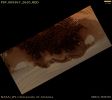
PSP_009367_2620_RED.jpgAeolian Source Layers exposed in Northwestern Abalos Scopuli (possible True Colors; credits: Lunar Explorer Italia)71 visiteMars Local Time: 14:25 (early afternoon)
Coord. (centered): 81,7° North Lat. and 282,6° East Long.
Spacecraft altitude: 320,1 Km (such as about 200,1 miles)
Original image scale range: 32 cm/pixel (with 1 x 1 binning) so objects ~96 mt across are resolved
Map projected scale: 25 cm/pixel
Map projection: EQUIRECTANGULAR
Emission Angle: 5,7°
Phase Angle: 54,5°
Solar Incidence Angle: 59° (meaning that the Sun is about 31° above the Local Horizon)
Solar Longitude: 103,9° (Northern Summer)
Credits: NASA/JPL/University of Arizona
Additional process. and coloring: Lunar Explorer ItaliaMareKromium
|
|

Psp_009794_1875_red.jpgRelatively Fresh (and Rayed) Crater, Windstreaks and Fissure in Cerberus Fossae (Saturated Natural Colors; credits for the additional process. and color.: Dr Paolo C. Fienga - Lunar Explorer Italia)71 visiteMars Local Time: 15:29 (early afternoon)
Coord. (centered): 7,4° North Lat. and 165,3° East Long.
Spacecraft altitude: 274,7 Km (such as about 171,7 miles)
Original image scale range: 27,5 cm/pixel (with 1 x 1 binning) so objects ~82 cm across are resolved
Map projected scale: 25 cm/pixel
Map projection: EQUIRECTANGULAR
Emission Angle: 0,1°
Phase Angle: 52,4°
Solar Incidence Angle: 52° (meaning that the Sun is about 38° above the Local Horizon)
Solar Longitude: 119,1° (Northern Summer)
Credits: NASA/JPL/University of Arizona
Additional process. and coloring: Lunar Explorer ItaliaMareKromium
|
|

Psp_009802_1700_red.jpgGanges Cavus' Walls and Interior (possible True Colors; credits: Lunar Explorer Italia)71 visiteMars Local Time: 15:30 (middle afternoon)
Coord. (centered): 9,9° South Lat. and 308,4° East Long.
Spacecraft altitude: 264,1 Km (such as about 165,1 miles)
Original image scale range: 26,4 cm/pixel (with 1 x 1 binning) so objects ~52,8 cm across are resolved
Map projected scale: 25 cm/pixel
Map projection: EQUIRECTANGULAR
Emission Angle: 8,3°
Phase Angle: 67,2°
Solar Incidence Angle: 61° (meaning that the Sun is about 29° above the Local Horizon)
Solar Longitude: 119,4° (Northern Summer)
Credits: NASA/JPL/University of Arizona
Additional process. and coloring: Lunar Explorer ItaliaMareKromium
|
|
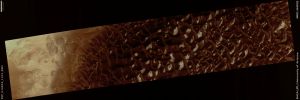
PSP_010854_1325_RED_abrowse.jpgProctor Crater Dunes (Natural Colors; credits: Lunar Explorer Italia)71 visiteIn the winter the dunes in Proctor Crater are covered with seasonal carbon dioxide frost (dry ice). In the spring, the frost gradually evaporates but lingers in protected regions. In this color image bright ice deposits in sheltered areas highlight the ripples on the dunes.
These dunes were imaged during the first year of MRO’s mission. Images taken now in the second Martian spring can be compared to the previous year to study interannual variability.
Mars Local Time: 15:59 (middle afternoon)
Coord. (centered): 47,2° South Lat. and 34,0° East Long.
Spacecraft altitude: 254,5 Km (such as about 159,1 miles)
Original image scale range: 50,9 cm/pixel (with 1 x 1 binning) so objects ~1,53 mt across are resolved
Map projected scale: 50 cm/pixel
Map projection: EQUIRECTANGULAR
Emission Angle: 8,2°
Phase Angle: 70,3°
Solar Incidence Angle: 77° (meaning that the Sun is about 13° above the Local Horizon)
Solar Longitude: 160,1° (Northern Summer)
Credits: NASA/JPL/University of Arizona
Additional process. and coloring: Lunar Explorer ItaliaMareKromium
|
|
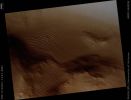
PSP_010447_1525_RED_abrowse.jpgKashira Crater (Natural Colors; credits: Lunar Explorer Italia)71 visiteMars Local Time: 15:44 (middle afternoon)
Coord. (centered): 27,0° South Lat. and 342,2° East Long.
Spacecraft altitude: 257,4 Km (such as about 160,8 miles)
Original image scale range: 51,5 cm/pixel (with 1 x 1 binning) so objects ~ 1,54 mt across are resolved
Map projected scale: 50 cm/pixel
Map projection: EQUIRECTANGULAR
Emission Angle: 0,3°
Phase Angle: 68,8°
Solar Incidence Angle:69° (meaning that the Sun is about 21° above the Local Horizon)
Solar Longitude: 143,7° (Northern Summer)
Credits: NASA/JPL/University of Arizona
Additional process. and coloring: Lunar Explorer ItaliaMareKromium
|
|
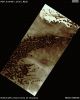
PSP_010467_2635_RED_abrowse.jpgNorth Polar Dunes (Natural Colors; credits: Lunar Explorer Italia)71 visiteMars Local Time: 14:01 (early afternoon)
Coord. (centered): 83,7° North Lat. and 121,7° East Long.
Spacecraft altitude: 319,7 Km (such as about 199,8 miles)
Original image scale range: 64 cm/pixel (with 1 x 1 binning) so objects ~ 1,92 mt across are resolved
Map projected scale: 50 cm/pixel
Map projection: EQUIRECTANGULAR
Emission Angle: 0,1°
Phase Angle: 70,3°
Solar Incidence Angle: 70° (meaning that the Sun is about 20° above the Local Horizon)
Solar Longitude: 144,5° (Northern Summer)
Credits: NASA/JPL/University of Arizona
Additional process. and coloring: Lunar Explorer ItaliaMareKromium
|
|
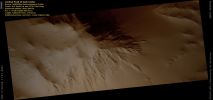
PSP_010428_1745_RED_abrowse.jpgThe Central Peak of Gale Crater (Natural Colors; credits: Lunar Explorer Italia)71 visitenessun commentoMareKromium
|
|
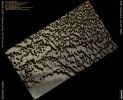
PSP_009324_2650_RED_abrowse.jpgNorth Polar Dunes (Natural Colors; credits: Lunar Explorer Italia)71 visitenessun commentoMareKromium
|
|

ESP_013545_1110_RED_abrowse-02.jpgSouthern Dust Devil (Perspective View - Natural Colors; credits: Dr M. Faccin)71 visitenessun commentoMareKromium
|
|

ESP_014159_1670_RED_abrowse-02.jpg"Worm-like" Surface Feature in the Southern Highlands (EDM n. 2 - False Colors; credits: Dr G. Barca)71 visiteRingraziando gli Amici di Lunexit per gli interessanti commenti, dobbiamo precisare (onde evitare l'insorgere di spiacevoli malintesi) che, a nostro parere, questa Surface Feature non possiede nulla di "Biogenico".
Si tratta, sempre a nostro modo di vedere, del letto asciutto di un antichissimo torrente (o forse anche un laghetto, le cui acque erano comunque soggette a deboli correnti).
L'apparenza - da svariate centinaia di Km di altezza - è quella di un grosso "vermone", ma la sostanza ci dice che siamo davanti ad un antico rilievo di presumibili origini fluviali, sinuoso e (ovviamente) prosciugato, sul quale si elevano delle bizzarre (e sempre affascinanti) "ripples".
Relativamente a queste ripples, da notare la loro albedo (elevata) e la loro forma a "scafo", la cui origne, con ogni probabilità, può essere fatta risalire all'azione congiunta di correnti d'aria persistenti e periodicamente contrapposte.
La loro consistenza, a nostro parere, dovrebbe rendere queste ripples simili in tutto e per tutto a quei rilievi rocciosi - ma fragili - che prendono il nome di "yardangs".MareKromium
|
|

ESP_014083_0945_RED_abrowse-01.jpgActive Geyser on Mars: the "Geysers' Field" (Natural Colors; credits: Dr M. Faccin & Lunexit)71 visitenessun commentoMareKromium
|
|
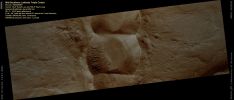
ESP_014329_1435_RED_abrowse.jpgTriple Crater (Natural Colors; credits: Lunexit)71 visitenessun commentoMareKromium
|
|
| 2237 immagini su 187 pagina(e) |
 |
|
|
|
|
95 | |
|
|
|
|





