| Piú viste - Mars Reconnaissance Orbiter (MRO) |

Meridiani_Planum-PIA13598-PCF-LXTT.jpgOpportunity's "Martian Traverse" through Sol 2442 (Natural Colors; credits for the additional process. and color.: Dr Paolo C. Fienga - Lunexit Team)72 visiteThe white line on this map shows where NASA's Mars Rover Opportunity has driven from the place where it landed in January 2004 - inside Eagle Crater, at the lower left end of the track - to where it reached on the 2442nd Martian Day, or Sol, of its work on Mars (such as December 6, 2010).
The map covers an area about 14 Km (approx. 8,7 miles) wide.
South is at the top.
An Eastward drive of 124 meters (405 feet) on Sol 2442 brought Opportunity to within about 550 meters (1800 feet) of Santa Maria Crater.
Santa Maria, with a diameter about of about 90 meters (295 feet), is nearly as big as Endurance Crater, which Opportunity entered and explored from June to December 2004.
The Sol 2442 drive brought Opportunity's Total Odometry to 25,92 Km (such as 16,11 miles). The long-term destination of the Mission since mid-2008 has been Endeavour Crater, still more than 6 Km (about 3,7 miles) away. The western edge of Endeavour appears in the upper right, including Ridges that are part of the Crater's eroded Rim. This Crater is about 22 Km (approx. 14 miles) in diameter, dwarfing the largest crater that Opportunity has visited so far, Victoria, which is about 800 meters (approx. half a mile) in diameter. Opportunity explored the Rim and interior of Victoria from mid-2006 to mid-2008.
The base map for this traverse map is a mosaic combining images from the High Resolution Imaging Science Experiment camera and the Context Camera, both on NASA's Mars Reconnaissance Orbiter. It is used by Tim Parker of NASA's Jet Propulsion Laboratory, Pasadena, for mapping each of Opportunity's drives based on images taken by the rover after the drive.
Opportunity completed its three-month prime mission in April 2004 and has continued operations in extended missions since then. JPL, a division of the California Institute of Technology in Pasadena, manages the Mars Exploration Rover Project for the NASA Science Mission Directorate, Washington. The University of Arizona, Tucson, operates the High Resolution Imaging Science Experiment. Malin Space Science Systems, San Diego, operates the Context Camera.MareKromium
|
|

ESP_019747_1975_RED_abrowse.jpgGraben cutting Lava-Flow (Absolute Natural Colors; credits for the additional process. and color.: Dr Paolo C. Fienga - Lunexit Team)72 visitenessun commentoMareKromium
|
|

ESP_020959_0985_RED_abrowse-PCF-LXTT.jpgEarly Spring at Inca City (Natural Colors; credits for the additional process. and color.: Dr Paolo C. Fienga - Lunexit Team)72 visitenessun commentoMareKromium
|
|

PSP_007055_2015_RED_abrowse-3.jpgVolcanic and Clay Materials near Nili Fossae (edm n. 2 - Natural Colors; credits for the additional process. and color.: Dr Paolo C. Fienga - Lunexit Team) 72 visitenessun commentoMareKromium
|
|

North_Polar_Layered_Deposits-PIA01925.jpgNorth Polar Layers71 visiteCaption NASA originale:"This view shows the basal layers of Mars' north polar layered deposits. The floor of Chasma Boreale is at the bottom of the image. This is a sub-image of a larger view imaged by the High Resolution Imaging Science Experiment (HiRISE) on NASA's Mars Reconnaissance Orbiter on Oct. 1, 2006. The resolution is 64 cm (about 25") per pixel, and the scene is 568 mt (approx. 621 yards) wide".
|
|

PSP_001474_2520_RED-new_lake-00.jpgThe Northern Lakes: Lake "Lunexit" (context image)71 visiteQuando si sa dove guardare e che cosa cercare...Si finisce SEMPRE (o quasi...) con il trovare.
L'albedo del dettaglio che vedete a mezza altezza alla Vostra Sx è assolutamente INCONFONDIBILE.
Il detail-mgnf che abbiamo operato (e che vedrete nel prossimo quadro) è chiarissimo: c'è un nuovo Lago nelle Grandi Pianure Nordiche di Marte!
"Lake Lunexit", in onore della nostra Fondazione di Ricerca e di coloro che la rendono viva, e cioè i vari Lorenzo Foschini, Gianluigi Barca, Matteo Fagone, Alessio Feltri, Lorenzo Leone e tanti altri Ricercatori ed Appassionati che, con grandissima umiltà e modestia, stanno contribuendo a scrivere una (piccola, ma non per questo insignificante) porzione della Storia del Pianeta Rosso (nota: Lake Lunexit è stato battezzato - purtroppo - "unofficially", ma con buona pace di IAU, NASA, ESA e di tutti i Fenomeni che guardano, guardano, guardano...senza vedere mai niente e poi blaterano, blaterano e blaterano...senza dire mai nulla!).
MareKromium
|
|

PSP_003292_2025.jpgCollapse Pits (natural colors + MULTISPECTRUM; credits: Dr M. Faccin e Lunexit)71 visitenessun commentoMareKromium
|
|

PSP_004313_1760_RED_abrowse-02.gifWinslow Crater's Changing (GIF-Movie; credits: NASA)71 visitenessun commentoMareKromium
|
|
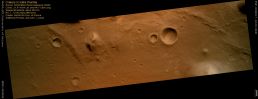
PSP_008017_2020_RED_abrowse.jpgCraters in Isidis Planitia (MULTISPECTRUM; credits: Lunexit)71 visiteThis image shows a young impact crater in the Northern part of Isidis Planitia. The crater is fresh enough to preserve some fine textures that are eroded around other craters.
The ejecta blanket of material thrown out of the crater is distinctly dark and rough, with many small boulders and rugged texture. To the South of the crater there is a wedge-shaped area with little ejected material. This may indicate that the impactor which formed this crater came from the south, since at moderate impact angles ejecta is preferentially thrown in the direction of motion of the impactor.
Eventually, a combination of erosion and mantling by dust will smooth and obscure the ejecta and cover over the crater, turning it into a shallow depression like the others in this image. Reworking of the crater is already beginning, as shown by the network of fine ridges (wind-blown ripples) on the crater floor.MareKromium
|
|
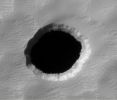
PSP_008130_1745_RED_abrowse-02.jpgSmall but deep Collapse Pit, North of Arsia Mons (extra-detail mgnf n. 2; credits: Dr G. Barca)71 visitenessun commentoMareKromium
|
|
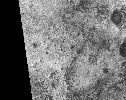
PSP_007612_2045-GIF.gifProposed MSL Landing Site in Mawrth Vallis - Ellipse 2 (GIF-Movie; credits: Carlo Contu)71 visiteSiamo nella Regione di Mawrth Vallis: una Regione di grandissimo interesse geologico (o forse sarebbe meglio dire "Mineralogico", vista la apparente varietà di minerali esposti e già individuati) la quale, forse, in un prossimo futuro, potrebbe costituire la "Casa" del Mars Science Laboratory Rover (anche se noi dubitiamo che il MSL Rover scenda effettivamente in questa zona del Pianeta Rosso...). +
Il dettaglio intrigante che ci viene proposto in questo suggestivo filmato GIF realizzato dal nostro Carissimo Amico e Partner, Carlo Contu, attiene un rilievo tanto piccolo, quanto bizzarro: una modesta collinetta con due lati "piallati".
Si tratterà di una frana o di qualcosa di più - diciamo così... - "esotico" (tipo uno scavo a cielo aperto)?
La Verità, anche in questo caso - e come sempre - non la conosciamo: noi possiamo solo invitarVi a guardare questo filmato ed a riflettere sui suoi particolari (uno su tutti, ma che NON Vi suggeriremo, in attesa che qualcuno di Voi se ne accorga e ne parli, in sede di commento).
Che altro dire? Complimenti a Carlo Contu e...Buona Esplorazione!MareKromium
|
|

PSP_009260_2050_red.jpgCharacterize Surface Hazards and Science of Possible MSL Rover Landing - Mawrth Vallis (natural colors; credits: Lunexit)71 visitenessun commentoMareKromium
|
|
| 2237 immagini su 187 pagina(e) |
 |
|
|
|
|
94 | |
|
|
|
|





