| Piú viste - Mars Reconnaissance Orbiter (MRO) |

ESP_018857_2225_RED_abrowse.jpgPseudo-Glacier (Natural Colors; credits for the additional process. and color.: Dr Paolo C. Fienga - Lunexit Team)73 visitenessun commentoMareKromium
|
|
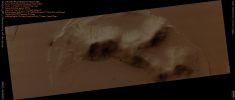
PSP_003570_1915_RED_abrowse-PCF-LXTT.jpgColourful Slope-Streaks in Marte Vallis (Natural Colors; credits for the additional process. and color.: Dr Paolo C. Fienga - Lunexit Team)73 visiteThis image of a large Hill in Marte Vallis has numerous dark- and light-toned Streaks along its Slopes, showing a variety of characteristics observed in other areas with these features.
For example, several dark Streaks have formed "fingers" at their Termini (such as the point where where the Streaks end).
Their formation may be due to the material "feeling" the roughness of the ground as it reaches shallower slopes near the base of the Hill. The dark Streaks also appear to travel over many obstacles along their paths, such as impact craters, small boulders, and rock outcrops. This indicates that the Slope Streaks have sufficient "momentum" and energy early in their descent downslope that they are not affected by such features or the ground.
The Slope Streaks also do not start at a common elevation along the sides of the Hill, suggesting that they are not related to any particular layer(s) of material.
Dark Slope Streaks are thought to fade over time by deposition of a new bright Dust Layer over the old streaked Surface. The presence of light-toned Streaks relative to their surrounding darker-toned surface is particularly interesting.
Scientists have wondered: if dark Streaks fade over time by deposits of new Dust, then how can there be light-toned streaks? Does this mean light-toned Streaks are formed differently? Are the materials of a light-toned Streak different from dark-toned Streaks?
Slope Streaks have been discovered and studied since the early Mariner and Viking Missions to Mars in the '60s and '70s. Scientists are hoping to resolve some of these questions using HiRISE images with its high spatial resolution compared to these previous Mars datasets.MareKromium
|
|

ESP_019599_1445_RED_abrowse-00.jpgBright Bedrock inside Hale Crater (Absolute Natural Colors; additional process. and color.: Dr Paolo C. Fienga - Lunexit Team)73 visitenessun commentoMareKromium
|
|

TRA_000825_2665_IRB-00.jpgNorth Polar Layers (1)72 visiteThis image of the north polar layered deposits was taken during the summer season (solar longitude of 113.6 degrees), when carbon dioxide frost had evaporated from the surface. The bright spots seen here are most likely patches of water frost, but the location of the frost patches does not appear to controlled by topography. Layers are visible at the bottom of the image, mostly due to difference in slope between them. The variations in slope are probably caused by differences in the physical properties of the layers. Thinner layers that have previously been observed in these deposits are visible, and may represent annual deposition of water ice and dust that is thought to form the polar layered deposits. These deposits are thought to record global climate variations on Mars, similar to ice ages on Earth. HiRISE images such as this should allow Mars' climate record to be inferred and compared with climate changes on Earth.
Image TRA_000825_2665 was taken by the High Resolution Imaging Science Experiment (HiRISE) camera onboard the Mars Reconnaissance Orbiter spacecraft on September 29, 2006. Shown here is the full image, centered at 86.5 degree latitude, 172.0 degrees East longitude. The image is oriented such that north is to the top. The range to the target site was 298.9 km (186.8 miles). At this distance the image scale is 59.8 cm/pixel {with 2 x 2 binning} so objects ~1.79 m across are resolved. In total the original image was 12.2 km (10024 pixels) wide and 6.1 km (5000 pixels) long. The image was taken at a local Mars time of 3:30 PM and the scene is illuminated from the southwest with a solar incidence angle of 63.5 degrees, thus the sun was about 26.5 degrees above the horizon.
|
|

Psp_001700_2505_red-00.jpgThe "Frozen Lake" of Vastitas Borealis...is not a Lake, according to NASA (CTX Frame - Enhanced Natural Colors; credits for the additional process. and color.: Dr Paolo C. Fienga - Lunexit Team)72 visiteEcco ancora lo splendido e suggestivo Lago di Ghiaccio individuato, assieme ad altri rilievi similari, nella Regione Marziana di Vastitas Borealis. L'ESA lo aveva "scoperto" e, sebbene trasformando l'immagine reale in uno dei suoi tipici "falsi virtuali", il fascino del Lago di Ghiaccio - grazie anche alle splendide immagini NASA - Mars Odyssey ed MGS - era cresciuto a dismisura. Poi, improvvisamente, ecco che la Sonda MRO fotografa, con un margine di dettaglio davvero fantastico, questo misterioso e magnifico rilievo e noi, da poveri Ricercatori solitari, ci aspettiamo qualche commento e qualche delucidazione in più sul Lago di Ghiaccio di Vastitas Borealis e invece...E invece ZERO, NULLA, BUIO TOTALE!
Zero commenti, zero chiarimenti, zero approfondimenti. La NASA si limita a dire (anzi: neppure lo dice in maniera chiara ed aperta, ma si limita a "suggerirlo fra le righe"...) che il Lago di Ghiaccio di Vastitas non è un Lago. Non è niente. Solo un anonimo cratere delle Pianure Nordiche Marziane sul cui fondo ci sono delle dune (ovviamente create dal "vento"...) le quali sono perennemente ricoperte di brina gelata.
Signori, per favore: la Vista è ingannevole, le immagini sono ingannevoli e - siamo noi i primi a dirlo - spesso chi analizza i frames per professione finisce con il vedere quello che vuole vedere. Tutto vero e sacrosanto. Ma è anche vero e sacrosanto che il ridurre l'affascinante rilievo di Vastitas Borealis (studiato dai Ricercatori di mezzo Mondo) al "NIENTE" al quale lo ha ridotto la NASA sulla base di quanto mostrato da questo frame (che rimane fantastico e - relativamente - semplice da interpretare) a noi fa davvero venire la nausea.
Già: forse alla NASA fa comodo che i Liberi Ricercatori parlino e straparlino (e continuino a farlo) di Templi e di Piramidi e lascino stare le sempre più fantastiche ed intriganti rivelazioni che arrivano, in piena luce, dal Pianeta Rosso.
E si, devono essersi detti alla NASA: perchè stare ancora a perdere tempo facendo disinformazione e contro-informazione quando i Profeti dell'Esoarcheologia stanno già provvedendo (ed alla grande!) al riguardo?!?
E scusateci per la franchezza.MareKromium
|
|

PSP_006952_1870_RED_abrowse-00~0.jpgDunefield in West Arabia Terra Unnamed Crater (context frame; MULTISPECTRUM - credits: Lunexit)72 visiteThis image shows dunes in an unnamed crater in the West Arabia Terra region.
The rim of the crater lies to the South of the image (Sx) and a dark, toned field of barchan sand dunes rests on the crater floor in the Northern portion of the observation (Dx). MareKromium
|
|
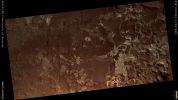
PSP_009381_1720_RED.jpgBlocky Floor Deposit in Melas Chasma (natural colors; credits: Lunar Explorer Italia)72 visiteMars Local Time: 15:27 (early afternoon)
Coord. (centered): 8,0° South Lat. and 282,7° East Long.
Spacecraft altitude: 266,7 Km (such as about 166,7 miles)
Original image scale range: 26,7 cm/pixel (with 1 x 1 binning) so objects ~80 cm across are resolved
Map projected scale: 25 cm/pixel
Map projection: EQUIRECTANGULAR
Emission Angle: 0,1°
Phase Angle: 60,2°
Solar Incidence Angle: 60° (meaning that the Sun is about 30° above the Local Horizon)
Solar Longitude: 104,4° (Northern Summer)
Credits: NASA/JPL/University of Arizona
Additional process. and coloring: Lunar Explorer ItaliaMareKromium
|
|

Psp_009757_2675_red.jpgHigh-Latitude Exposure of North Polar Layered Deposits (possible True Colors; credits: Lunar Explorer Italia)72 visiteMars Local Time: 14:41 (early afternoon)
Coord. (centered): 87,3° North Lat. and 77,4° East Long.
Spacecraft altitude: 342,6 Km (such as about 214,1 miles)
Original image scale range: 68,5 cm/pixel (with 1 x 1 binning) so objects ~2,06 mt across are resolved
Map projected scale: 50 cm/pixel
Map projection: EQUIRECTANGULAR
Emission Angle: 23,8°
Phase Angle: 47,9°
Solar Incidence Angle: 66° (meaning that the Sun is about 24° above the Local Horizon)
Solar Longitude: 117,8° (Northern Summer)
Credits: NASA/JPL/University of Arizona
Additional process. and coloring: Lunar Explorer ItaliaMareKromium
|
|

Psp_009743_2565_red.jpgNorthern Dunes (possible True Colors; credits: Lunar Explorer Italia)72 visiteMars Local Time: 14:20 (early afternoon)
Coord. (centered): 76,2° North Lat. and 95,3° East Long.
Spacecraft altitude: 330,1 Km (such as about 206,3 miles)
Original image scale range: 33 cm/pixel (with 1 x 1 binning) so objects ~99 cm across are resolved
Map projected scale: 25 cm/pixel
Map projection: EQUIRECTANGULAR
Emission Angle: 17,0°
Phase Angle: 71,6°
Solar Incidence Angle: 57° (meaning that the Sun is about 33° above the Local Horizon)
Solar Longitude: 117,3° (Northern Summer)
Credits: NASA/JPL/University of Arizona
Additional process. and coloring: Lunar Explorer ItaliaMareKromium
|
|

Psp_009758_2030_red.jpgExtremely Unusually-looking Northern Dunefield (possible True Colors; credits: Lunar Explorer Italia)72 visiteMars Local Time: 15:24 (early afternoon)
Coord. (centered): 22,7° North Lat. and 65,8° East Long.
Spacecraft altitude: 282,4 Km (such as about 176,5 miles)
Original image scale range: 28,3 cm/pixel (with 1 x 1 binning) so objects ~56,5 cm across are resolved
Map projected scale: 25 cm/pixel
Map projection: EQUIRECTANGULAR
Emission Angle: 4,8°
Phase Angle: 51,5°
Solar Incidence Angle: 47° (meaning that the Sun is about 43° above the Local Horizon)
Solar Longitude: 117,8° (Northern Summer)
Credits: NASA/JPL/University of Arizona
Additional process. and coloring: Lunar Explorer ItaliaMareKromium
|
|

PSP_010638_1890_RED_abrowse-01.jpgAngular Unconformity in Cerberus Fossae (edm; possible True Colors; credits: Lunar Explorer Italia)72 visitenessun commentoMareKromium
|
|

PSP_010460_2500_RED_abrowse.jpgVastitas' Texture (Enhanced Natural Colors; credits: Lunar Explorer Italia)72 visiteMars Local Time: 15:11 (early afternoon)
Coord. (centered): 69,6° North Lat. and 331,4° East Long.
Spacecraft altitude: 314,8 Km (such as about 196,7 miles)
Original image scale range: 63,0 cm/pixel (with 1 x 1 binning) so objects ~ 1,89 mt across are resolved
Map projected scale: 50 cm/pixel
Map projection: EQUIRECTANGULAR
Emission Angle: 0,2°
Phase Angle: 62,8°
Solar Incidence Angle: 63° (meaning that the Sun is about 27° above the Local Horizon)
Solar Longitude: 144,2° (Northern Summer)
Credits: NASA/JPL/University of Arizona
Additional process. and coloring: Lunar Explorer ItaliaMareKromium
|
|
| 2237 immagini su 187 pagina(e) |
 |
|
|
|
|
92 | |
|
|
|
|





