| |

| Piú viste - Mars Reconnaissance Orbiter (MRO) |
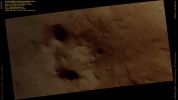
PSP_010454_1635_RED_abrowse~0.jpgCentral Uplift of Unnamed Impact Crater (Natural Colors; credits: Lunar Explorer Italia)74 visitenessun commentoMareKromium
|
|
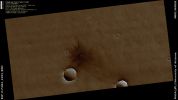
ESP_015962_1695_RED_abrowse-00.jpgRelatively fresh Impact Crater (CTX Frame - Natural Colors; credits: Dr Paolo C. Fienga - Lunexit Team)74 visiteThis image shows a very fresh-looking Impact Crater with an extensive Radial Ejecta Blanket.
The Crater was first seen in an image acquired with MRO's Context Camera (CTX). The best image of this Region prior to CTX was from one of the Viking Orbiters, and the Crater is not visible in it.
This could either mean that the Crater formed sometime between 1976 and 1999, or that there might have been more Dust on the Surface in 1976, or that maybe the air could have been hazy, thus obscuring the Crater.
Based on the HiRISE image, we suspect that the Crater is more than several decades old, because at full resolution we see a "Textured Surface" (see EDM n.2) that is common in Dust-Mantled Regions of Mars, but absent in the youngest craters.MareKromium
|
|
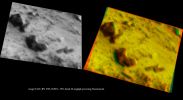
ESP_018075_1955_RED_abrowse-01.jpgUnusually-looking Surface Feature in Cerberus Fossae (credits for the additional process.: Dr Marco Faccin - Lunexit Team)74 visitenessun commentoMareKromium
|
|
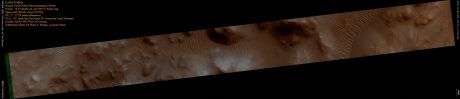
ESP_018728_1655-PCF-LXTT2.jpgLoire Valles (Absolute Natural Colors; credits for the additional process. and color.: Dr Paolo C. Fienga - Lunexit Team)74 visitenessun commentoMareKromium
|
|
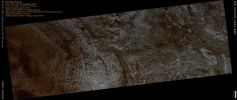
PSP_003379_1835_RED_abrowse.jpgMeridiani Planum (Natural Colors; credits for the additonal process. and color.: Dr Paolo C. Fienga - Lunexit Team)74 visitenessun commentoMareKromium
|
|

ESP_018857_2225_RED_abrowse.jpgPseudo-Glacier (Natural Colors; credits for the additional process. and color.: Dr Paolo C. Fienga - Lunexit Team)74 visitenessun commentoMareKromium
|
|
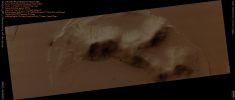
PSP_003570_1915_RED_abrowse-PCF-LXTT.jpgColourful Slope-Streaks in Marte Vallis (Natural Colors; credits for the additional process. and color.: Dr Paolo C. Fienga - Lunexit Team)74 visiteThis image of a large Hill in Marte Vallis has numerous dark- and light-toned Streaks along its Slopes, showing a variety of characteristics observed in other areas with these features.
For example, several dark Streaks have formed "fingers" at their Termini (such as the point where where the Streaks end).
Their formation may be due to the material "feeling" the roughness of the ground as it reaches shallower slopes near the base of the Hill. The dark Streaks also appear to travel over many obstacles along their paths, such as impact craters, small boulders, and rock outcrops. This indicates that the Slope Streaks have sufficient "momentum" and energy early in their descent downslope that they are not affected by such features or the ground.
The Slope Streaks also do not start at a common elevation along the sides of the Hill, suggesting that they are not related to any particular layer(s) of material.
Dark Slope Streaks are thought to fade over time by deposition of a new bright Dust Layer over the old streaked Surface. The presence of light-toned Streaks relative to their surrounding darker-toned surface is particularly interesting.
Scientists have wondered: if dark Streaks fade over time by deposits of new Dust, then how can there be light-toned streaks? Does this mean light-toned Streaks are formed differently? Are the materials of a light-toned Streak different from dark-toned Streaks?
Slope Streaks have been discovered and studied since the early Mariner and Viking Missions to Mars in the '60s and '70s. Scientists are hoping to resolve some of these questions using HiRISE images with its high spatial resolution compared to these previous Mars datasets.MareKromium
|
|
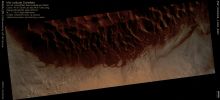
PSP_006648_1300_RED_abrowse-00-PCF-LXTT.jpgSouthern Dunefield (Absolute Natural Colors; credits: Dr Paolo C. Fienga - Lunexit Team)74 visiteSeen here is the Eastern Edge of a Dunefield located in a large, degraded crater in the Southern Hemisphere.
Similar to other Dunes on Mars, these Dunes are dark-toned and contain Gullies. Gullies are features found on Slopes and Dunes in the Mid-Latitudes of both Hemispheres. Both Slope and Dune Gullies were initially suggested to be a result of liquid water from the Surface or Subsurface. Slope and Dune Gullies usually have different morphologies: Dune Gullies are more linear and have Levees bordering their Channels. They typically have no distinguishable, or very small, Alcove and Debris Aprons.
Slope gullies, on the other hand, often have deeply incised Alcoves and Channels that exhibit fluvial characteristics such as Streamlined Islands.
What is highly unusual about this Dunefield is that one of its Gullies has the morphology of a "Slope Gully! (approx. 3 Km across)! This Dune Gully has a very incised Alcove, what appears to be Streamlined Islands on the Channel Floor, and a large, and "feathery" Debris Apron.MareKromium
|
|
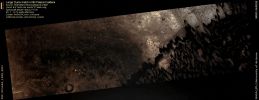
PSP_005684_1890_RED_abrowse-00-PCF-LXTT.jpgDark Dunefield in Nili Patera Caldera (CTX Frame - Enhanced Absolute Natural Colors; credits for the additional process. and color.: Dr Paolo C. Fienga - Lunexit Team)74 visitenessun commentoMareKromium
|
|

ESP_028957_2085-PCF-LXTT-IPF-01.jpgInteresting Surface Feature in Nilosyrtis Mensae (EDM - Absolute Natural Colors; credits for the additional process. and color.: Dr Paolo C. Fienga - Lunar Explorer Italia/Italian Planetary Foundation)74 visiteNilosyrtis Mensae is an ancient Terrain with a wonderful variety of Landforms and Rock Types. And so: what is this Circular Landform? It probably got its shape from an Impact Crater long ago, but was subsequently eroded and filled in, and then eroded again, so that now it is something like a "Low Mesa", surrounded by a Boulder-rich Geological Unit.
Mars Local Time: 15:34 (Middle Afternoon)
Coord. (centered): 28,286° North Lat. and 75,424° East Long.
Spacecraft altitude: 287,8 Km (such as about 179,9 miles)
Original image scale range: 28,8 cm/pixel (with 1 x 1 binning) so objects ~ 86 cm across are resolved
Map projected scale: 25 cm/pixel
Map projection: EQUIRECTANGULAR
Emission Angle: 8,5°
Sun-Mars-MRO (or "Phase") Angle: 50,4°
Solar Incidence Angle: 59° (meaning that the Sun was about 31° above the Local Horizon of the imaged Region, at the time that the picture was taken)
Solar Longitude: 180,1° (Northern Autumn - Southern Spring)
Credits: NASA/JPL/University of Arizona
Additional process. and coloring: Lunar Explorer ItaliaMareKromium
|
|

Craters-Kasimov_Crater-ESP_030609_1550-PCF-LXTT-IPF-3.jpgInverted Channels in Kasimov Crater (Absolute Natural Colors; credits for the additional process. and color.: Dr Paolo C. Fienga - Lunar Explorer Italia/Italian Planetary Foundation)74 visiteBy slightly enhancing an Absolute Natural Color image such as the EDM (see the inset to the right of the CTX Frame, which represents an about 1-Km wide - such as 0,621 miles - section of the whole area photographed by the NASA - Mars Reconnaissance Orbiter), can help us to achieve a better understanding of the imaged Surface Features, as well as to clearly distinguish between Surface Materials possessing different Histories, Textures and Mineral (---> Chemical) Compositions.
The whole image shows us a portion of the Floor of the Martian Impact Crater named "Kasimov" (a large - approx. 91 Km in diameter - and extremely ancient Impact Crater located in the Southern Hemisphere of the Red Planet), with several brown-gray (with subtle reddish nuances) Ridges that run from the bottom center to the upper left side of the frame. If you look carefully at all these different Ridges, you will notice that the Main Ridge is joined by a smaller one (look at the central portion of the CTX Frame) like small Tributary Rivers join together with larger ones on Earth. Indeed, this is exactly what happened here, on Mars, but - most likely - a few billions of years ago.
These Ridges are called "Inverted Channels" and they mark the locations of ancient Martian Riverbeds (in this case the Main River flowed towards the upper left of the image). Such Inverted Channels formed because the bottoms of these Rivers (---> Tributaries) were all full of Gravel-sized Rocks, whereas the areas around them were made of fine Clays. A VERY long time after the Rivers stopped flowing and dried-up, the Wind, slowly, removed completely the fine and light Clays, but it was not strong enough to blow away the heavy Gravel. In the end, after all the Clays were gone, the old Riverbeds were left as High-standing Gravel Ridges, such as the ones very well visible here (both in the CTX Frame as well as in the EDM).
Mars Local Time: 15:49 (Middle Afternoon)
Coord. (centered): 35,729° North Lat. and 129,386° East Long.
Spacecraft altitude: 258,2 Km (such as about 160,3 miles)
Original image scale range: 25,8 cm/pixel (with 1 x 1 binning) so objects ~ 78 cm across are resolved
Map projected scale: 25 cm/pixel
Map projection: EQUIRECTANGULAR
Emission Angle: 11,0°
Sun-Mars-Spacecraft (or Phase) Angle: 47,6°
Solar Incidence Angle: 58° (meaning that the Sun was about 32° above the Local Horizon at the time the picture was taken)
Solar Longitude: 203,7° (Northern Fall - Southern Spring)
Credits: NASA/JPL/University of Arizona
Additional process. and coloring: Lunar Explorer Italia
The CTX Frame (which is an Original Mars Reconnaissance Orbiter non-map projected b/w frame, identified by the serial n. ESP_030609_1550) and the EDM (which is an Original Mars Reconnaissance Orbiter enhanced color frame, identified by the serial n. ESP_030609_1550-1) have both been additionally processed and then colorized (as far as the EDM is concerned, re-colorized) in Absolute Natural Colors (such as the colors that a human eye would actually perceive if someone were onboard the NASA - Mars Reconnaissance Orbiter and then looked down, towards the Surface of Kasimov Crater - Mars), by using an original technique created - and, in time, dramatically improved - by the Lunar Explorer Italia Team. Different colors, as well as different shades of the same color, mean, among others, the existence of different Elements present on the Surface of Kasimov Crater, each having a different Albedo (---> Reflectivity) and Chemical Composition.MareKromium
|
|

Craters-Unnamed_Craters-ESP_031292_1295-PCF-LXTT-IPF.jpgUnnamed Craters in Hellas Planitia (Absolute Natural Colors; credits for the additional process. and color.: Dr Paolo C. Fienga/Lunar Explorer Italia/Italian Planetary Foundation)74 visiteIn this frame, taken by the NASA - Mars Reconnaissance Orbiter on March, 30, 2013 and showing us a small portion of the Southern Martian Region known as Hellas Planitia, we can see - litterally lost in a "Sea" of Sand that has also been heavily marked by the passage of a countless number of Dust Devils - two relatively small Unnamed Impact Craters which are going through two very different (and very distant, in terms of time) moments of their evolution.
Barely visible, on the left (Sx) side of the picture, there is an extremely old and now almost completely "Buried Impact Crater", whose Rim, however, can still be discerned from the surrounding landscape; on the right (Dx) side of the frame, instead, a way more recent Unnamed Impact Crater that shows a very well defined (and therefore - of course, always relatively speaking - "fresh") Rim, with signs of a Landslide, that has occurred on its Inner Southern Slope, and also with what appears to be just a hint of a light-colored Windstreak on its Northern Outer Rim. Also a few Gullies can be spotted in several locations of the Inner Slopes of the Crater (particularly on its North-facing Inner Rim and Slope).
Mars Local Time: 14:37 (Early Afternoon)
Coord. (centered): 50,284° South Lat. and 54,671° East Long.
Spacecraft altitude: 255,9 Km (such as about 158,913 miles)
Original image scale range: 51,2 cm/pixel (with 2 x 2 binning) so objects ~ 1 mt and 54 cm across are resolved
Map projected scale: 50 cm/pixel
Map projection: EQUIRECTANGULAR
Emission Angle: 1,6°
Phase Angle: 42,2°
Solar Incidence Angle: 41° (meaning that the Sun was about 49° above the Local Horizon at the time the picture was taken)
Solar Longitude: 292,3° (Northern Winter - Southern Summer)
Credits: NASA/JPL/University of Arizona
Additional process. and coloring: Lunar Explorer Italia
This picture (which has been cropped from a NASA - Original Mars Reconnaissance Orbiter NON-Map Projected CTX b/w frame identified by the serial n. ESP_031292_1295) has also been additionally processed and then colorized in Absolute Natural Colors (such as the colors that a human eye would actually perceive if someone were onboard the NASA - Mars Reconnaissance Orbiter and then looked down, towards the Surface of Mars - Region of Hellas Planitia), by using an original technique created - and, in time, dramatically improved - by the Lunar Explorer Italia Team.MareKromium
|
|
| 2237 immagini su 187 pagina(e) |
|
|
|
|
|
90 | |
|
|
|
|
|
|





