| Piú viste - Mars Reconnaissance Orbiter (MRO) |

ESP_022212_1650_RED_abrowse-PCF-LXTT-1.jpgInteresting Surface Features in Syria Planum (Absolute Natural Colors; credits for the additional process. and color.: Dr Paolo C. Fienga - Lunexit Team) 259 visiteCaption NASA:"This observation was to offer us a two-for-one treat: a small Volcano and a Double Crater with Ejecta Ridges caused by a binary impact. However, with little data volume, we were not able to get both targets, so we used a manual delay to image the Double Crater. A possible re-image of this area might focus on the Volcano. The site appears fairly dusty and there may not be much fine-scale structure to see.
Syria Planum is a broad Plateau, forming part of the Tharsis Region, which is home to the largest Volcanos in the Solar System. Some of these, Arsia Mons and Pavonis Mons, are also known as "Shield Volcanoes".MareKromium
|
|
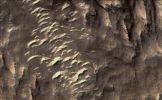
Yardangs-Medusae_Fossae-TRA_000828_1805_IRB-04-PCF-LXTT.jpgYardangs in Medusae Fossae (Absolute Natural Colors; credits for the additional process. and color.: Dr Paolo C. Fienga - Lunexit Team)258 visitenessun commentoMareKromium
|
|
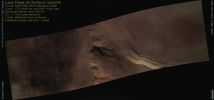
PSP_007959_1980_RED_abrowse-PCF-LXTT.jpgThe Beautiful Colors of Olympus Mons' Summit (Absolute Natural Colors; credits for the additional process. and color.: Dr Paolo C. Fienga - Lunexit Team)257 visiteOlympus Mons, the largest Volcano in the Solar System, has a large depression at its top. This depression, called “Caldera” by geologists, is caused by the collapse of the top of the Volcano as magma is drained out from an underground Holding Chamber.
Previous studies have demonstrated multiple collapses, indicating that there were Holding Chambers in slightly different locations within the Volcano that emptied at various times.
This HiRISE image examines the walls of one such collapse which exposes the Layers of rock within the uppermost part of Olympus Mons.
In the sections not covered by Dust, hundreds of thin discontinuous Layers are visible. The thicknesses and widths of these Layers are similar to those of the Lava Flows seen on the Surface of Olympus Mons. This confirms the assumption that the Volcano is built up of many thousands of similar Lava Flows.
There is also at least one Layer cutting diagonally across the stack of Lava Flows. This is an intrusion of magma, most likely a feeder to some of the uppermost Lava Flows. However, this HiRISE image indicates that such intrusions make up only a minor part of the upper section of the Volcano.MareKromium
|
|
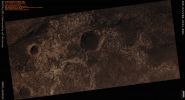
ESP_022288_2035_RED_abrowse-PCF-LXTT.jpgFeatures of Mawrth Vallis (Absolute Natural Colors; credits for the additional process. and color: Dr Paolo C. Fienga - Lunexit Team)257 visitenessun commentoMareKromium
|
|

ESP_024025_1005-PCF-LXTT-00.jpgFeatures of Promethei Lingula Region (CTX Frame "A" - Absolute Natural Colors; credits for the additional process. and color.: Dr Paolo C. Fienga - Lunexit Team)257 visiteMars Local Time: 15:51 (Middle Afternoon)
Coord. (centered): 79,5° South Lat. and 111,8° East Long.
Spacecraft altitude: 264,9 Km (such as about 165,6 miles)
Original image scale range: 53,0 cm/pixel (with 2 x 2 binning) so objects ~ 1 mt and 59,0 cm across are resolved
Map projected scale: 50 cm/pixel
Map projection: POLAR STEREOGRAPHIC
Emission Angle: 22,0°
Sun-Mars-Spacecraft (or "Phase") Angle: 72,4°
Solar Incidence Angle: 84° (meaning that the Sun is about 6° above the Local Horizon)
Solar Longitude: 359,0° (Northern Winter)
Credits: NASA/JPL/University of Arizona
Additional process. and coloring: Dr Paolo C. Fienga - Lunar Explorer ItaliaMareKromium
|
|

ESP_021641_1205_RED_abrowse-PCF-LXTT.jpgSouthern Dunefield (Absolute Natural Colors; credits for the additional process. and color.: Dr Paolo C. Fienga - Lunexit Team)256 visitenessun commentoMareKromium
|
|
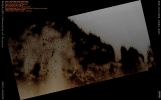
ESP_021998_0980_RED_abrowse-PCF-LXTT.jpgFans in "Non-Cryptic" South Polar Terrain (Absolute Natural Colors; credits: Dr Paolo C. Fienga - Lunexit Team)255 visitenessun commentoMareKromium
|
|
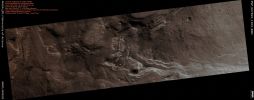
PSP_007820_1505_RED_abrowse-PCF-LXTT.jpgLayered Sediments in Hellas Planitia (Natural Colors; credits for the additional process. and color.: Dr Paolo C. Fienga - Lunexit Team)252 visitenessun commentoMareKromium
|
|

ESP_024462_1340_RED-PCF-LXTT.jpgPossible Migrating Dunefield (Absolute Natural Colors; credits for the additional process. and color.: Dr Paolo C. Fienga - Lunexit Team)252 visiteCoord. (centered): 45,4° South Lat. and 38,8° East Long.
MareKromium
|
|

ESP_021536_1780_00-PCF-LXTT.jpgSanta Maria Crater and "Oppy" (Absolute Natural Colors; credits: Dr Paolo C. Fienga - Lunexit Team)251 visitenessun commentoMareKromium
|
|

PSP_006679_1680_RED_abrowse-PCF-LXTT.jpgLayered Features in Noctis Labyrinthus (Absolute Natural Colors; credits for the additional process. and color.: Dr Paolo C. Fienga - Lunexit Team)251 visitenessun commentoMareKromium
|
|
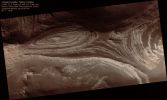
PSP_001596_1525_RED_browse-01-PCF-LXTT.jpgLayering inside Terby Crater (Absolute Natural Colors; credits: Dr Paolo C. Fienga - Lunexit Team)251 visiteImage PSP_001596_1525 shows a sequence of predominantly light-toned, layered, sedimentary rocks exposed by erosion on the floor of Terby Crater. Terby Crater is ~165 Km (~100 miles) in diameter. It's located on the northern rim of the Hellas impact basin in the Southern Hemisphere of Mars.
The layered sequence is ~2 Km (~1,2 miles) thick and consists of many repetitive, relatively horizontal beds. The beds appear to be laterally continuous, which means you can identify a given layer in many locations across the area.
Details in the layering seen in this HiRISE image reveal variations in the brightness of the layers and may indicate differing mineralogies. Based on the ease with which wind appears to erode these layers, they are believed to be composed mostly of fine-grained sediments.
However, one or more of the beds is weathering to form meter(yard)-scale boulders that have accumulated downslope in fans of debris.
These larger boulders indicate the material in the layers may be stronger than just fine-grained sediments.
It's not clear how these layers formed, but it may have involved deposition by wind or volcanic activity. Another theory involves all or part of the Hellas basin being filled with ice-covered lakes at one time in the past. The layers we see may have formed as material that was suspended in the water dropped down to the bottom of the lake. MareKromium
|
|
| 2237 immagini su 187 pagina(e) |
 |
|
|
|
|
9 | |
|
|
|
|





