| Piú viste - Mars Reconnaissance Orbiter (MRO) |

SPLD-PIA13269-PCF-LXTT2.jpgSouth Polar Layered Deposits and Residual Cap (Absolute Natural Colors; credits for the additional process. and color.: Dr Paolo C. Fienga - Lunexit Team)75 visiteThis image from NASA's Mars Reconnaissance Orbiter (MRO) shows a variety of surface textures within the South Polar Residual Cap of Mars.
It was taken during the Southern Spring, when the Surface was covered by seasonal CO2 Frost, so that Surface relief is easily seen. Illumination is from the bottom left, highlighting long Troughs at to the right and round pits and irregular Mesas to the left of center.
These unique landforms are common in the South Polar Residual Cap, which is known from previous Mars Global Surveyor images to be eroding rapidly in places. Right of center, SPLDs are exposed on a Sun-facing Scarp. These Deposits are older than the Residual Ice Cap, and the Layers are thought to record climate variations on Mars similar to ice ages on Earth. MareKromium
|
|
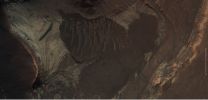
ESP_014287_1685_RED_abrowse-MF-LXTT.jpgNoctis Labyrinthus (EDM - possible True Colors; credits for the additional process. and color.: Dr Marco Faccin - Lunexit Team)75 visitenessun commentoMareKromium
|
|

PSP_003234_2210_RED_abrowse-HD3D-MF-LXTT.jpgThe "Face on Mars" as you've never seen it before! (High-Def-3D and Natural Colors; credits for the additional process. and color.: Dr Marco Faccin - Lunexit Team)75 visitenessun commentoMareKromium
|
|

PSP_002390_1320_RED_abrowse-01.jpgGullies in a Trough-Crater's Edge (EDM - Absolute Natural Colors; credits for the additional process. and color.: Dr Paolo C. Fienga - Lunexit Team)75 visitenessun commentoMareKromium
|
|
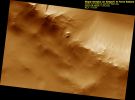
Psp_001808_1875_red.jpgSlope Streaks (or "Seeps"?) in Terra Sabaea74 visiteSlope streak formation is among the few known processes currently active on Mars. While their mechanism of formation and triggering is debated, they are most commonly believed to form by downslope movement of extremely dry sand or very fine-grained dust in an almost fluidlike manner (analogous to a terrestrial snow avalanche) exposing darker underlying material. Other ideas include the triggering of slope streak formation by possible concentrations of near-surface ice or scouring of the surface by running water from aquifers intercepting slope faces, spring discharge (perhaps brines) and/or hydrothermal activity.
Several of the slope streaks visible here, particularly the 3 longest darker streaks, show evidence that downslope movement is being diverted around obstacles such as large boulders. Several streaks also appear to originate at boulders or clumps of rocky material.
In general, the slope streaks do not have large deposits of displaced material at their downslope ends and do not run out onto the crater floor suggesting that they have little reserve kinetic energy. The darkest slope streaks are youngest and can be seen to cross cut and superpose older and lighter-toned streaks. The lighter-toned streaks are believed to be dark streaks that have lightened with time as new dust is deposited on their surface.
MareKromium
|
|

PSP_008100_1790_RED_abrowse.jpgLayered Rocks in Iani Chaos (MULTISPECTRUM; credits: Lunexit)74 visiteThis image shows rocks on the floor of Iani Chaos, a Region of collapsed and disorganized Terrain.
The Chaotic Terrains on Mars may have been the sources of floodwaters that carved the giant outflow channels. They typically contain irregular hills like the one in the center of this image. In some cases, they also have light-toned rocks exposed on the floors. The point of interest is to determine whether these rocks predate the chaos or formed after the collapse; however, the contacts may be obscured by later material mantling the ground.
The rocks here are light-toned, and have dark low patches which are likely a thin cover of wind-blown sand. At a coarse scale, linear features are also visible in the rock, likely reflecting aeolian (wind) erosion in a preferred direction. A variety of processes could have contributed to forming these rocks, from volcanic eruptions to lake deposition or accumulation of wind-blown sand.
Stepped layers occur in places, suggesting a repetitive process. This argues for an origin as aeolian or lake-bed sediments, since volcanic eruptions may be of variable strength.MareKromium
|
|
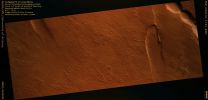
PSP_008130_1745_RED_abrowse-00.jpgSmall but deep Collapse Pit, North of Arsia Mons (context frame - MULTISPECTRUM; credits: Lunexit)74 visitenessun commentoMareKromium
|
|

Psp_009799_2205_red.jpgFeatures of Deuteronilus Mensae (natural colors; credits: Lunexit)74 visiteThis image shows Lineated Valley Fill and Lobate Debris Aprons in the Deuteronilus Mensae Region. Deuteronilus Mensae is located on the northern edge of Arabia Terra and borders the high-standing, heavily-cratered Southern Hemisphere and the low, uncratered plains that cover most of the Northern Hemisphere of Mars.
The Region is characterized by Hills and Mesas surrounded by debris Slopes and broad Valleys.
Many of the valley floors in the Deuteronilus Mensae Region exhibit complex alignments of small Ridges and Pits often called “Lineated Valley Fill”.
The cause of the small-scale texture is not well understood, but may result from patterns in ice-rich soils or ice loss due to sublimation (ice changing into water vapor).
The linear alignment may be caused by downhill movement of ice-rich soil or by glacial flow.
For example, flowing ice on Earth typically develops wrinkles or ridges and pits due to stresses in the ice as it moves.
The result is flow patterns, called “stream lines” that follow the valleys and curve around obstacles. In this image, stream lines are diverted or curve around the Mesas.
The mesas in this image are also surrounded by aprons of debris that appear to have flowed away from the Mesa. Recent results from the SHAllow RADar (SHARAD) instrument, another instrument onboard the Mars Reconnaissance Orbiter, indicate that lobate debris aprons in Deuteronilus Mensae, similar to those visible here, are composed of material dominated by ice [Plaut et al., 2008] and are interpreted to be potential debris-covered glaciers or rock glaciers.
The Debris Aprons in this image appear to lie on top of the Lineated Valley Fill and are therefore probably younger deposits.MareKromium
|
|
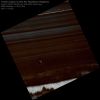
Psp_001462_2630_red~0.jpgFresh crater in the Northern Regions (possible Natural Colors; credits: Lunar Explorer Italia)74 visitenessun commentoMareKromium
|
|

ESP_011635_1510_RED_abrowse.jpgRitchey Crater's Central Uplift (Natural Colors; credits: Lunar Explorer Italia)74 visiteThe Natural Color image of this observation includes some interesting features in and near the central uplift of Ritchey Crater.
At the top is an ancient streambed, above center are very bright rocks and minerals can be seen in the Central Uplift. Large impact craters are unstable when they are formed, because their Walls are so steep.
Gravity causes the Walls to collapse toward the center of the Crater, colliding to form an Uplift or Peak. This process of Central Uplift formation can bring rocks from deep in the Crater Walls up to the surface. The angular bright blocks near the center of this image show that this process breaks the wall rocks into fragments as the Central Uplift is formed.
Mars Local Time: 16:00 (middle afternoon)
Coord. (centered): 28,5° South Lat. and 309,1° East Long.
Spacecraft altitude: 264,8 Km (such as about 165,5 miles)
Original image scale range: 26,5 cm/pixel (with 1 x 1 binning) so objects ~79 cm across are resolved
Map projected scale: 25 cm/pixel
Map projection: EQUIRECTANGULAR
Emission Angle: 15,1°
Phase Angle: 46,9°
Solar Incidence Angle: 61° (meaning that the Sun is about 29° above the Local Horizon)
Solar Longitude: 194,0° (Northern Autumn)
Credits: NASA/JPL/University of Arizona
Additional process. and coloring: Lunar Explorer ItaliaMareKromium
|
|

ESP_011909_1320_RED_abrowse.jpgSand Dunes and Ripples in Proctor Crater (Natural Colors; credits: Lunar Explorer Italia)74 visiteMars Local Time: 16:00 (middle afternoon)
Coord. (centered): 47,8° South Lat. and 30,7° East Long.
Spacecraft altitude: 253,2 Km (such as about 158,3 miles)
Original image scale range: 50,7 cm/pixel (with 1 x 1 binning) so objects ~ 1,52 mt across are resolved
Map projected scale: 50 cm/pixel
Map projection: EQUIRECTANGULAR
Emission Angle: 3,2°
Phase Angle: 59,1°
Solar Incidence Angle: 62° (meaning that the Sun is about 28° above the Local Horizon)
Solar Longitude: 206,7° (Northern Autumn)
Credits: NASA/JPL/University of Arizona
Additional process. and coloring: Lunar Explorer ItaliaMareKromium
|
|

PSP_010472_2590_RED_abrowse.jpgStreaks on Exposure of North Polar Layered Deposits (Natural Colors; credits: Lunar Explorer Italia)74 visiteMars Local Time: 14:47 (early afternoon)
Coord. (centered): 78,8° North Lat. and 357,2° East Long.
Spacecraft altitude: 317,4 Km (such as about 198,4 miles)
Original image scale range: 63,5 cm/pixel (with 1 x 1 binning) so objects ~ 1,91 mt across are resolved
Map projected scale: 50 cm/pixel
Map projection: EQUIRECTANGULAR
Emission Angle: 0,9°
Phase Angle: 66,9°
Solar Incidence Angle: 68° (meaning that the Sun is about 22° above the Local Horizon)
Solar Longitude: 144,7° (Northern Summer)
Credits: NASA/JPL/University of Arizona
Additional process. and coloring: Lunar Explorer ItaliaMareKromium
|
|
| 2237 immagini su 187 pagina(e) |
 |
|
|
|
|
89 | |
|
|
|
|





