| Piú viste - Mars Reconnaissance Orbiter (MRO) |
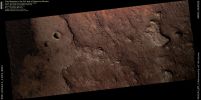
PSP_006625_1405_RED_abrowse-00-PCF-LXTT.jpgClay Minerals in the NW side of Bosporos Montes (Absolute Natural Colors; credits for the additional process. and color.: Dr Paolo C. Fienga - Lunexit Team)76 visiteThe Bosporos Montes make up part of the Rim of the giant Argyre Impact Basin on Mars. The Compact Reconnaissance Imaging Spectrometer (CRISM) identified this as a location with Clay Minerals (---> minerali a matrice argillosa). Such minerals contain water and may have formed under conditions favorable for life.
This HiRISE image was taken to support the CRISM Team’s investigation of this area. While HiRISE does not have the ability to identify minerals the way CRISM can, the enhanced colors in this image are similar to those seen in other Clay-containing parts of Mars.
The light-toned Mesas and Plains are crisscrossed with small Fractures that could have formed as a muddy Clay Deposit dried. However, this material is strong enough to form Boulders where it has been hit by Impact Craters.MareKromium
|
|
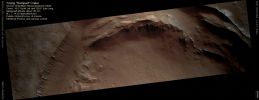
PSP_006588_1615_RED_abrowse-PCF-LXTT.jpgRelatively young "Rampart" Crater (Absolute Natural Colors; credits for the additional process. and color.: Dr Paolo C. Fienga - Lunexit Team)76 visiteThis image captures the Western Side of a relatively young “Rampart” Crater located in the Tharsis Region.
Rampart Craters are surrounded by a fluidized Ejecta Blanket (an Ejecta Blanket is the material thrown out around a Crater when the impact occured, in this case resembling the whites of a fried egg, where the crater is the yolk). Researchers speculate that these may form when an object impacts ground that contains fluid (liquid or frozen) that is released upon impact.
THEMIS images V06896002 and V10266002 provide context images for this side of the Crater and show better its Rampart.
Within the Crater we see evidence of Landslides originating at the upper edges. These Landslides have exposed individual Rocky Layers as well as Outcrops of stronger rock types which are more resistant to erosion.MareKromium
|
|

ESP_025042_1375_RED-PCF-LXTT-01.jpgLarge Dunefield in Noachis Terra (EDM - Absolute Natural Colors; credits for the additional process. and color.: Dr Paolo C. Fienga - Lunexit Team)76 visiteMars Local Time: 14:52 (early afternoon)
Coord. (centered): 42,4° South Lat. and 42,0° East Long.
Spacecraft altitude: 252,2 Km (such as about 157,6 miles)
Original image scale range: 25,2 cm/pixel (with 1 x 1 binning) so objects ~ 76,0 cm across are resolved
Map projected scale: 25 cm/pixel
Map projection: EQUIRECTANGULAR
Emission Angle: 0,4°
Sun - Mars - MRO (or "Phase") Angle: 69,9°
Solar Incidence Angle: 69° (meaning that the Sun is about 21° above the Local Horizon)
Solar Longitude: 36,5° (Northern Spring)
Credits: NASA/JPL/University of Arizona
Additional process. and coloring: Lunar Explorer ItaliaMareKromium
|
|
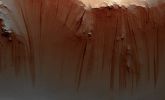
PSP_006991_1905_cut_b.jpgSeeps (MULTISPECTRUM; credits: Lunexit)75 visitenessun commentoMareKromium
|
|

Psp_008222_1640_red.jpgCollpse Pits along Claritas Rupes (Saturated and Enhaced Natural Colors; credits for the additional process. and color.: Dr Paolo C. Fienga - Lunexit Team)75 visitenessun commentoMareKromium
|
|
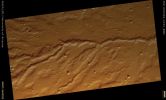
PSP_009369_2255_RED.jpgErosion on the Flank of Alba Patera (natural colors; credits: Lunar Explorer Italia)75 visiteMars Local Time: 15:15 (early afternoon)
Coord. (centered): 45,0° North Lat. and 243,2° East Long.
Spacecraft altitude: 295,0 Km (such as about 184,4 miles)
Original image scale range: 29,5 cm/pixel (with 1 x 1 binning) so objects ~89 cm across are resolved
Map projected scale: 25 cm/pixel
Map projection: EQUIRECTANGULAR
Emission Angle: 0,4°
Phase Angle: 44,3°
Solar Incidence Angle: 44° (meaning that the Sun is about 46° above the Local Horizon)
Solar Longitude: 104,0° (Northern Summer)
Credits: NASA/JPL/University of Arizona
Additional process. and coloring: Lunar Explorer ItaliaMareKromium
|
|

Psp_009389_1510_red.jpgBedrock Layers Exposed in Northern Hellas Basin (possible True Colors; credits: Lunar Explorer Italia)75 visiteMars Local Time: 15:30 (middle afternoon)
Coord. (centered): 28,9° South Lat. and 67,0° East Long.
Spacecraft altitude: 261,7 Km (such as about 163,6 miles)
Original image scale range: 52,4 cm/pixel (with 1 x 1 binning) so objects ~1,57 mt across are resolved
Map projected scale: 50 cm/pixel
Map projection: EQUIRECTANGULAR
Emission Angle: 0,3°
Phase Angle: 73,9°
Solar Incidence Angle: 74° (meaning that the Sun is about 16° above the Local Horizon)
Solar Longitude: 104,7° (Northern Summer)
Credits: NASA/JPL/University of Arizona
Additional process. and coloring: Lunar Explorer ItaliaMareKromium
|
|

ESP_011277_1825_RED_abrowse.jpgUnnamed Crater with Layers in Meridiani Planum (Natural Colors; credits: Lunar Explorer Italia)75 visiteMars Local Time: 15:47 (middle afternoon)
Coord. (centered): 2,2° North Lat. and 357,5° East Long.
Spacecraft altitude: 270,8 Km (such as about 169,2 miles)
Original image scale range: 27,1 cm/pixel (with 1 x 1 binning) so objects ~81 cm across are resolved
Map projected scale: 25 cm/pixel
Map projection: EQUIRECTANGULAR
Emission Angle: 3,9°
Phase Angle: 60,7°
Solar Incidence Angle: 57° (meaning that the Sun is about 33° above the Local Horizon)
Solar Longitude: 178,0° (Northern Summer)
Credits: NASA/JPL/University of Arizona
Additional process. and coloring: Lunar Explorer ItaliaMareKromium
|
|
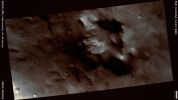
PSP_010454_1635_RED_abrowse.jpgCentral Uplift within an Unnamed Impact Crater (Natural Colors; credits: Lunar Explorer Italia)75 visiteMars Local Time: 15:45 (middle afternoon)
Coord. (centered): 16,1° South Lat. and 150,2° East Long.
Spacecraft altitude: 261,3 Km (such as about 163,3 miles)
Original image scale range: 26,1 cm/pixel (with 1 x 1 binning) so objects ~ 78 cm across are resolved
Map projected scale: 25 cm/pixel
Map projection: EQUIRECTANGULAR
Emission Angle: 8,4°
Phase Angle: 56,6°
Solar Incidence Angle: 63° (meaning that the Sun is about 27° above the Local Horizon)
Solar Longitude: 144,0° (Northern Summer)
Credits: NASA/JPL/University of Arizona
Additional process. and coloring: Lunar Explorer ItaliaMareKromium
|
|

ESP_011898_2175_RED_abrowse.jpgUnnamed Crater with Gullies in Acidalia Planitia (Natural Colors; credits: Lunar Explorer Italia)75 visitenessun commentoMareKromium
|
|

PSP_001348_1770_RED_abrowse-00.jpgUnusual Crater in Meridiani Planum (Natural Colors; credits: Lunar Explorer Italia)75 visiteQuesto è il context frame dal quale è stato estratto il particolare controverso che potete vedere nella Sezione "X-Mars" (frame "What is THAT???"). La colorizzazione è quanto di più realistico si possa ottenere usando la metodologia Made by Lunexit denominata "MULTISPECTRUM".
In questo frame, oltre al dettaglio che ha "intrigato" tanti Amici Lettori, potete vedere (e BENE) anche un elemento che, di fatto, supporta la nostra idea/ipotesi per cui, (poco) al di sotto della Superficie di Meridiani Planum, vi potrebbe essere un ulteriore ambiente (una sorta di intercapedine) destinato ad ospitare - magari stagionalmente - delle acque correnti e - chissà - forse anche delle Forme Vitali Indigene.
Il bolide che ha scavato questo cratere senza nome, infatti, se ci fate caso, pare aver sfondato l'ambiente-intercapedine il quale, per come appare in questa immagine, potrebbe trovarsi a non più di 8/10 metri al di sotto del Datum (o Altitudine Zero).
Solo "Fantasie"? Staremo a vedere...MareKromium
|
|
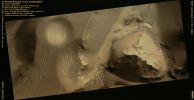
PSP_009342_1725_RED_abrowse-00.jpgPseudo-Pyramid, Dunes, Boulders and Other Misteries...75 visiteUn frame in apparenza di scarso interesse per gli Anomaly Hunters (ma ricco di suggestione per i Cultori delle Scienze Planetarie, con tutte le Surface Features da erosione eolica e da fluidi che mostra), sembra essersi rivelato - dopo un'analisi approfondita svolta usando la sua versione in JP2 - come un'autentica "Fucina di Anomalìe e Singolarità".
Fra le svariate Anomalìe individuabili nel frame, abbiamo deciso di investigarne due: la prima, suggeritaci dalla nostra Amica Elisabetta Bonora - e che ha già suscitato grandi interessi nei Forum di mezzo mondo, a cominciare da quello dei nostri Amici Americani di "AboveTopSecret") -, è rinvenibile in una Surface Feature che, ancora una volta, sembra mostrare ai nostri occhi, avidi di Mistero e di Immaginazione, un Monolito (davvero molto simile a quello di "2001 Odissea nello Spazio").
La seconda, invece, individuata dal nostro Marco Faccin, pare mostrare ai Terrestri il "volto" (si fa per dire...) di una bizzarra e, per certi versi, inquietante Forma Vitale Indigena.
Osservate e giudicate Voi stessi...MareKromium
|
|
| 2237 immagini su 187 pagina(e) |
 |
|
|
|
|
88 | |
|
|
|
|





