| Piú viste - Mars Reconnaissance Orbiter (MRO) |
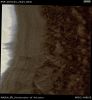
PSP_009345_2645_RED_abrowse.jpgBasal Unit Contact in North Polar Layered Deposits (Natural Colors; credits: Lunar Explorer Italia)78 visitenessun commentoMareKromium
|
|
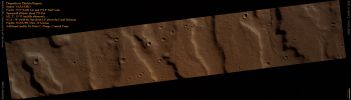
ESP_018471_1420_RED_abrowse.jpgElectris Region (Natural Colors; credits for the additional process. and color.: Dr Paolo C. Fienga - Lunexit Team)78 visitenessun commentoMareKromium
|
|

ESP_019188_2595_RED_abrowse.jpgNorth Presso-Polar Layers (Absolute Natural Colors; credits for the additional process. and color.: Dr Paolo C. Fienga - Lunexit Team:)78 visitenessun commentoMareKromium
|
|

PSP_002824_1355_RED_abrowse-01.jpgDunefield inside Rabe Crater (EDM - Natural Colors; credits for the additional process. and color.: Dr Paolo C. Fienga - Lunexit Team)78 visiteMareKromium
|
|

PSP_005361_2005_RED_abrowse-00.jpgCatastrophic Outflow Feature in Tharsis (Absolute Natural Colors; credits for the additional process. and color.: Dr Paolo C. Fienga - Lunexit Team)78 visitenessun commentoMareKromium
|
|
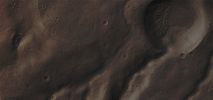
ESP_024955_1390_RED-PCF-LXTT-00.jpgFeatures of Icaria Region (CTX Frame "A" - Absolute Natural Colors; credits for the additional process. and color.: Dr Paolo C. Fienga - Lunexit Team)78 visiteMars Local Time: 14:49 (early afternoon)
Coord. (centered): 40,5° South Lat. and 257,0° East Long.
Spacecraft altitude: 247,9 Km (such as about 155,0 miles)
Original image scale range: 49,6 cm/pixel (with 2 x 2 binning) so objects ~ 1 mt and 49 cm across are resolved
Map projected scale: 50 cm/pixel
Map projection: EQUIRECTANGULAR
Emission Angle: 0,4°
Sun - Mars - MRO (or "Phase") Angle: 67,2°
Solar Incidence Angle: 67° (meaning that the Sun is about 23° above the Local Horizon)
Solar Longitude: 33,5° (Northern Spring)
Credits: NASA/JPL/University of Arizona
Additional process. and coloring: Lunar Explorer ItaliaMareKromium
|
|
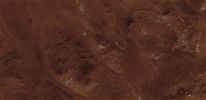
PSP_004277_1530_RED-PCF-LXTT-01.jpgFeatures of Holden Crater's Rim (CTX Frame "B" - Absolute Natural Colors; credits for the additional process. and color.: Dr Paolo C. Fienga - Lunexit Team)78 visiteHiRISE image PSP_004277_1530 covers a portion of the rim of Holden Crater, revealing breaches created when water over-topped the Rim and incised a series of Channels as it flowed down the Crater Wall.
The water responsible for the Channels was impounded outside of the rim of Holden in Uzboi Vallis (Holden Crater itself is approx. 150 Km in diameter).
Uzboi Vallis was interrupted when Holden Crater formed and the Rim formed an effective, temporary damn to flow farther to the North. Once the Uzboi Basin filled, water began flowing into Holden again, creating a series of low fan-shaped Deltas, alluvial deposits and a shallow, but relatively short-lived lake.
The Channels in this image were only active for a short time, as a Channel just to the East cut quickly into the Rim and became responsible for most of the drainage into the Crater.
The fact that most of the fan-shaped Deltas radiate from the Dominant Channel to the East rather than those in this image supports this scenario. MareKromium
|
|
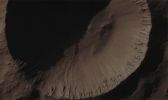
ESP_026061_1435-PCF-LXTT-001.jpgLong Shadows... (CTX Frame "B" - Absolute Natural Colors; credits for the additional process. and color.: Dr Paolo C. Fienga - Lunexit Team)78 visiteMars Local Time: 15:13 (early afternoon)
Coord. (centered): 36,4° South Lat. and 302,3° East Long.
Spacecraft altitude: 251,9 Km (such as about 157,4 miles)
Original image scale range: 50,4 cm/pixel (with 2 x 2 binning) so objects ~ 1 mt and 51 cm across are resolved (with 4 x 4 binning)
Map projected scale: 50 cm/pixel
Map projection: EQUIRECTANGULAR
Emission Angle: 1,2°
Sun - Mars - MRO (or "Phase") Angle: 75,0°
Solar Incidence Angle: 76° (meaning that the Sun is about 14° above the Local Horizon)
Solar Longitude: 71,6° (Northern Spring)
Credits: NASA/JPL/University of Arizona
Additional process. and coloring: Lunar Explorer ItaliaMareKromium
|
|
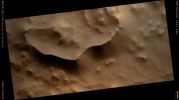
PSP_009356_1835_RED.jpgRidged Margin of Elevated Plateau North/West of Pavonis Mons (possible True Colors; credits: Lunar Explorer Italia)77 visiteSnaking across this observation is a ridged margin that appears as though it separates two parts of a canvas.
On closer examination (see the edm), it almost looks as though there is a relatively smooth landscape on the left, and pockmarked terrain on the right.
The ridge itself is revealed in incredible detail with what appear to be "gulley-esque" grooves running its length.
Pavonis Mons is part of what is called Tharsis Montes, being the middle of three volcanoes in this Region. The name "Pavonis Mons" itself is Latin for "Mount of the Peacock".
Mars Local Time: 15:25 (early afternoon)
Coord. (centered): 3,6° North Lat. and 243,8° East Long.
Spacecraft altitude: 265,3 Km (such as about 165,8 miles)
Original image scale range: 26,5 cm/pixel (with 1 x 1 binning) so objects ~80 cm across are resolved
Map projected scale: 25 cm/pixel
Map projection: EQUIRECTANGULAR
Emission Angle: 1,3°
Phase Angle: 54,5°
Solar Incidence Angle: 54° (meaning that the Sun is about 36° above the Local Horizon)
Solar Longitude: 103,5° (Northern Summer)
Credits: NASA/JPL/University of Arizona
Additional process. and coloring: Lunar Explorer ItaliaMareKromium
|
|

PSP_006262_1080_RED_abrowse-00~0.jpgExposure of Basal Section of South Polar Layered Deposits (MULTISPECTRUM; credits: Lunexit)77 visiteThis observation shows internal layering exposed in a so-called "Basal Section" of the Polar Layered Deposits.
The South Polar Layered Deposits are composed primarily of water ice with a small amount of dust.
Variations in dust content most likely controls the erosion of the layers. The layers were laid down over a large area near the South Pole, probably over the past few million years. They are believed to record recent global climate changes on Mars in much the same way that polar ice in Greenland and Antarctica provide information about varying climatic conditions on Earth.
Several layers appear to be truncated and most likely represent unconformities. Unconformities form when an episode of erosion that removes all or part of a layer, is followed by more deposition.MareKromium
|
|

PSP_003249_1510_RED_browse_01~0.jpgLayered Deposits in Ritchey Crater (edm - possible True Colors; credits: Lunar Explorer Italia)77 visite
This cutout from the top center part of the context image shows this stack.
The dark unit is thin and breaking into boulders. The light material is actually divided into smaller layers, and is pervasively fractured. However, the boulders falling from the edge are mostly small and rarely remain intact if they move more than a few meters.
The cracking of the layer could be due to water loss from the layer, or to regional tectonic effects such as stresses from burial and erosion.
The base unit is partially covered by wind-blown ripples.MareKromium
|
|

EndeavourCrater-PIA11837.jpgEndeavour Crater (Natural Colors; credits: Lunexit)77 visiteThe largest crater in this mosaic of images taken by the Context Camera on NASA's Mars Reconnaissance Orbiter is Endeavour Crater, which is approx. 22 Km (about 14 miles) in diameter.
The team operating NASA's Mars Exploration Rover Opportunity in the Meridiani Planum Region of Mars chose to drive the Rover toward Endeavour after Opportunity ascended out of smaller Victoria Crater in August 2008.
Opportunity caught its first glimpse of Endeavour's rim on March 7, 2008, during the 1820th Martian Day, or Sol, of the Rover's Mission on Mars. The Rover was about 12 Km (approx. 7 miles) from the closest point of Endeavour.MareKromium
|
|
| 2237 immagini su 187 pagina(e) |
 |
|
|
|
|
85 | |
|
|
|
|





