| Piú viste - Mars Reconnaissance Orbiter (MRO) |

ESP_019181_2655_RED_abrowse.jpgNorth Polar Boundary (Absolute Natural Colors; credits for the additional process. and color.: Dr Paolo C. Fienga - Lunexit Team:)79 visitenessun commentoMareKromium
|
|

ESP_019669_2450_RED_abrowse.jpgMega-Polygons in Vastitas Borealis (Absolute Natural Colors; credits for the additional process. and color.: Dr Paolo C. Fienga - Lunexit Team)79 visitenessun commentoMareKromium
|
|
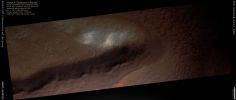
PSP_006648_2255_RED_abrowse-PCF-LXTT.jpgScarps in Deuteronilus Mensae (Absolute Natural Colors; credits for the additional process. and color.: Dr Paolo C. Fienga - Lunexit Team:)79 visiteThis image shows Scarps (such as "Steep Slopes") in Deuteronilus Mensae, a Region of distinctive Terrain in the Northern Hemisphere of Mars. Polygonal fractures, possibly formed by thermal cycles in ice-rich ground, are visible throughout the scene.
The high-standing topography at the top of the Scarps have several muted circles: these are Remnant Impact Craters that have degraded throughout time and their degradation process might have been enhanced by the presence of ground ice.
The two Scarps have different morphologies: the lower (East-facing) side has a Debris Apron with a wave-like texture at its base.
This is suggestive of material that has moved down the Scarp and gradually flowed away from it. Such a process would be expected if the material were ice-rich. There is no counterpart of this feature at the base of the upper (such as the West-facing) side.MareKromium
|
|

PSP_005370_1845_RED_abrowse-00.jpgExtremely unusually-looking Surface Feature in Sinus Meridiani (CTX Frame - Absolute Natural Colors; credits for the additional process. and color.: Dr Paolo C. Fienga - Lunexit Team)79 visitenessun commentoMareKromium
|
|

ESP_019559_1390_RED_abrowse-PCF-LXTT.jpgThe Dunes of Arkhangelsky Crater (Absolute Natural Colors; credits for the additional process. and color.: Dr Paolo C. Fienga - Lunexit Team)79 visitenessun commentoMareKromium
|
|
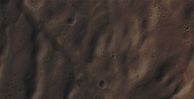
ESP_024955_1390_RED-PCF-LXTT-01.jpgFeatures of Icaria Region (CTX Frame "B" - Absolute Natural Colors; credits for the additional process. and color.: Dr Paolo C. Fienga - Lunexit Team)79 visiteMars Local Time: 14:49 (early afternoon)
Coord. (centered): 40,5° South Lat. and 257,0° East Long.
Spacecraft altitude: 247,9 Km (such as about 155,0 miles)
Original image scale range: 49,6 cm/pixel (with 2 x 2 binning) so objects ~ 1 mt and 49 cm across are resolved
Map projected scale: 50 cm/pixel
Map projection: EQUIRECTANGULAR
Emission Angle: 0,4°
Sun - Mars - MRO (or "Phase") Angle: 67,2°
Solar Incidence Angle: 67° (meaning that the Sun is about 23° above the Local Horizon)
Solar Longitude: 33,5° (Northern Spring)
Credits: NASA/JPL/University of Arizona
Additional process. and coloring: Lunar Explorer ItaliaMareKromium
|
|

ESP_024952_2250_RED-PCF-LXTT-01.jpgLow Albedo Surface Features in Acidalia Planitia (CTX Frame "B" - Absolute Natural Colors; credits for the additional process. and color.: Dr Paolo C. Fienga - Lunexit Team)79 visiteMars Local Time: 14:27 (early afternoon)
Coord. (centered): 44,4° North Lat. and 326,8° East Long.
Spacecraft altitude: 304,0 Km (such as about 190,0 miles)
Original image scale range: 60,8 cm/pixel (with 2 x 2 binning) so objects ~ 1 mt and 82 cm across are resolved
Map projected scale: 50 cm/pixel
Map projection: EQUIRECTANGULAR
Emission Angle: 6,9°
Sun - Mars - MRO (or "Phase") Angle: 50,3°
Solar Incidence Angle: 44° (meaning that the Sun is about 46° above the Local Horizon)
Solar Longitude: 33,4° (Northern Spring)
Credits: NASA/JPL/University of Arizona
Additional process. and coloring: Lunar Explorer ItaliaMareKromium
|
|

ESP_025387_1555-PCF-LXTT-000.jpgUnnamed Crater and a "patch" of bright Bedrock (CTX Frame - Absolute Natural Colors; credits for the additional process. and color.: Dr Paolo C. Fienga - Lunexit Team)79 visiteMars Local Time: 14:58 (early afternoon)
Coord. (centered): 24,4° South Lat. and 341,2° East Long.
Spacecraft altitude: 260,1 Km (such as about 162,5 miles)
Original image scale range: 26,9 cm/pixel (with 1 x 1 binning) so objects ~ 78 cm across are resolved
Map projected scale: 25 cm/pixel
Map projection: EQUIRECTANGULAR
Emission Angle: 6,5°
Sun - Mars - MRO (or "Phase") Angle: 57,1°
Solar Incidence Angle: 61° (meaning that the Sun is about 29° above the Local Horizon)
Solar Longitude: 48,6° (Northern Spring)
Credits: NASA/JPL/University of Arizona
Additional process. and coloring: Lunar Explorer ItaliaMareKromium
|
|

ESP_025665_1825-PCF-LXTT-00.jpgUnnamed Crater with Layers of Water-deposited Sediments (CTX Frame - Absolute Natural Colors; credits for the additional process. and color.: Dr Paolo C. Fienga - Lunexit Team)79 visiteMars Local Time: 14:56 (Early Afternoon)
Coord. (centered): 2,317° North Lat. and 307,960° East Long.
Spacecraft altitude: 269,9 Km (such as about 168,7 miles)
Original image scale range: 54,0 cm/pixel (with 2 x 2 binning) so objects ~ 1 mt and 62 cm across are resolved (with 4 x 4 binning)
Map projected scale: 50 cm/pixel
Map projection: EQUIRECTANGULAR
Emission Angle: 2,3°
Sun - Mars - MRO (or "Phase") Angle: 48,9°
Solar Incidence Angle: 47° (meaning that the Sun is about 43° above the Local Horizon)
Solar Longitude: 58,1° (Northern Spring/Southern Fall)
Credits: NASA/JPL/University of ArizonaMareKromium
|
|
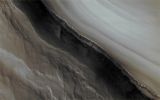
ESP_025010_2650-PCF-LXTT-IPF.jpgOn the North Polar Scarp (EDM - Absolute Natural Colors; credits for the additional process. and color. Dr Paolo C. Fienga/Lunar Explorer Italia/Italian Planetary Foundation)79 visiteThis image, taken by the NASA - Mars Reconnaissance Orbiter in the late November of the AD 2011, was acquired in order to monitor the effects on the North Polar Scarp of the so-called "Frost Avalanches" that occurred the year prior. HiRISE often re-images certain areas of Mars so to track those changes which, over time, might have occurred in some particularly interesting Regions and, in this case, the NASA People wanted to photograph the North Polar Scarp near the onset of the Martian Springtime, so to get a better understanding, among other things, of the number, extent and frequency of these Frost Avalanches; their possible causes (beside the thawing ---> the fact that Ice, Snow, or other frozen substances, start to become liquid, or just soft, as a result of warming) and the role that they have in the evolution of the North Poalr Scarp itself.
It is a fact that, even though the HiRISE has captured the occurrence of many other Frost Avalanches in the past, their view never ceases to amaze, since it demonstrates (but we, as IPF, just like many other Researchers and Scientists all over the World, had no doubts about it) that there still are, even at present time, several Active Geologic and Atmospheric Processes which keep happening (or regular bases) on the Red Planet. And this one, in other words, is just "one of the many"...
Mars Local Time: 12:33 (Early Afternoon)
Coord. (centered): 84,995° North Lat. and 151,528° East Long.
Spacecraft altitude: 320,4 Km (such as about 200,2 miles)
Original image scale range: 32,1 cm/pixel (with 1 x 1 binning) so objects ~ 96 cm across are resolved
Map projected scale: 25 cm/pixel
Map projection: POLAR STEREOGRAPHIC
Emission Angle: 0,5°
Phase Angle: 71,1°
Solar Incidence Angle: 71° (meaning that the Sun was about 19° above the Local Horizon at the time the picture was taken)
Solar Longitude: 35,4° (Northern Spring - Southern Fall)
Credits: NASA/JPL/University of Arizona
Additional process. and coloring: Lunar Explorer Italia
This picture (which is a cropped and NON-Map Projected NASA - Original Mars Reconnaissance Orbiter CTX b/w frame, identified by the serial n. ESP_025010_2650) has been additionally processed and then colorized in Absolute Natural Colors (such as the colors that a human eye would actually perceive if someone were onboard the NASA - Mars Reconnaissance Orbiter and then looked down, towards the Surface of Mars), by using an original technique created - and, in time, dramatically improved - by the Lunar Explorer Italia Team.MareKromium
|
|

PSP_005946_0975_RED_abrowse-01.jpgUnconformity in the South Polar Layered Deposits (SPLD) - (extra-detail mgmf - natural colors; elab. Lunexit)78 visiteThe layers in the upper center/right end abruptly (truncate) at a curve in the layers that extend along the left side of the image.
This type of truncation (termed "unconformity" in Geology) is usually due to erosion, wherein the layers in the lower right were eroded, followed by later deposition of the rest of the layers on top of the older layers (layer age likely increases from left to right). It is also possible that flow of these icy layers played a part in the complicated layer geometry exhibited in this extra-detail mgnf".MareKromium
|
|
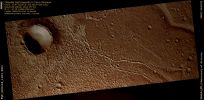
PSP_009318_1465_RED-00.jpgChloride Salt Deposits within a Channel in Terra Sirenum (ctx frame - natural colors; credits: Lunexit)78 visiteThis image shows a series of knobs, channels and inverted channels in the ancient Southern Highlands of Mars.
The inverted channels, which now appear as sinuous ridges, are filled with a fractured light-toned material that is also apparent in the knobs and nearby bedrock. Previous analyses of the infrared data from TES and THEMIS of similar materials in Terra Sirenum and elsewhere on Mars suggest that these light-toned materials are deposits of chloride salts such as Sodium Chloride (ordinary rock salt).
Salt deposits are key targets in the search for ancient life on Mars, because they represent places where bodies of liquid water may have ponded and evaporated.
The salt forms an ideal setting in which to preserve signs of biological activity. The clear association of the salt with the sinuous channels visible here suggests that the material was precipitated from brines that once flowed through these channels.
The fractured surface of the deposits is consistent with cracking by desiccation (rapid drying) of the thick salts as they were deposited.MareKromium
|
|
| 2237 immagini su 187 pagina(e) |
 |
|
|
|
|
84 | |
|
|
|
|





