| |

| Piú viste - Mars Reconnaissance Orbiter (MRO) |
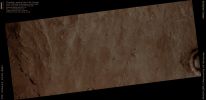
PSP_006633_2010_RED_abrowse~0.jpgPossible MSL Landing Site in Nili Fossae (Absolute Natural Colors; credits for the additional process. and color.: Dr Paolo C. Fienga - Lunexit Team) 81 visiteThe Nili Fossae are Valleys that have cut into the ancient crust of Mars, exposing Clay Minerals. These minerals formed in the presence of water and may be the result of chemical reactions between hot water and rocks. If so, this could have been a favorable location for Martian Life in ancient times.
This HiRISE image is part of a series in search for a safe place the Mars Science Laboratory Rover can land. In the central part of the image, the Terrain is a mix of Sand Dunes and relatively smooth rock exposures. There are some small Knobs but very few large rocks in the area. Instead, the multi-colored rock exposures seem to be mostly a mosaic of flat fractured rock.
On the Southern edge of the image (Dx), an Impact Crater is a potential hazard. In the Northern part of the image, the Scarp marking the boundary of the valley is visible.MareKromium
|
|

PSP_005369_1925_RED_abrowse.jpgFeatures of Terra Sabaea (Absolute Natural Colors; credits for the additional process. and color.: Dr Paolo C. Fienga - Lunexit Team)81 visitenessun commentoMareKromium
|
|
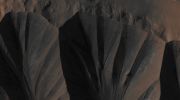
Gullies-ESP_020661_1440-PCF-LXTT-IPF.jpgGullies in Gasa Crater (Absolute Natural Colors; credits for the additional process. and color.: Dr Paolo C. Fienga/Lunar Explorer Italia/Italian Planetary Foundation)81 visiteThe so-called "Gully Landforms" - just like the ones shown here, in this NASA - Mars Reconnaissance Orbiter image - can often be found in the Inner Rims (or even below, along the Inner Slopes) of many Impact Craters that are located at the Martian Mid-Latitudes. Some changes in these Gully Landforms were first seen in frames taken by the NASA - Mars Global Surveyor - Mars Orbiter Camera (MGS-MOC) in the AD 2006, and studying such activity has been a high priority for HiRISE ever since (and, in fact, many examples of New Deposits located inside Gully Landforms are now well known).
This frame shows a New Deposit inside some Gully Landforms located on the Inner Rim of Gasa Crater; a very (relatively speaking) "fresh" approx. 7-Km diameter Impact Crater that is found in the Southern Mid-Latitudes of the Red Planet (to be precise, at 35,72° South Latitude and 129.45° East Longitude). Said New Deposit appears of a distinctive gray color, with some patches of white Material too, in this Absolute Natural Color version of the NASA - Mars Reconnaissance Orbiter image n. ESP_020661_1440. The picture was acquired during the Southern Spring of Mars, but the Flow that formed the Deposit occurred in the preceding Winter.
As a matter of fact, the current Gully Activities appear to be concentrated in periods going from the late Winter to the early Spring of Mars, and this circumstance may be a consequence of the Sublimation of the Seasonal Carbon Dioxide (CO2) Frost (which, by the way, is well visible in several Gully "Alcoves" during Wintertime).
Mars Local Time: 15:49 (Middle Afternoon)
Coord. (centered): 35,729° North Lat. and 129,386° East Long.
Spacecraft altitude: 258,2 Km (such as about 160,3 miles)
Original image scale range: 25,8 cm/pixel (with 1 x 1 binning) so objects ~ 78 cm across are resolved
Map projected scale: 25 cm/pixel
Map projection: EQUIRECTANGULAR
Emission Angle: 11,0°
Sun-Mars-Spacecraft (or Phase) Angle: 47,6°
Solar Incidence Angle: 58° (meaning that the Sun was about 32° above the Local Horizon at the time the picture was taken)
Solar Longitude: 203,7° (Northern Fall - Southern Spring)
Credits: NASA/JPL/University of Arizona
Additional process. and coloring: Lunar Explorer Italia
This picture (which is an Original Mars Reconnaissance Orbiter EDM enhanced color frame, identified by the serial n. ESP_020661_1440) has been additionally processed and then re-colorized in Absolute Natural Colors (such as the colors that a human eye would actually perceive if someone were onboard the NASA - Mars Reconnaissance Orbiter and then looked down, towards the Surface of Mars), by using an original technique created - and, in time, dramatically improved - by the Lunar Explorer Italia Team.MareKromium
|
|
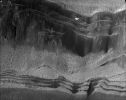
North_Polar_Regions-Chasma_Boreale-PIA01926-det.jpgThe Walls of Chasma Boreale80 visiteThe Martian terrain in this remarkable image is at the head of a large chasm, named Chasma Boreale, which cuts through Mars' North Polar Layered Deposits (MNPLD). These ice-rich layered deposits are about 3000 mt (about 9.800 feet) thick and 1000 Km (1.600 miles) across, much like the Greenland ice-sheet on Earth. The head of Chasma Boreale ends in a steep icy cliff more than 1000 mt (about 3300 feet) high. The cliff has both light- and dark-toned layers, seen at right in this image. The image was taken by the HiRISE camera on NASA's MRO. The internal layers of the ice-sheet are visible in the cliff walls. The dark-toned flat area in the center and left of the image is the floor of this chasm, which contains many craters.
Scientists have proposed that Chasma Boreale was formed by a catastrophic flood that began under the ice-sheet and was later widened by wind erosion. However, the large number of craters on the chasm's floor implies that the floor is much older than the ice sheet. These craters should have been removed by the suggested flood; their presence has caused some Mars researchers to instead speculate that no large flood occurred and that Chasma Boreale was not covered with very much ice.
In addition to layered ice, there is also some material within the north polar layered deposits that appears to be composed of sand. The dark material near the base of the cliff wall is thought to be aprons of debris being eroded from sand-rich layers. Zooming in on this dark material with HiRISE reveals ripples, which are diagnostic of moving sand.
Some bright spots of material visible on the cliff wall were not present in previous years. These are likely patches of water frost. Each year layers of carbon dioxide and water frost coat this terrain before being removed during the summer. The water frost lasts longer, and patches that are shaded by nearby steep topography (such as this one) can persist even into late summer.
An unexpected surprise, not visible with previous camera resolutions, is the fragmentation of the exposed surfaces of these icy layers into polygonal blocks. These blocks appear to be breaking away from the layer margins and forming boulder-sized debris, which then rolls down slope (a process called mass-wasting). These boulders are likely to be large blocks of dusty water ice; once separated from the main ice-sheet they can be eroded away by sunlight. More boulder-sized objects are visible out in the floor of the chasm. Polygons are also visible throughout the chasm floor, indicating that water-ice is just below the surface.
Image TRA_000845_2645 was taken by the HiRISE camera on Oct. 1, 2006. The complete image is centered at 84.6 degrees latitude, 3.4 degrees east longitude. The range to the target site was 316 kilometers (198 miles). At this distance the image scale is 63 centimeters (25 inches) per pixel (with 2 x 2 binning), so objects about 186 centimeters (73 inches) across are resolved. The image shown here has been map-projected to 50 centimeters (20 inches) per pixel. North is up. The image was taken at a local Mars time of 3:34 p.m. and the scene is illuminated from the west with a solar incidence angle of 62.3 degrees, thus the sun was about 27.7 degrees above the horizon. At a solar longitude of 114.3 degrees, the season on Mars is northern summer.
|
|
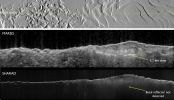
SHARAD-2.jpgUnder the Ice... (2)80 visiteTwo complementary Radar Sounder Instruments work together to discover hidden Martian secrets. They are the Mars Advanced Radar for Subsurface and Ionospheric Sounding (MARSIS) on the European Space Agency's Mars Express orbiter and the Shallow Subsurface Radar (SHARAD) on NASA's Mars Reconnaissance Orbiter.
MARSIS was designed to penetrate deep and it has delivered on its promise. This figure shows the base of Mars' South Polar Layered Deposits at the deepest recorded point of 3,7 Km (2,3 miles).
In contrast, SHARAD was designed as a High-Resolution Radar for a maximum penetration of 1 Km (0,6 mile) has difficulty detecting the base of these layered deposits.
MARSIS was funded by NASA and the Italian Space Agency and developed by the University of Rome, Italy, in partnership with NASA's Jet Propulsion Laboratory, Pasadena, Calif. Italy provided the instrument's digital processing system and integrated the parts. The University of Iowa, Iowa City, built the transmitter for the instrument, JPL built the receiver and Astro Aerospace, Carpinteria, Calif., built the antenna. JPL is a division of the California Institute of Technology in Pasadena. Additional information about Mars Express is at www.esa.int/marsexpress.
SHARAD was provided by the Italian Space Agency (ASI). Its operations are led by the University of Rome and its data are analyzed by a joint U.S.-Italian science team. JPL, a division of the California Institute of Technology, Pasadena, manages the Mars Reconnaissance Orbiter for the NASA Science Mission Directorate, Washington.MareKromium
|
|

ESP_011341_0980_RED_abrowse.jpgStarburst Fans, or: the Arthur Clarke Trees (Natural Colors; credits: Lunar Explorer Italia)80 visiteQuante volte, su Siti (fanta/pseudo) Scientifici avete visto e letto degli "Alberi Marziani" (che sono anche - e meglio - noti al Pubblico come "Arthur Clarke Trees", in omaggio al Creatore della Saga di "2001 - Odissea nello Spazio")?
Sicuramente tante volte.
Oggi (in realtà esistevano già altre riprese sufficientemente chiare, ma facciamo finta che non lo fossero...), grazie a questa splendida immagine ottenuta dalla Sonda MRO, il "mistero" degli Alberi Marziani possiamo dire che è definitivamente risolto (anche se, a nostro avviso, queste Surface Features non erano mai state un VERO mistero): si tratta di Fans a forma di "stella che esplode".
E come si sono generati questi Fans (---sbuffi)? Ce lo spiega la NASA stessa:"During the Martian Winter a layer of Carbon Dioxide Ice (CO2, or Dry Ice) forms a seasonal cap over the South Polar Region. In the Spring — when the Sun starts to warm the ice and the surface below — gas escapes from beneath the ice layer, carrying dust with it.
The dust is deposited on top of the ice in Fans, with an orientation determined by the prevailing wind direction. In this Region, the gas flows along radial channels, so that when it emerges we see a circular set of Dust Fans. These inspire the “starburst” description".
La "morale" è sempre la stessa: i Misteri - su Marte e nel resto di Sistema Solare e del Cosmo - ci sono, esistono e sono grandi ed affascinanti.
Non serve quindi "inventarne" di sana pianta (se non per consentire a qualcuno di mettersi soldi e facile notorietà in tasca): basta osservare, studiare ed infine - credeteci - di motivi per sognare e per comprendere che "non siamo soli", ne troverete a milioni.
"Piramidi", "Sfingi" e "Parabole"? NO, grazie!
Mars Local Time: 17:06 (middle afternoon)
Coord. (centered): 81,8° South Lat. and 76,1° East Long.
Spacecraft altitude: 246,9 Km (such as about 154,3 miles)
Original image scale range: 49,4 cm/pixel (with 1 x 1 binning) so objects ~1,48 mt across are resolved
Map projected scale: 50 cm/pixel
Map projection: EQUIRECTANGULAR
Emission Angle: 0,2°
Phase Angle: 88,0°
Solar Incidence Angle: 88° (meaning that the Sun is about 2° above the Local Horizon)
Solar Longitude: 180,8° (Northern Autumn)
Credits: NASA/JPL/University of Arizona
Additional process. and coloring: Lunar Explorer ItaliaMareKromium
|
|
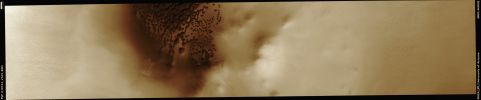
PSP_010512_2505_RED_abrowse.jpgImpact Crater with possible Summer Ice in Vastitas Borealis (Natural Colors; credits: Lunar Explorer Italia)80 visiteMars Local Time: 15:13 (early afternoon)
Coord. (centered): 70,0° North Lat. and 352,1° East Long.
Spacecraft altitude: 317,9 Km (such as about 198,7 miles)
Original image scale range: 63,6 cm/pixel (with 1 x 1 binning) so objects ~ 1,61 mt across are resolved
Map projected scale: 50 cm/pixel
Map projection: EQUIRECTANGULAR
Emission Angle: 2,0°
Phase Angle: 62,1°
Solar Incidence Angle: 64° (meaning that the Sun is about 26° above the Local Horizon)
Solar Longitude: 146,3° (Northern Summer)
Credits: NASA/JPL/University of Arizona
Additional process. and coloring: Lunar Explorer ItaliaMareKromium
|
|
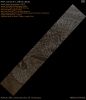
PSP_003193_0850_RED_abrowse-00.jpgThe South Polar Spring of AD 2007 (Absolute Natural Colors; credits for the additional process. and color.: Dr Paolo C. Fienga - Lunexit Team)80 visitenessun commentoMareKromium
|
|
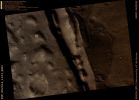
PSP_002014_1415_RED_abrowse-00.jpgTrough in Gorgonum Fossae (Absolute Natural Colors; credits for the additional process. and color.: Dr Paolo C. Fienga - Lunexit Team)80 visitePSP_002014_1415 shows Gullies in a Trough that is near Gorgonum Chaos, a Region filled with Gullies.
The Trough Gullies, like many of the Gullies on nearby Gorgonum Chaos' Mesas, appear to originate at a distinct Layer. There are Mounds within the Trough that have Layers exposed near their Peaks. The Layers in the Mound and on the Trough Walls are resistant, meaning they do not break up mostly into small particles that the wind can easily carry away.
Instead, they are breaking up into Boulders up to several meters wide that HiRISE can see (the fact that the Layers are eroding as boulders tells us that the material is not easily broken up into smaller and smaller pieces, so it is therefore termed "resistant to erosion").
However, it is not completely resistant to erosion as we can see by the Boulders rolling down the Slopes.
Gullies are thought by many to require liquid water to form and a major debate is whether this water comes from the surface (i.e., melting surface ice or melting snow) or the subsurface (i.e., from an aquifer).
Gullies are often found to originate at layers, like those seen here.
The subsurface water theory states that water travels under the surface to slope faces where it flows down the slope to form gullies. Visible layers are suggested to be impermeable, such that water cannot penetrate them, which is why the gullies originate from beneath the layers.
Often Gullies will originate between Layers, which suggests that there is a permeable Layer trapped between impermeable Layers.
It is also possible that the Layer preferentially traps ice or snow that may melt to form Gullies, thus providing a surface source of water to form the Gullies.
Please note that the stripe-like features on the lower side of the image are camera artifacts and not real features.MareKromium
|
|

PSP_002932_1445_RED_abrowse-01.jpgSection of the Outer Rim of Hale Crater (EDM - Absolute Natural Colors; credits for the additional process. and color.: Dr Paolo C. Fienga - Lunexit Team)80 visitenessun commentoMareKromium
|
|
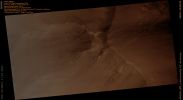
PSP_004805_1710_RED_abrowse.jpgOn the Edge of Ganges Chasma (Absolute Natural Colors; credits for the additional process. and color.: Dr Paolo C. Fienga - Lunexit Team)80 visiteThe Troughs and Chasms of the Valles Marineris Canyon System contain Light-Toned Deposits of enigmatic origin. The light materials, often layered, have variously been proposed to be Volcanic Ash or Sediments laid down by Rivers, Lakes or Sand Dunes.
One aspect of the Light-Toned material that has remained unclear is the timing of its deposition relative to canyon formation - was the material deposited in the Troughs, or does it crop out in the Walls, indicating that it existed before the Valles Marineris Canyon System formed?
This HiRISE image shows a part of the wall of Ganges Chasma. (This image, taken during the major Dust Storms which have raged through the summer of 2007, is grainy and low-contrast because of Dust in the Atmosphere). The Plateau above the Chasm is on the right side of the image, with the Wall of the Trough descending to the North. A few fine Layers, likely Basalt Flows, form the cap layers.
In the Spur, at the center of the image, light material appears to crop out, contrasting with the relatively dark material elsewhere in the Wall of the trough. At least some of this material is inherently lighter than other Wallrock; changes in tone occur at several sites where there are no breaks in Slope.
The light material appears be forming Spurs and Ridges similar to the surrounding rock, suggesting that it comprises at least some part of the Walls. However, darker, bouldery material occurs at the same level just to the West (up) of the light patch, indicating that the light outcrop may not extend very far.
Images like this provide clues to help unravel the history of deposition and deformation in Valles Marineris, and may eventually tell a complex story. In order to fully understand what this image means, several questions must be addressed: is this light material the same as intensively Layered Deposits observed elsewhere?
How extensive are light Wall Materials?
Are these materials conformable (part of a continuous sequence) with the rest of the Wall?
More HiRISE imaging will help address these questions. MareKromium
|
|
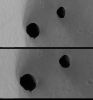
PSP_003317_1975_and_ESP_003317_1975-EB-LXTT-01.jpgThe "OO Pits" - Rimless Collapse Pits in Tharsis (High-Def-3D; credits for the additional process.: Elisabetta Bonora - Lunexit Team)80 visitenessun commentoMareKromium
|
|
| 2237 immagini su 187 pagina(e) |
|
|
|
|
|
82 | |
|
|
|
|
|
|





