| Piú viste - Mars Reconnaissance Orbiter (MRO) |
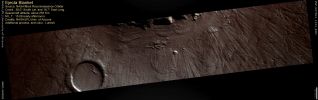
PSP_007822_1415_RED_abrowse~0.jpgEjecta Blanket (MULTISPECTRUM; credits: Lunexit)82 visiteThe Ejecta Blanket of a large (20 Km diameter) impact crater is shown here in vivid detail. The ejecta formed strong linear patterns in the topography that extend radially outward from the crater. This ejecta is rocky material that was ejected from the crater as a result of the high-velocity impact of an object about 100-200 meters in diameter, which probably escaped from the asteroid belt.
Since the impact event, this ejecta has been subject to millions of years of wind erosion that may have etched the surface and accentuated the radial pattern. There are also small-scale landforms such as fractured mounds that may have formed due to the presence of subsurface ice (note: this is a so-called "periglacial phenomenon"). MareKromium
|
|

PSP_009328_1755_RED.jpgLayering and Faulting in Candor Chasma's Layered Deposits (natural colors; credits: Lunar Explorer Italia)82 visiteMars Local Time: 15:24 (early afternoon)
Coord. (centered): 4,4° South Lat. and 288,8° East Long.
Spacecraft altitude: 271,0 Km (such as about 169,4 miles)
Original image scale range: 54,2 cm/pixel (with 1 x 1 binning) so objects ~1,63 mt across are resolved
Map projected scale: 50 cm/pixel
Map projection: EQUIRECTANGULAR
Emission Angle: 5,7°
Phase Angle: 62,0°
Solar Incidence Angle: 58° (meaning that the Sun is about 32° above the Local Horizon)
Solar Longitude: 102,5° (Northern Summer)
Credits: NASA/JPL/University of Arizona
Additional process. and coloring: Lunar Explorer ItaliaMareKromium
|
|

Deimos-HiRISE-090309.jpgDeimos in Natural Colors and HR (credits: NASA/JPL-Caltech and Univ. of Arizona)82 visiteThese color-enhanced views of Deimos, the smaller of the two moons of Mars, result from imaging on Feb. 21, 2009, by the High Resolution Imaging Science Experiment (HiRISE) camera on NASA's Mars Reconnaissance Orbiter.
Deimos has a smooth surface due to a blanket of fragmental rock or regolith, except for the most recent impact craters. It is a dark, reddish object, very similar to Mars' other moon, Phobos. For a comparison, see HiRISE images of Phobos taken on March 23, 2008.
These Deimos images combine HiRISE exposures in Near-InfraRed, Red and Blue-Green wavelengths. In the enhanced color, subtle color variations are visible -- redder in the smoothest areas and less red near the fresh impact craters and over ridges of topographic highs (relative to Deimos' center of gravity). The color variations are probably caused by exposure of surface material to the space environment, which leads to darkening and reddening. Brighter and less-red surface materials have seen less exposure to space due to recent impacts or downslope movement of regolith.
Deimos is about 12 Km (approx. 7,5 miles) in diameter. Its orbital period is 1 day, 6 hours, 17' and 54".
These two images were acquired 5 hours and 35 minutes apart.
The Sun was to the upper left in the first (left) image, and to the right in the second image. The viewing geometry is similar in the two images, but surface features appear very different due to the change in illumination.
With an image scale of about 20 mt (66 feet) per pixel, features 60 mt (197 feet) or larger can be discerned.
These images are products from observations catalogued by the HiRISE team as ESP_012065_9000 and ESP_012068_9000. Other products from these observations are available at http://hirise.lpl.arizona.edu/deimos.php .MareKromium
|
|
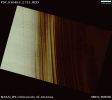
PSP_010463_2735_RED_abrowse.jpgNorth Polar Layers (Natural Colors; credits: Lunar Explorer Italia)82 visiteMars Local Time: 07:04 (early morning)
Coord. (centered): 86,5° North Lat. and 126,1° East Long.
Spacecraft altitude: 315,9 Km (such as about 197,4 miles)
Original image scale range: 63,2 cm/pixel (with 1 x 1 binning) so objects ~ 1,90 mt across are resolved
Map projected scale: 50 cm/pixel
Map projection: EQUIRECTANGULAR
Emission Angle: 0,0°
Phase Angle: 74,7°
Solar Incidence Angle: 75° (meaning that the Sun is about 15° above the Local Horizon)
Solar Longitude: 144,4° (Northern Summer)
Credits: NASA/JPL/University of Arizona
Additional process. and coloring: Lunar Explorer ItaliaMareKromium
|
|
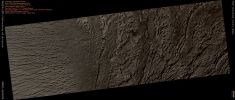
PSP_003656_2015_RED_abrowse-PCF-LXTT.jpgLayering in Becquerel Crater (Natural Colors; credits for the additional process. and color.: Dr Paolo C. Fienga - Lunexit Team)82 visiteBecquerel Crater is one of several impact craters in Arabia Terra that have light-toned layered deposits along the crater floor. The light-toned deposits are particularly striking to look at in this HiRISE image because they are stacked together to produce a thick sequence of layered beds. The layers appear to be only a few meters thick and show little variations in thickness.
On Earth, layered beds with these characteristics are typically formed in water environments, although aeolian (wind blown) deposition on Mars through a cyclic process is also possible. Volcanic eruptions would not be expected to produce ash or volcanic flows of such regular thickness, and there are no nearby volcanic vents.
Some of the layering in the image appears dark, probably due to deposition of basalt sand along flatter surfaces rather than any compositional variations in the layer beds themselves. Faults can also be seen displacing portions of the layered beds. The surface of the light-toned deposit is not smooth but instead appears disrupted into polygonal cracks and blocks.
Relative to most surfaces on Mars, there are almost no impact craters seen in this image. This is not due to a young age but rather to the friable (easily eroded) nature of the light-toned layered deposits that enable wind easily to erode the unit, thereby removing any impact craters. Evidence of erosion by the wind is most apparent in the bottom of the image where linear ridges most likely formed by wind scouring away material in a North-South direction and creating the ridges.
MareKromium
|
|
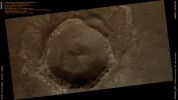
ESP_020086_2020_RED_abrowse-00.jpgUnnamed Crater with Light-toned Layered Bedrock (Absolute Natural Colors; credits for the additional process. and color.: Dr Paolo C. Fienga - Lunexit Team)82 visitenessun commentoMareKromium
|
|
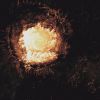
PSP_005370_1845_RED_abrowse-01.jpgExtremely unusually-looking Surface Feature in Sinus Meridiani (EDM - Absolute Natural Colors; credits for the additional process. and color.: Dr Paolo C. Fienga - Lunexit Team)82 visitenessun commentoMareKromium
|
|
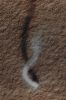
ESP_026051_2160-PCF-LXTT-02.jpgSerpentine Dust Devil in Amazonis Planitia (EDM - Absolute Natural Colors; credits for the additional process. and color.: Dr Paolo C. Fienga - Lunexit Team)82 visitenessun commentoMareKromium
|
|

Psp_001401_1850_red-1.jpgThe "Bridges" of Arabia Terra (1) extra-detail mgnf81 visiteUn detail-mgnf che ci mostra con sconcertante chiarezza l'impossibilità che questi rilievi sìano il prodotto di azioni eoliche (anche complesse).
Alcuni Ricercatori suggeriscono un'origine artificiale per questi "ponti!" (o "tubi"); noi supponiamo, invece, una loro origine naturale, ma da investigarsi in un'ottica non geologica (o almeno NON SOLO geologica).
|
|
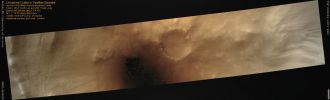
PSP_008181_2405_RED_abrowse.jpgUnnamed Crater in Vastitas Borealis (MULTISPECTRUM-2; credits: Lunexit)81 visitenessun commentoMareKromium
|
|
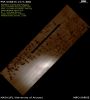
PSP_008839_2575_RED-00.jpgDunes and Polygons (ctx frame - natural colors; credits: Lunexit)81 visiteAt high Northern Latitudes, shallow troughs in the ice-rich ground form polygonal patterns. The polygons form over many years as the near-surface ice contracts and expands seasonally.
On top of this patterned ground in this image are dunes. Loose sand and dust are blown across the hard-cemented surface until collecting and forming a dune.
Streaks of dust are visible in the following edm-frame, coming from the horns of the dunes, while the higher portion of the dune blocks the dust from being blown across the surface.
Small ripples are also visible, and the small bright spots are the remnants of the seasonal Carbon Dioxide (CO2) Polar Cap that coats this area in the Winter.MareKromium
|
|
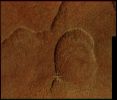
PSP_001331_2260andPSP_001872_2260-MidNorthernLatitudeScallopedTerrain.jpgScalloped Terrain (Hi-def-3D - possible True Colors; credits: Dr M. Faccin & Lunar Explorer Italia)81 visiteLatitude (centered): 45,6° North
Longitude (East): 93,7°
Range to target site: 298,4 Km (approx. 186,5 miles)
Original image scale range: 29,9 cm/pixel (with 1 x 1 binning) so objects ~90 cm across are resolved
Map projected scale: 25 cm/pixel and North is up
Map projection: EQUIRECTANGULAR
M.L.T.: 15:19 (early afternoon)
Emission angle: 0,4°
Phase angle: 49,4°
Solar Incidence Angle: 49°, with the Sun about 41 ° above the Local Horizon
Solar Longitude: 132,2° (Northern Summer)MareKromium
|
|
| 2237 immagini su 187 pagina(e) |
 |
|
|
|
|
80 | |
|
|
|
|





