| Piú viste - Mars Reconnaissance Orbiter (MRO) |
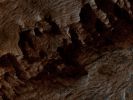
PSP_003830_1740_RED_abrowse-02.jpgLayered Bedrock in Candor Chasma (EDM n.2 - Absolute Natural Colors; credits for the additional process. and color.: Dr Paolo C. Fienga - Lunexit Team)84 visitenessun commentoMareKromium
|
|
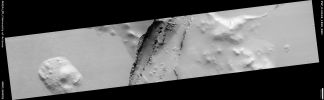
PSP_010638_1890_RED_abrowse-00.jpgAngular Unconformity in Cerberus Fossae (ctx RAW frame)83 visiteThis HiRISE image shows a part of the Cerberus Fossae, a long system of aligned fissures. The Cerberus Fossae were the source of the youngest major volcanic eruption on Mars that covered much of the surrounding area in lava. The region has also seen much other volcanic activity.
The walls of the fissures typically reveal lava layers. At this site, they have cut through an older hill that protrudes above the surrounding plains. The layers within the hill are tilted relative to the overlying rock, which appears to drape the region and runs continuously over the hill and plains.
This tilted contact is known as an Angular Unconformity. It is most likely that this formed when horizontal layers were tilted by faults before the most recent volcanic eruptions, forming the irregular hills.
The hills represent relatively old rock, while the smooth plains and the thin draping cover were formed more recently.MareKromium
|
|
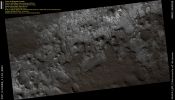
PSP_010888_1510_RED_abrowse.jpgClays and other "Hydrated Materials" in Sirenum Fossae Region (Natural Colors; credits: Lunar Explorer Italia)83 visitenessun commentoMareKromium
|
|

ESP_012588_1855_RED_abrowse-00.jpgFresh Impact (Natural Colors; credits: Lunexit)83 visiteIl "Dark Splat" che vedete in questa splendida immagine MRO costituisce l'evidenza oggettiva, a nostro parere, di un recentissimo impatto. Ma...che genere di impatto?
Come potrete meglio ammirare nei dettagli magnificati che seguono (tutti in formato JP-2000 ed ottenuti dal nostro eccezionale Marco Faccin), in corrispondenza del punto di (presumibile) impatto, NON C'E' CRATERE, ma solo evidenze di bruciature.
Questa circostanza la possiamo spiegare facendo 2 ipotesi:
1) il bolide si è disintegrato/è esploso quando era ormai vicinissimo al suolo (la Superficie di Marte è stata quindi "macchiata" dall'esplosione, senza restarne intaccata - se non in misura assolutamente marginale e visivamente non risolvibile - neppure dalle ottiche MRO!);
2) il bolide (una piccola cometa, riteniamo) ha EFFETTIVAMENTE impattato Marte, ma la sua massa e composizione erano talmente inconsistenti da risultare inidonee a scavare un cratere (ancorchè piccolo e poco profondo) sulla dura e rocciosa Superficie del Pianeta Rosso.
In pratica, quindi, l'evento che potrebbe essersi verificato si risolverebbe nell'impatto di una cometina (una "palla di neve sporca", come dicono alla NASA) con una superficie piatta ed oltremodo resistente. Risultato: il suolo viene appena "macchiato", ma NON intaccato!
Se avete altre ipotesi, scrivete!MareKromium
|
|
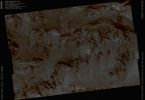
PSP_001415_1875_RED_abrowse.jpgAlluvial Fans in Mojave Crater (Natural Colors; credits: Lunexit)83 visiteAptly-named Mojave Crater in the Xanthe Terra Region has Alluvial Fans that look remarkably similar to landforms in the Mojave Desert of South-Eastern California and portions of Nevada and Arizona.
Alluvial Fans are "fan-shaped deposits of water-transported material" (---> Lat.: alluvium). They typically form at the base of hills or mountains where there is a marked break, or flattening of slope.
They typically deposit big rocks near their Mouths (close to the mountains) and smaller rocks at greater distances. Alluvial Fans form as a result of heavy desert Downpours, typically "Thundershowers" (Nota Lunexit: piogge torrenziali che occorrono durante violenti temporali, per lo più di tipo tropicale).
Because deserts are poorly vegetated, heavy and short-lived Downpours create a great deal of erosion and nearby deposition.
There are Fans inside and around the outsides of Mojave Crater on Mars that perfectly match the morphology of Alluvial Fans on Earth, with the exception of a few small impact craters dotting this Martian Landscape.
Channels begin at the apex of topographic Ridges, consistent with precipitation as the source of water, rather than groundwater. This remarkable landscape was first discovered from Mars Orbital Camera images. Mars researchers have suggested that impact-induced Atmospheric Precipitation may have created these unique landscapes.
This HiRISE image at up to 29 cm/pixel scale supports the Alluvial Fan interpretation, in particular by showing that the sizes of the largest rocks decrease away from the Mouths of the Fans.MareKromium
|
|
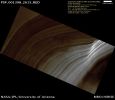
PSP_001398_2615_RED_abrowse.jpgExposure of NPLD with "Unconformities" (Natural - but enhanced - Colors; credits: Dr Paolo C. Fienga - Lunexit Team)83 visiteThis image shows a portion of the North Polar Layered Deposits (NPLD). The NPLD are layers that have been deposited over an extensive area at both Poles, possibly throughout Martian History. They likely contain ice-rich and dust-rich layers, with the darker layers being probably more dust-rich than the bright layers.
The NPLD holds clues to past climate regimes similar to ice cores on Earth. Several of the layers occur in fairly regular sequences, as seen in this image, suggesting that Mars underwent cyclic climate changes in the past.
Towards the top left side of the image, there is a series of layers that appears truncated at an angle, forming what geologists call "Angular Uncomformity". They typically form by first laying down a series of continuous beds. Then erosion cuts through the beds at an angle. Aferwards, a new set of beds are laid over this partially eroded sequence. A similar Unconformity exists at the bottom right of the image.MareKromium
|
|

ESP_018722_1860-PCF-LXTT3.jpgSouthern Elysium Planitia (Absolute Natural Colors; credits for the additional process. and color.: Dr Paolo C. Fienga - Lunexit Team)83 visitenessun commentoMareKromium
|
|
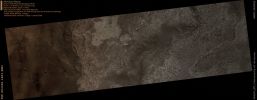
PSP_003392_1825_RED_abrowse.jpgMeridiani Planum (Natural Colors; credits for the additonal process. and color.: Dr Paolo C. Fienga - Lunexit Team)83 visitenessun commentoMareKromium
|
|
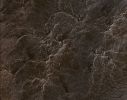
PSP_003734_0950_RED_abrowse-01.jpgSouthern Spring's Features (EDM - Absolute Natural Colors; credits for the additional process. and color.: Dr Paolo C. Fienga - Lunexit Team)83 visitenessun commentoMareKromium
|
|
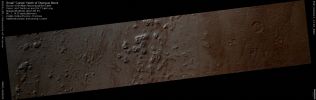
PSP_006667_2150_RED_abrowse-00-PCF-LXTT.jpgSmall "Cones", North of Olympus Mons (Absolute Natural Colors; credits for the additional process. and color.: Dr Paolo C. Fienga - Lunexit) 83 visiteOlympus Mons is the largest Volcano in the Solar System and is thought to have been active in the relatively recent past (which on Mars means many millions of years ago). While this towering giant gets a lot of the attention, it is surrounded by a vast field of other Volcanic Features. This HiRISE image takes a close look at one set of intriguing landforms: small Cones.
Cones similar to these are found atop the freshest Lava Flows on Mars in Athabasca Valles. In that location, HiRISE found proof that they formed by steam exploding through the Lava Flow. The steam was produced by boiling water (or ice) in the ground underneath the Lava Flow. Could the same thing have happened here?
Unfortunately, HiRISE finds that this area north of Olympus Mons is covered in a thick layer of Dust. While the wonderful resolution of HiRISE reveals details of the Ripples in the Dust, it cannot show us what is underneath the Dust. Therefore we cannot prove that these Cones formed the same was as the Athabasca Valles ones.
They could be small Volcanic Vents, but it is unlikely that so many small eruptions would have taken place so close together.
However, since we cannot show that the ground under the Dust is actually Lava, we cannot rule out non-volcanic processes. Still, the similarity in the shapes and sizes of these Cones to the ones in Athabasca Valles leaves open the possibility that Water and Lava interacted explosively here.MareKromium
|
|

ESP_020058_1300_RED_abrowse-01-PCF-LXTT.jpgDune-Gullies in Matara Crater (EDM - Absolute Natural Colors; credits for the additional process. and color.: Dr Paolo C. Fienga - Lunexit Team)83 visiteCaption NASA:"This image shows changing Dunes and incised Gullies (so-called "Dune-Gullies") in the Southern Matara Crater.
Repeat imaging of the Dunes in this Crater shows that material towards the top of the Gullies has moved downslope and the Channel Beds may have widened over time.
Since this activity occurs during Martian Southern Hemisphere Winter, it is believed to be related to Carbon Dioxide (CO2) Frost that forms as the area grows colder. Scientists continue to monitor this specific Region for changes in the Gullies and the Dunes themselves. This frame is approx. 1 (one) Km (0,6 miles) across".MareKromium
|
|
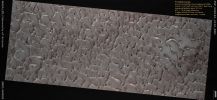
PSP_008185_2610_RED_abrowse.jpgFrosted Dunes (MULTISPECTRUM; credits: Lunexit)82 visitenessun commentoMareKromium
|
|
| 2237 immagini su 187 pagina(e) |
 |
|
|
|
|
79 | |
|
|
|
|





