| Piú viste - Mars Reconnaissance Orbiter (MRO) |

Deuteronilus_Mensae-PIA12996.jpgDeuteronilus Mensae (Natural Colors; credits for the add. process, and color.: Dr Paolo C. Fienga - Lunexit Team)85 visiteThe Terrain in this image lies in the Deuteronilus Mensae Region, along the highland-lowland Dichotomy Boundary in the Northern Hemisphere of Mars.
The High Resolution Imaging Science Experiment (HiRISE) camera on NASA's Mars Reconnaissance Orbiter recorded this image on March 9, 2010.
The target for this HiRISE observation was a suggestion submitted through the camera team's HiWish public-suggestion program. For more information about how to submit target suggestions, see http://uahirise.org/hiwish/.
This Region contains many Mesas surrounded by Lobate Debris Aprons that are thought to be ice-rich. These Aprons have been interpreted as a variety of possible features including rock glaciers, ice-rich mass movements, or debris-covered glacial flows. Recent radar data from the Shallow Radar instrument on the Mars Reconnaissance Orbiter has shown them to be composed of nearly pure ice. This image shows an area at the edge of one of these Mesas with a Lobate Debris Apron extending from its base.
Both the Mesa top and the Surface of the Debris Apron appear covered with ice-rich mantling materials characteristic of the Martian Mid-Latitudes and thought to have been deposited around 10 million years ago during a period of high obliquity.
This image covers a swath of ground about 1 Km (about two-thirds of a mile) wide. It is a portion of HiRISE observation ESP_016959_2240, which is centered at 43,62° North Latitude and 28,62° East Longitude. The season on Mars is Northern-Hemisphere Spring. MareKromium
|
|
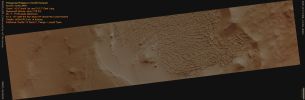
ESP_017348_1910_RED_abrowse-00.jpgPolygonal Ridges in Gordii Dorsum (CTX Frame - Natural Colors; credits for the additional process. and color.: Dr Paolo C. Fienga - Lunexit Team)85 visiteThis image from the Gordii Dorsum Region of Mars shows a large area covered with Polygonal Ridges in an almost geometric pattern.
The Ridges may have originally been Dunes which hardened (indurated) through the action of an unknown process.
Groundwater might have been involved.MareKromium
|
|
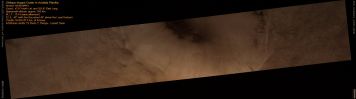
ESP_018425_2285_RED_abrowse.jpgOblique Impact Crater in Acidalia Planitia (Natural Colors; credits for the additional process. and color.: Dr Paolo C. Fienga - Lunexit Team)85 visitenessun commentoMareKromium
|
|
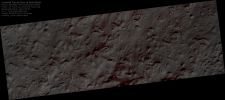
PSP_004056_1735_RED_browse.jpgJumbled Terrain (Natural Colors; credits for the additional process. and color.: Dr Paolo C. Fienga - Lunexit Team)85 visitenessun commentoMareKromium
|
|

ESP_019197_2290_RED_abrowse-03.jpgExtremely unusually-looking Unnamed Northern Crater (EDM n.2 - Absolute Natural Colors; credits for the additional process. and color.: Drr Gianluigi Barca and Paolo C. Fienga - Lunexit Team)85 visitenessun commentoMareKromium
|
|

ESP_019560_1650_RED_abrowse-PCF-LXTT.jpgDunes of Coprates Chasma (Absolute Natural Colors; credits for the additional process. and color.: Dr Paolo C. Fienga - Lunexit Team)85 visitenessun commentoMareKromium
|
|

PSP_002884_1395_RED_abrowse-01.jpgUnnamed Southern Crater with deep Gullies (EDM - Absolute Natural Colors; credits for the additional process. and color.: Dr Paolo C. Fienga - Lunexit Team)85 visitenessun commentoMareKromium
|
|

Dunes_and_DD_Tracks-PIA13538-EB-LXTT-001.jpgSouthern Dunes and DD Tracks (Possible True Colors; credits for the additional process. and color.: Elisabetta Bonora - Lunexit Team)85 visitenessun commentoMareKromium
|
|

PSP_004988_1085_RED_abrowse-01.jpgSouth Presso-Polar Pit Gullies (EDM - Absolute Natural Colors; credits for the additional process. and color.: Dr Paolo C. Fienga - Lunexit Team)85 visiteWhat is particularly interesting about these Gullies is that some might be forming (see this EDM, approx. 800 meters across, of the South-facing Gullies in the bottom Pit). The Gullies on this Wall have incised Alcoves, but only a few have well-developed Channels.
This could be a Region of current Gully formation. Aiding this hypothesis is the fact that there are a couple of depressions between the visible Gullies, suggestive of a developing Gully where water and/or material removed from under the Surface caused the overlying ground to collapse. It is also possible that water originating on the Surface is carving out these depressions, although it is difficult to melt water ice at the temperatures found in this particular location.MareKromium
|
|
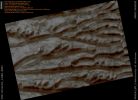
PSP_004230_1080_RED_abrowse.jpgDefrosting Dunefield inside Richardson Crater (Absolute Natural Colors; credits for the additional process. and color.: Dr Paolo C. Fienga - Lunexit Team)85 visiteCovered by Seasonal CO2 Frost, the Dunefield here in Richardson Crater has only partially defrosted, although the image was acquired late in Mars' Southern Spring.
Large patches of Carbon Dioxide Frost can be observed, linked in some places by Channels possibly carved into the ground by the erosion of CO2 gas, as blocks dry ice slide down slope and sublimate.
Numerous Dust Devil Tracks (or DDT for short) have left their mark.
MareKromium
|
|
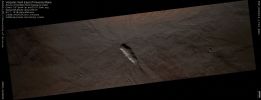
PSP_006653_1795_RED_abrowse-PCF-LXTT.jpgVolcanic Vent, East of Pavonis Mons (Absolute Natural Colors; credits for the additional process. and color.: Dr Paolo C. Fienga - Lunexit) 85 visiteThis image shows an Equatorial Volcanic Vent. A Volcanic Vent is an opening in the Crust of a Planet that emits Lava (such as "molten rock") and Volcanic Gases. The rough texture of the Plains surrounding the Vent is indicative of Lava.
There is a large number of snake-like features emanating from the Vent. The parallel lines that outline the features are "Levees", which mark the edges of Channels that carried molten Lava. As Lava flows, it moves slowest at its edges and bottom because the Lava sticks to the non-flowing rocks; as a consequence of this event, the lava slows down, cools off and, in the end, it hardens.
Levees, on their side, form when the sides of the Lava Flow harden but the center of it keeps moving. As the eruption episode ends, and the Lava drains, the center is left lower than the sides producing these high-standing structures.MareKromium
|
|

Collapse_features-Pits-East_Tharsis-PCF-LXTT.jpgCollapse Pits, East of Tharsis Region (Absolute Natural Colors; additional process.: Dr Paolo C. Fienga - Lunexit Team)85 visitenessun commentoMareKromium
|
|
| 2237 immagini su 187 pagina(e) |
 |
|
|
|
|
77 | |
|
|
|
|





