| |

| Piú viste - Mars Reconnaissance Orbiter (MRO) |

PSP_001552_1410_RED_abrowse-02.jpgFrost Covered Gullies in Terra Sirenum (CTX Frame + EDM - Absolute Natural Colors; credits: Dr Paolo C. Fienga - Lunexit Team) 87 visitePSP_001552_1410 shows Gullies in a Unnamed Crater located in Terra Sirenum (Southern Hemisphere of Mars).
This image was acquired during the Winter, which explains the abundant frost (the bright material) seen throughout the image. The frost is likely water frost, as opposed to CO2, because temperatures at this latitude probably do not get cold enough for Carbon Dioxide to condense.
The formation mechanism of Gullies is much debated. Several theories support erosion by liquid water, while others favor dry debris flows or Carbon Dioxide. A major unknown is, if the Gullies are formed by liquid water, does the water originate from the Surface or Subsurface?
Also interesting about this scene is the fact that the Gullies occur at multiple elevations along the same Crater Wall. This is uncommon on Mars. Gullies, whether or not they are found in conjunction with an obvious horizontal layer, usually form at the same elevation on a given slope. It is unknown what caused these Gullies to form at multiple elevations. Their locations are suggestive of a distributed water source, which also favors a Surface, rather than a confined Subsurface origin of water, such as an Aquifer.
Acquisition Date: November, 25th, 2006
Mars Local Time (M.L.T.): 15:40 (Middle Afternoon)
Latitude (centered): 38,9° South
Longitude (East): 195,9 °
Range to Target Site (or Spacecraft Altitude as to the pictured area): 250,5 Km (such as approx. 156,6 miles)
Original Image Scale Range: 50,1 cm/pixel (with 2 x 2 binning) so objects ~150 cm across are resolved
Map Projected Scale: 50 cm/pixel and North is up
Map projection: EQUIRECTANGULAR
Emission Angle: 2,4°
Phase Angle: 76,9°
Solar Incidence Angle: 75° (with the Sun about 15° above the Local Horizon)
Solar Longitude: 140,6° (Northern Summer)MareKromium
|
|
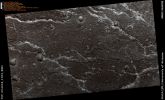
PSP_004018_1505_RED_abrowse.jpgLayers in Columbus Crater (Natural Colors; credits for the additional process. and color.: Dr Paolo C. Fienga - Lunexit Team)87 visiteThis HiRISE image shows bright Layers on the Floor of Columbus Crater, a large Impact Basin in the Southern Highlands of Mars.
The Crater is very old and has gone through much modification. Its Rim is relatively low and the Floor is flat, and it is likely that material has been eroded from the Rim and deposited on the Crater Floor.
The bright stripes that appear in this image at low resolution are likely Sedimentary Deposits. This bright material also includes dark patches which may be embedded within it, or the dark material could be covering the light one. The small-scale topography is rugged, likely an erosional characteristic of the dark material which covers much of the Surface.
Bright materials like those visible here are found in many places on Mars. In this case, it is likely that they are part of the Sediments that have filled the Basin, but it is not certain how they were deposited.
In many places, bright Sediments exhibit fine horizontal banding, suggesting that they were once part of more extensive, flat-lying Layers of rock. In the bright materials here, Layering is rare and the original geometry somewhat more obscure. Impact Craters in the scene have excavated the Dark Surface, but in several cases this has neither exposed layering nor bright material.MareKromium
|
|

Craters-Rabe_Crater-PIA13728-PCF-LXTT-3.jpgInside Rabe Crater - Wintertime (Absolute Natural Colors; credits for the additional process. and color.: Dr Paolo C. Fienga - Lunexit Team)87 visitenessun commentoMareKromium
|
|

Meridiani_Planum-ESP_032098_1785-PCF-LXTT-IPF.jpgFeatures of Meridiani Planum (Absolute Natural Colors; credits for the additional process. and color.: Dr Paolo C. Fienga/Lunar Explorer Italia/Italian Planetary Foundation)87 visiteIn this frame, taken by the NASA - Mars Reconnaissance Orbiter on the date of June, 1st, 2013, we can see a few interesting (although very common) Surface Features which characterize the Meridiani Planum Region of Mars. In particular, we can see an old and (still) Unnamed Impact Crater - with the "usual" Dunefield on its Floor - that is located on the very upper portion of the frame and just below a (relatively) Sand-free section of Surface known as "Martian Paving". Afterwards, moving down towards the South (such as towards the lower portion of the frame), we can find an area where there are many Sand Ripples and a few small Impact Craters. Finally, on the very lowest portion of the picture, we can also see more Sand Ripples, a number of Sand Dunes, several very small Impact Craters and quite a few Rocky Outcrops.
However, the Martian Surface pictured here, in our opinion (as IPF), and contrary to the common idea of how the Meridiani Planum Region of Mars is - generally - characterized and known (such as an almost totally plain and reliefs-free Region), is really far from being flat at all: as a matter of fact, if you observe the picture carefully, you will be able to notice that the whole area which has been photographed by the NASA - Mars Reconnaissance Orbiter (and, particularly, the area visible in the central and lower portion of the frame - meaning the one located to the South of the main visible Feature, such as the Unnamed Impact Crater) appears to show several points of Subsidence, a few Ridges and some (most likely very short and small) Hillocks.
Mars Local Time: 14:09 (Early Afternoon)
Coord. (centered): 1,584° South Lat. and 3,132° East Long.
Spacecraft altitude: 268,9 Km (such as about 166,986 miles)
Original image scale range: 26,9 cm/pixel (with 1 x 1 binning) so objects ~ 81 cm across are resolved
Map projected scale: 25 cm/pixel
Map projection: EQUIRECTANGULAR
Emission Angle: 0,0°
Phase Angle: 34,0°
Solar Incidence Angle: 34° (meaning that the Sun was about 56° above the Local Horizon at the time the picture was taken)
Solar Longitude: 328,5° (Northern Winter - Southern Summer)
Credits: NASA/JPL/University of Arizona
Additional process. and coloring: Lunar Explorer Italia
This picturee (which is a NASA - Original Mars Reconnaissance Orbiter NON-Map Projected b/w frame identified by the serial n. ESP_032098_1785) has been additionally processed and then colorized in Absolute Natural Colors (such as the colors that a human eye would actually perceive if someone were onboard the NASA - Mars Reconnaissance Orbiter and then looked down, towards the Surface of Mars), by using an original technique created - and, in time, dramatically improved - by the Lunar Explorer Italia Team.MareKromium
|
|
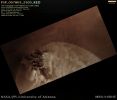
PSP_007805_2505_RED_abrowse-00.jpgThe "Frozen Lake" of Vastitas Borealis, alias Louth Crater (context frame - MULTISPECTRUM; credits: Lunexit)86 visiteThis image shows the changing seasonal frost patterns on Louth Crater, located at latitude 70° North. This crater contains a mound covered by water frost that persists throughout the year, which is unusual for this latitude.
The seasonal Carbon Dioxide frost deposited during Northern Winter can also reach this Latitude. At the time this image was acquired in Northern Spring, the CO2 frost is in the process of sublimating back into the atmosphere.
There are sand dunes near the edge of the mound, which become clear of frost in the Summer.
Per avere qualche Informazione in più...
Geophysical Research Abstracts,
Vol. 10, EGU2008-A-10434, 2008
SRef-ID: 1607-7962/gra/EGU2008-A-10434
EGU General Assembly 2008
© Author(s) 2008
Louth crater: Water vapour distribution as seen by CRISM/MRO
R. Melchiorri (1); T.L. Roush (1); R.M. Haberle (1); A. J. Brown (2) ; T. Encrenaz
(3); CRISM team
1) NASA AMES Research Center, Moffet Field, CA, 94035, USA
2) SETI Institute, 515N. Whisman Rd, Mountain View, CA 94043, USA
3) LESIA Observatoire de Meudon 5, place Jules Janssen, 92195 Meudon, France
“Louth” crater (70.5°N, 103.2°E, name submitted to IAU for consideration) has been identified to have a greater resemblance to the polar cap than previously expected [1 and 2]. This crater is a conveniently small and contains a central water ice deposit that is suitable for testing models of volatile stability in the Martian north polar region. A sensitive detector for water stability is the study of water vapour distribution, which could reveal the presence of interactions between the surface and atmosphere by identifying possible sources and sinks. By adapting the water vapour analysis already developed and tested for the
OMEGA/Mars Express data [3 and 4] we have been able to retrieve the total amount of water vapour from the CRISM/MRO data. This retrieval was performed on two independent high spectral-spatial resolution observations of Louth crater.
For the first time a water vapour distribution at the 1/1000 of a degree scale is presented. Opening the possibility of studying atmospheric water dynamics at very high spatial resolution, like on the boundary of the ice mound, and thus providing hints
regarding the presence and extent of the ice under the close dusty regions.
We present the method and some preliminary results of the analysis, showing in detail the distribution of water vapour on and near the ice mound and near the northern crater rim.
References:
[1] A.J. Brown et al; ICARUS (in press) 2008
[2] A.J. Brown et al; LPCI 2008
[3] R. Melchiorri et al ; Plan and Space Sci. 55 (2007) 333–342
[4] T. Encrenaz et al A&A 441, L9–L12 (2005)MareKromium
|
|
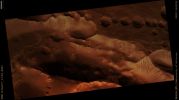
PSP_010477_1720_RED_abrowse.jpgPit Chain and other Collapse Features in Arsia Chasma (Natural Colors; credits: Lunar Explorer Italia)86 visiteMars Local Time: 15:41 (middle afternoon)
Coord. (centered): 7,8° South Lat. and 240,7° East Long.
Spacecraft altitude: 256,1 Km (such as about 153,8 miles)
Original image scale range: 49,2 cm/pixel (with 1 x 1 binning) so objects ~ 1,48 mt across are resolved
Map projected scale: 50 cm/pixel
Map projection: EQUIRECTANGULAR
Emission Angle: 0,1°
Phase Angle: 59,2°
Solar Incidence Angle: 59° (meaning that the Sun is about 31° above the Local Horizon)
Solar Longitude: 144,9° (Northern Summer)
Credits: NASA/JPL/University of Arizona
Additional process. and coloring: Lunar Explorer ItaliaMareKromium
|
|
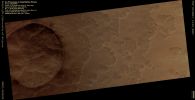
PSP_004867_1220_RED_abrowse-00.jpgIce Processes in Amphitrites Patera (CTX Frame - Natural Colors; elab. Lunexit)86 visiteThis image captures an impact crater on the surface of Amphitrites Patera, an ancient volcano on the southern margin of the giant Hellas Basin. The Hellas Basin was formed by a very large impact into the Southern Highlands early in the geologic history of Mars. The basin has a number of volcanoes along its margin, perhaps because magma could take advantage of the deep cracks in the crust that resulted from the impact.
Amphitrites Patera is far enough South to approach the Martian Antarctic and there is evidence for large amounts of ice in the ground. As in the Polar Regions of Earth, the icy ground (permafrost) is able to move and be modified by a variety of processes. In this case, the rim of the small impact crater is filled with a honeycomb of cracks. These are likely to have formed where dust- and soil-covered ice or ice cemented soil was cracked by thermal contraction in the winter. Subsequently, the underlying ice was able to escape into the atmosphere (sublimate) allowing the ground along the cracks to collapse. The only place where large boulders are visible is along the rim of the crater; this is probably where the boulders were not so deeply buried by the icy layer. MareKromium
|
|
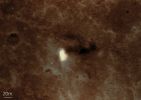
ESP_013499_1650-2.jpgDust Devil inside Gusev Crater (edm n.2 - Natural - but enhanced - Colors; credits: Lunexit)86 visiteQuesto EDM - che ci mostra un Dust Devil durante la sua corsa sulla Pianura di Gusev Crater - è stato realizzato dalla NASA.
L'importanza del frame, come ormai sapete, deriva dal fatto che il DD è stato ripreso in contemporanea da due punti di osservazione privilegiati: dall'orbita, grazie alla Sonda MRO, e dalla Superficie, grazie al MER Spirit.
Tutto fantastico, sicuramente.
Ci preme però sottolineare come il "taglio" della subimage in questione sia stato fatto in maniera tale da "eliminare" la visione della possibile Silver Sphere, presente a poco più di un centinaio di metri dal DD (Silver Sphere che è stata invece localizzata dal nostro Dr Faccin, tramite l'analisi del frame originale, nella sua versione in JP2).
Meditateci sopra...MareKromium
|
|

PSP_007494_2580_RED_abrowse.jpgNorth Polar "Erg" (Natural Colors; credits for the additional process. and color.: Dr Paolo C. Fienga - Lunexit Team)86 visitenessun commentoMareKromium
|
|
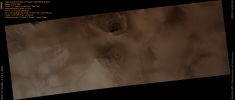
ESP_018480_1725_RED_abrowse.jpgLight-toned Outcrops in Noctis Labyrinthus (Natural Colors; credits for the additional process. and color.: Dr Paolo C. Fienga - Lunexit Team)86 visitenessun commentoMareKromium
|
|
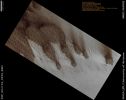
PSP_003734_0950_RED_abrowse-00.jpgSouthern Spring's Features (CTX Frame - Absolute Natural Colors; credits for the additional process. and color.: Dr Paolo C. Fienga - Lunexit Team)86 visitenessun commentoMareKromium
|
|

ESP_019360_1780_RED_abrowse-02.jpgFeatures of Meridiani Planum (EDM n.2 - Natural Colors; credits for the additional process. and color.: Dr Paolo C. Fienga - Lunexit Team)86 visitenessun commentoMareKromium
|
|
| 2237 immagini su 187 pagina(e) |
|
|
|
|
|
75 | |
|
|
|
|
|
|





