| Piú viste - Mars Reconnaissance Orbiter (MRO) |
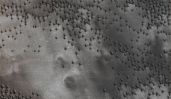
ESP_027378_2540-PCF-LXTT-IPF-1A.jpgNorthern Dunes (CTX Frame "A" - Absolute Natural Colors; credits for the additional process. and color.: Dr Paolo C. Fienga/Lunexit Team)88 visiteThis Field of crescent-shaped Dunes (located at Lat. 73,62° North and 328,215° East Long.) is located just South of the North Polar Layered Terrain. These Dunes, known as "Barchan Dunes", usually form where there is a moderate supply of Sand and a Prevailing Wind Direction (meaning that they form in Regions where there are Dominant Winds). The "Arms" (or "Horns") of the Barchan Dunes point in the downwind direction and in this case this circumstance indicates that the Dominant Winds blow towards the North/West.
Mars Local Time: 14:42 (Early Afternoon)
Coord. (centered): 73,622° North Lat. and 328,215° East Long.
Spacecraft altitude: 316,7 Km (such as about 198,0 miles)
Original image scale range: 63,4 cm/pixel (with 2 x 2 binning) so objects ~ 1 mt and 90 cm across are resolved
Map projected scale: 50 cm/pixel
Map projection: POLAR STEREOGRAPHIC
Emission Angle: 1,9°
Sun - Mars - MRO (or "Phase") Angle: 57,6°
Solar Incidence Angle: 56° (meaning that the Sun is about 34° above the Local Horizon)
Solar Longitude: 117,4° (Northern Summer - Southern Winter)
Credits: NASA/JPL/University of Arizona
Additional process. and coloring: Lunar Explorer ItaliaMareKromium
|
|
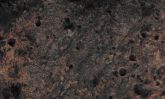
ESP_028367_2085-PCF-LXTT-IPF.jpgClay-rich Bedrock (Absolute Natural Colors; credits for the additional process. and color.: Dr Paolo C. Fienga/Lunar Explorer Italia/Italian Planetary Foundation)88 visiteThis image covers an exposure of Clay-rich Bedrock on the "shore" of the Northern Plains, North of Mawrth Vallis. The relatively bright areas reveal a Complex Terrain with a wide range of textures and colors.MareKromium
|
|

PSP_008060_1770_RED_abrowse.jpgLayers and Phyllosilicates in Miyamoto Crater (MULTISPECTRUM; credits: Lunexit)87 visiteThis observation was taken in Miyamoto Crater in South-West Meridiani, an area near the Equator of Mars. This image is located to the East of one of the potential Mars Science Laboratory Landing Sites and is near the contact between the Hematite-bearing plains unit to the North-East (where the MER Opportunity is exploring) and the phyllosilicate-bearing unit to the South-West.
Aeolian (meaning "wind deposited") processes are active here, which are visible in dunes and ripples, most likely made of basaltic sand. The bedrock contains Phyllosilicates (such as Clay Minerals), which form in the presence of water. Phyllosilicates have been detected in higher concentrations in other areas of Mars such as Mawrth Vallis and Nili Fossae, but detections of lesser abundance have been noticed in Meridiani as well.MareKromium
|
|
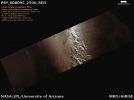
PSP_008095_2500_RED_abrowse.jpgLouth Crater, Southern Rim (MULTISPECTRUM; credits: Lunexit)87 visitenessun commentoMareKromium
|
|

Psp_009820_1510_red.jpgOutcrops in Eridania Basin (possible True Colors; credits: Lunar Explorer Italia)87 visiteMars Local Time: 15:37 (middle afternoon)
Coord. (centered): 28,7° South Lat. and 180,0° East Long.
Spacecraft altitude: 254,2 Km (such as about 158,9 miles)
Original image scale range: 50,9 cm/pixel (with 1 x 1 binning) so objects ~1,53 mt across are resolved
Map projected scale: 50 cm/pixel
Map projection: EQUIRECTANGULAR
Emission Angle: 0,3°
Phase Angle: 72,7°
Solar Incidence Angle: 73° (meaning that the Sun is about 17° above the Local Horizon)
Solar Longitude: 120,1° (Northern Summer)
Credits: NASA/JPL/University of Arizona
Additional process. and coloring: Lunar Explorer ItaliaMareKromium
|
|
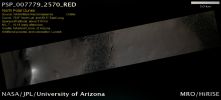
PSP_007779_2570_RED_abrowse~0.jpgDunes of the High Northern Latitudes (MULTISPECTRUM; credits: Lunexit)87 visiteIn this image, we can see that the North Pole is surrounded by a vast “sea” of Basaltic Sand Dunes. In Northern Winter a Seasonal Polar Cap composed of CO2 ice (dry ice) forms and the surrounding dunes become covered with frost. In the Spring, the ice sublimates (evaporates directly from ice to gas) loosening and moving tiny dust particles.
The bright portions of the dunes in this image are areas still covered with seasonal frost while dark spots are areas where the frost is gone or dark dust has cascaded down the sides of the dune.
The dunes imaged here are similar to Barchan dunes that are commonly found in desert regions on Earth. Barchan dunes are generally crescent-shaped with a steep slip face bordered by horns oriented in the downwind direction. Barchan dunes form by winds blowing mainly in one direction and thus are good indicators of the dominant wind direction when the dunes formed.
MareKromium
|
|
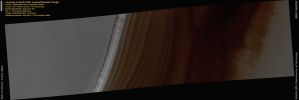
PSP_010525_2595_RED_abrowse.jpgLayering in North Polar Layered Deposit Trough (Natural Colors; credits: Lunar Explorer Italia)87 visitenessun commentoMareKromium
|
|
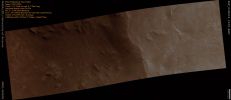
ESP_018474_1970_RED_abrowse.jpgFloor Deposits in Toro Crater (Natural Colors; credits for the additional process. and color.: Dr Paolo C. Fienga - Lunexit Team)87 visitenessun commentoMareKromium
|
|
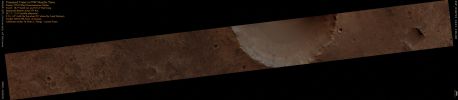
ESP_018795_1615-PCF-LXTT2.jpgUnnamed Crater in N/W Noachis Terra (Absolute Natural Colors; credits for the additional process. and color.: Dr Paolo C. Fienga - Lunexit Team)87 visitenessun commentoMareKromium
|
|
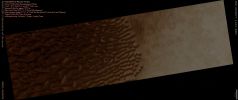
PSP_004077_1325_RED_abrowse-PCF-LXTT.jpgLarge Dunefield inside Proctor Crater (Absolute Natural Colors; credits for the additional process. and color.: Dr Paolo C. Fienga - Lunexit Team)87 visiteImage PSP_004077_1325 shows the edge of a Dark Dunefield on the Floor of Proctor Crater, an about 150 Km diameter Crater located in the Southern Highlands of Mars.
The Dark Dunes are composed of Basaltic Sand that has collected on the bottom of the Crater. Dark Dune "Slip Faces" - such as the steeper (---> più ripido) sides of the Dunes - are located on the Eastern side of the Dunes and are believed to have formed in response to Fall and Winter Westerly Winds caused by geostrophic forces (winds balanced by Coriolis and pressure gradient forces).
Superimposed on their Surface are smaller Secondary Dunes that are commonly seen on terrestrial Dunes of this size.
Many smaller and brighter bedforms, most likely small Dunes or granule Ripples, cover the substrate between the larger Dark Dunes as well as most of the Floor of Proctor Crater. The Dark Dunes overlie the small bright bedforms indicating that they formed more recently.
In several areas, however, the dark dunes appear to influence the orientation of the small bright Dunes, possibly by Wind flowing around the larger ones, suggesting that both dark and bright bedforms are coeval.
The Dunes in Proctor Crater may still be active today, moving in response to Martian Winds. MareKromium
|
|

PSP_002070_2250_RED_abrowse-00.jpgPolygons in Utopia Planitia (Absolute Natural Colors; credits for the additional process. and color.: Dr Paolo C. Fienga - Lunexit Team) 87 visiteThis observation, in the Utopia Planitia, is marked by Depressions in the Mantle, several of which have coalesced together and now possess Scalloped edges and Layers.
Scalloped pits, such as these, are typical features of the Mid-Latitude Mantle and are most commonly found at approx. 55° both North and South Latitude; in the Utopia Planitia, Scalloped Terrain is found between 45-50° North latitude where the Mantle is highly discontinuous. The presence of Scalloped Pits has led to hypotheses of the removal of Sub-Surface material, possibly interstitial ice, by Sublimation. Scalloped Depressions in the Utopia Planitia have also been interpreted to be "Thermokarst Lakes" created by melting of Permafrost (frozen ground) and collapse of the dry Surface Layer.
Scalloped Pits typically have a steep Pole-facing Scarp and a gentler Equator-facing Slope. This is most likely due to differences in solar heating.MareKromium
|
|

ESP_020077_1915_RED_abrowse-00.jpgRelatively fresh "Lunar-like" Unnamed Crater (Absolute Natural Colors; credits for the additional process. and color.: Dr Paolo C. Fienga - Lunexit Team)87 visitenessun commentoMareKromium
|
|
| 2237 immagini su 187 pagina(e) |
 |
|
|
|
|
74 | |
|
|
|
|





