| Piú viste - Mars Reconnaissance Orbiter (MRO) |
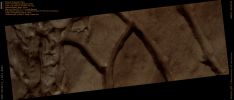
PSP_004071_1425_RED_abrowse.jpgMesas in Gorgonum Chaos (CTX Frame - Absolute Natural Colors; credits for the additional process. and color.: Dr Paolo C. Fienga - Lunexit Team) 89 visitePSP_004071_1425 shows Mesas that are part of Gorgonum Chaos, a Region of Chaotic Terrain, which is a jumble of Mounds and Mesas grouped together. Chaotic Terrain is most commonly found in Mars near the sources of the gigantic Outflow Channels. Gorgonum Chaos is one of the few exceptions.
Some of the Troughs between the Mesas appear to have V-shaped bottoms; there is no obvious flat floor in between. Others have Dunes running down their centers probably indicating flat floors.
It is possible that the Mesas were once connected and that something caused fractures in the original Mesa's Surface that were then preferentially eroded.MareKromium
|
|
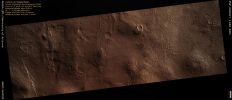
PSP_008427_1380_RED_abrowse-00.jpgAutumn in Hellas Basin (ctx frame - MULTISPECTRUM-2; credits: Lunexit)88 visiteIt is now fall in the Southern Hemisphere and in the giant impact crater known as Hellas Basin small boulders cast long shadows. The long shadows emphasize small scale topographic features and wind erosion is responsible for much of the morphology in this Region.
MareKromium
|
|
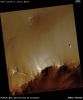
PSP_010437_1655_RED_abrowse.jpgSample of Southern Surface (Natural Colors; credits: Lunar Explorer Italia)88 visiteMars Local Time: 15:42 (middle afternoon)
Coord. (centered): 14,5° South Lat. and 253,6° East Long.
Spacecraft altitude: 251,9 Km (such as about 157,5 miles)
Original image scale range: 25,2 cm/pixel (with 1 x 1 binning) so objects ~ 76 cm across are resolved
Map projected scale: 25 cm/pixel
Map projection: EQUIRECTANGULAR
Emission Angle: 0,2°
Phase Angle: 62,3°
Solar Incidence Angle: 62° (meaning that the Sun is about 28° above the Local Horizon)
Solar Longitude: 143,3° (Northern Summer)
Credits: NASA/JPL/University of Arizona
Additional process. and coloring: Lunar Explorer ItaliaMareKromium
|
|
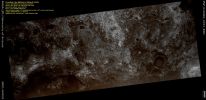
PSP_010460_2055_RED_abrowse.jpgEscarpment with Possible Clays in Mawrth Vallis (Natural Colors; credits: Lunar Explorer Italia)88 visitenessun commentoMareKromium
|
|
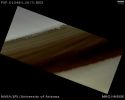
PSP_010483_2675_RED_abrowse.jpgHigh-Latitude Exposure of North Polar Layered Deposits (Natural Colors; credits: Lunar Explorer Italia)88 visiteMars Local Time: 14:44 (early afternoon)
Coord. (centered): 87,3° North Lat. and 55,2° East Long.
Spacecraft altitude: 340,6 Km (such as about 212,9 miles)
Original image scale range: 68,2 cm/pixel (with 1 x 1 binning) so objects ~2,04 mt across are resolved
Map projected scale: 50 cm/pixel
Map projection: EQUIRECTANGULAR
Emission Angle: 23,5°
Phase Angle: 55,2°
Solar Incidence Angle: 74° (meaning that the Sun is about 16° above the Local Horizon)
Solar Longitude: 145,1° (Northern Summer)
Credits: NASA/JPL/University of Arizona
Additional process. and coloring: Lunar Explorer ItaliaMareKromium
|
|

ESP_019533_2310_RED_abrowse.jpgNorhern Plains (Absolute Natural Colors; credits for the additional process. and color.: Dr Paolo C. Fienga - Lunexit Team:)88 visitenessun commentoMareKromium
|
|

PSP_004988_1085_RED_abrowse-00.jpgSouth Presso-Polar Pit Gullies (CTX Frame - Absolute Natural Colors; credits for the additional process. and color.: Dr Paolo C. Fienga - Lunexit Team)88 visiteThis observation shows partial views of two high latitude Pits. These Polar Pits contain Gullies, small-scale Slope Features that are proposed to require some amount of liquid water to form.
Several of the Gullies have multiple Channels and Debris-Aprons from numerous Flows that occurred throughout time. Many of the Gullies are seen to originate at a Boulder-Layer at the Pit Edges. This layer is deteriorating and releasing Boulders that can be seen rolling down the Pit Walls. The bright material near the Pit Edges is probably Seasonal Frost. MareKromium
|
|

ESP_020204_1835_RED_abrowse-00.jpgNorthern Meridiani Planum (CTX Frame - Absolute Natural Colors; credits for the additional process. and color.: Dr Paolo C. Fienga - Lunexit Team:)88 visitenessun commentoMareKromium
|
|
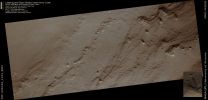
PSP_006569_1915_RED_abrowse-00-PCF-LXTT.jpgFeatures of Henry Crater (Absolute Natural Colors; credits for the additional process. and color.: Dr Paolo C. Fienga - Lunexit Team)88 visiteNamed after a 19th Century French Astronomer, Henry Crater is an about 165 Km (approx. 103 mile) diameter Impact Crater, located in Arabia Terra, on a portion of the Martian Highlands extending into the Northern Hemisphere. This observation shows multiple Layers on the Edge of a Mound on the Floor of the Crater, which is distinct from others in the immediate vicinity.
The Layers represent the eroded remains of Sedimentary Rocks that formed from Sediments deposited within the Crater sometime after its formation. The origin of the Sediments on the Crater Floor in not known but may be windblown Dust and Sand.
The Layers exhibit differences in degrees of hardness and resistance to erosion with resistant Layers forming Cliffs and more easily eroded Layers forming Ledges.
Inset: Several Dark Streaks are visible on the Slopes. Slope Streak formation is among the few known processes currently active on Mars. Streaks are believed to form by downslope movement of Dust in an almost fluid-like manner (analogous to a terrestrial Snow Avalanche) either exposing darker underlying material or creating a darker surface by increasing its roughness. MareKromium
|
|

Craters-Rabe_Crater-PIA13728-PCF-LXTT-2.jpgInside Rabe Crater - Springtime (Absolute Natural Colors; credits for the additional process. and color.: Dr Paolo C. Fienga - Lunexit Team)88 visitenessun commentoMareKromium
|
|
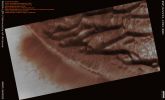
ESP_022255_1095_RED_abrowse-PCF-LXTT.jpgSouthern Dunefield (Enhanced Natural Colors; credits for the additional process. and color.: Dr Paolo C. Fienga - Lunexit Team)88 visitenessun commentoMareKromium
|
|
ESP_026061_1435-PCF-LXTT-000.jpgLong Shadows... (CTX Frame "A" - Absolute Natural Colors; credits for the additional process. and color.: Dr Paolo C. Fienga - Lunexit Team)88 visiteMars Local Time: 15:13 (early afternoon)
Coord. (centered): 36,4° South Lat. and 302,3° East Long.
Spacecraft altitude: 251,9 Km (such as about 157,4 miles)
Original image scale range: 50,4 cm/pixel (with 2 x 2 binning) so objects ~ 1 mt and 51 cm across are resolved (with 4 x 4 binning)
Map projected scale: 50 cm/pixel
Map projection: EQUIRECTANGULAR
Emission Angle: 1,2°
Sun - Mars - MRO (or "Phase") Angle: 75,0°
Solar Incidence Angle: 76° (meaning that the Sun is about 14° above the Local Horizon)
Solar Longitude: 71,6° (Northern Spring)
Credits: NASA/JPL/University of Arizona
Additional process. and coloring: Lunar Explorer ItaliaMareKromium
|
|
| 2237 immagini su 187 pagina(e) |
 |
|
|
|
|
73 | |
|
|
|
|





